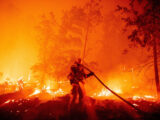
Under pressure from Washington to sell more timber, agency leaders overrode their own field staff at nearly every turn. –
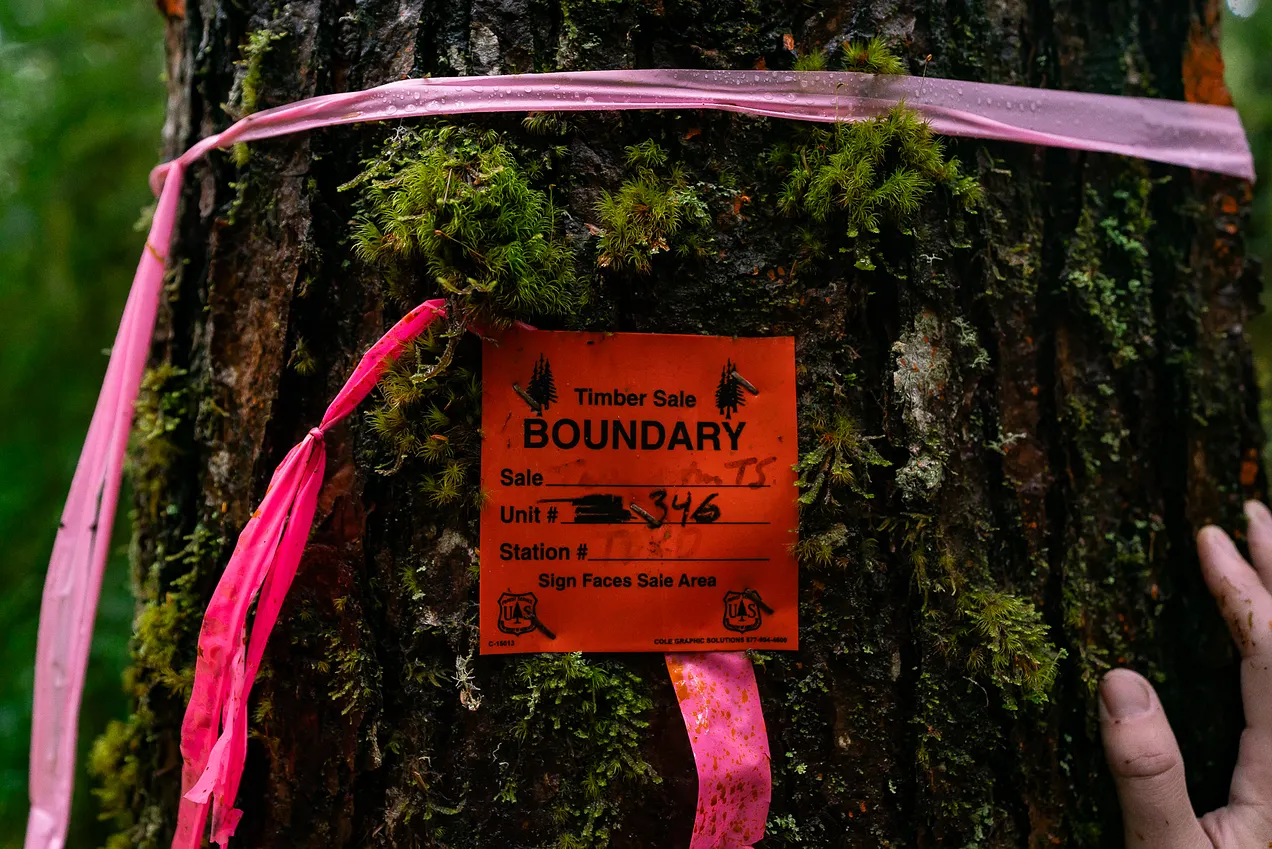
A timber sale marker in Alaska’s Tongass National Forest
By Will Pattiz, Jim Pattiz –
More Than Just Parks –
Washington wants more timber out of America’s national forests, and fast.
In Alaska’s Tongass National Forest, the Forest Service employees sent into the woods kept finding things that complicated those orders. Enormous ancient trees, bear dens, sensitive waterways, problems with logging roads and gaps in the scientific work meant to protect the forest.
Their superiors were under orders to move faster.
More Than Just Parks has obtained 1,707 internal Forest Service records, from emails between agency leaders to the field notes of the crews sent to survey the forest. Together they offer an unusually detailed view of how the Trump administration’s rush to log America’s national forests is being forced through on the ground, with forest leaders overriding their own scientists and field crews again and again to keep the timber on schedule.
A Forest Service hydrologist warned that an emerging “urgency” culture was masking poor planning and threatening the quality of the agency’s work. Wildlife crews found bear dens inside proposed clearcuts, and leadership rejected a biologist’s call for stronger protections and ordered the dens left out of the individual logging plans. A tribal Cultural Tree Plan was set aside because working it in would interfere with a self-imposed publication deadline.
The pressure came from Washington. Agency leaders there directed the Tongass to speed the project up, and internal emails show officials weighing how much time could be cut from the environmental review and whether a public comment period could be avoided altogether.
The courts had already stopped this sale once. In 2020, a federal judge threw out the logging plan behind it because the Forest Service had signed off on cutting before it had even identified where the cutting would happen. This time the agency sent field crews into the forest to look. What they found, and what their own leadership did with it, is the story these records tell.
The Forest They Were Sent to Study
On June 23, 2026, a Forest Service wildlife crew was working through a stand of ancient rainforest on Alaska’s Prince of Wales Island. Enormous Sitka spruce and western hemlock towered overhead, remnants of the great forest that blanketed much of the island before generations of industrial logging took their toll.
The crew’s field notes were full of admiration: “Beautiful patch of old growth, huge 8ft wide spruce, deer beds… Wet seeps, karst holes. Snags, logs. Just amazing old growth habitat.” Elsewhere they described “Functional old growth, large spruces and hemlocks” and “Good looking habitat for goshawks.”
Then, beneath the sprawling roots of an enormous old-growth spruce, they found a bear den.
The crew described a spacious, dry shelter containing old scat, scrape marks and fur. It appeared to be excellent habitat for a bear to spend the long Alaskan winter.
“Big dug-out bear den under the roots of a large oldgrowth spruce. Very spacious inside. Lots of old scat, scrape marks, fur. Looks like an excellent hibernation den, dry inside with a large cavity and small opening.”
The Forest Service was preparing to clearcut the forest surrounding it.
The agency’s field entry didn’t identify a logging unit, but plotting the recorded location against its own maps places the den inside Unit 346, a 16.2-acre stand proposed for clearcutting. The unit is part of Twin Mountain II, a massive timber sale targeting 1,738 acres of old-growth forest on Prince of Wales Island, with an estimated 26.4 million board feet of timber.
We first reported on this extraordinary forest in September, following our own field investigation of Unit 346.
We’ve spent this year traveling the country in search of America’s last and greatest old-growth forests for another ongoing project, and the stands threatened by Twin Mountain II are among the finest we’ve found anywhere. Standing beneath those giants in August, with bright pink logging ribbons wrapped around their trunks and orange timber sale signs marking the edges of the proposed clearcuts, we were astonished by what the Forest Service intended to do.
Its own field crews had recorded the same qualities we saw, and their discoveries were starting to complicate the agency’s plans.
The Bear Dens Leadership Left Out
When the crew found the den on June 23, the public comment period on Twin Mountain II had already closed. Two weeks earlier, the Alaska Department of Fish and Game had told the Forest Service that “There are no known bear dens that would be affected by any timber sale units in the Red Bay project area,” the northern of the sale’s two areas, and asked to be notified if any were found so protective buffers could be set. Now the Forest Service had found one inside Unit 346 on its own maps.
More observations followed. On July 9, crews documented an old spruce with a large opening and bear claw marks near another logging unit, although it wasn’t recorded as a confirmed den. On July 15, they found another den in a large cedar in a third unit. The agency also possessed historical records of other bear dens within and around the proposed logging areas.
One of its wildlife biologists raised serious concerns about the proposed protections, warning that retaining individual den trees “does not actually protect the den from windthrow.” The biologist pointed to another Tongass timber project, Big Thorne, where 300-foot protective buffers had been established around known dens.
And the Forest Service had already assured the public in its environmental review.
“All units comply with required Forest Plan Wildlife Standards and Guidelines. Any nests and animal dens discovered at any time will receive the necessary standard and guideline applications.”
That promise covered dens discovered at any time. On July 16, twenty-three days after the discovery in Unit 346, Acting Forest Supervisor Janelle Crocker’s decision was relayed to project staff. The Forest Service would follow its existing 2016 management plan rather than adopt additional bear den buffers or seasonal logging restrictions, despite the concerns raised by its own biologist and assurances it had made to the public.
The instruction ended with an explicit order.
Unit cards are the individual logging plans that explain how each stand will be cut. The July 16 email addressed bear den protections generally rather than the June 23 discovery specifically, but when the plans were published in October, Unit 346’s card contained no mention of the den.
Two months after Crocker’s decision, Forest Service employees were still trying to determine what protections would actually be provided. In September, one of them wrote to the wildlife staff to confirm that no buffers would be added, asking whether “at least” the bear den tree would be left standing.
The answer was that a den tree could still be left standing, but that buffers protecting a den’s viability against wind or cold “may be lacking from reserve tree guidelines, alone.” In other words, the Forest Service could leave the den tree standing and clearcut the forest that makes it a shelter worth using. As late as the end of September, the wildlife staff still had no written confirmation of whether any additional bear den protections would be approved.
The Forest Service promised that dens found at any time would be protected. When its own biologist warned that its approach fell short, leadership rejected stronger measures and published logging plans that say nothing about how these dens will be protected.
Because the dens turned up after public comments closed, nobody outside the agency had a chance to raise them during the review.
And the bear dens were only one part of what the internal records revealed.
Washington’s Orders
The Forest Service has tried to sell some of these same trees before. In September 2019, U.S. District Judge Sharon Gleason halted the original 1,156-acre Twin Mountain timber sale just as bids were about to be opened. The following year, the court threw out the logging and road-building approvals under the broader Prince of Wales Landscape Level Analysis.
The problem was fundamental. The Forest Service had failed to conduct adequate site-specific environmental analysis before approving logging and road construction, denying the public a meaningful opportunity to understand and challenge the consequences. The government eventually abandoned its appeal.
Five years later, the Forest Service was preparing to revive logging in the area with a substantially larger project. This time, the direction came from Washington.
On November 3, 2025, Tongass Forest Supervisor Monique Nelson emailed agency officials about instructions from the Forest Service’s Washington Office and Deputy Chief’s office. They had been directed to pause work on another timber project, West Wales, and move forward “as efficiently as possible” with Twin Mountain II.
Nelson described an upcoming discussion about what would be required to advance the project under environmental review rules. Among the questions on the agenda for an upcoming discussion were “What timeframes we can reduce to get to a decision” and “When/if to have a DEIS comment period, how much clean up/evaluation of changed conditions should go into the DEIS.”
Here was a project whose earlier approvals had been overturned over inadequate site-specific analysis. As the Forest Service prepared to revive it, officials were discussing how much time could be cut from the review and whether a draft public comment period would even be held. The agency ultimately did hold that comment period.
But the correspondence offers a revealing look at the priorities shaping the project’s revival. By December 23, the administration’s timber directive was formally embedded in Twin Mountain II.
In a letter restarting the project, the Forest Supervisor invoked President Trump’s executive order calling for an immediate expansion of American timber production. The letter also laid out what was expected of the scientists and specialists assigned to the environmental review.
“I do not expect additional field work to be needed for this planning project, unless required by the Forest Plan or law, policy, or regulation.”
The Forest Service was reviving a sale whose earlier approvals had been struck down because the agency hadn’t adequately examined the consequences of logging in specific places, and its starting assumption was that little new fieldwork would be needed. The people responsible for examining those places soon found otherwise.
The Scientists Sound the Alarm
By spring 2026, Forest Service employees were struggling to reconcile the project’s schedule with the work that remained.
An internal timetable circulated in April gave staff just eleven calendar days after the public comment period closed to respond to comments and prepare the Final Environmental Impact Statement and draft decision for further review.
The project had already attracted more than 170 public comments by early May, with weeks remaining for more to arrive. Meanwhile, employees were trying to determine which logging units would be offered first, what needed to be surveyed, and how to divide the work among specialists already stretched thin across an enormous national forest.
That spring, a Forest Service hydrologist sent a lengthy email to colleagues and supervisors explaining that the district needed a full four-person aquatics crew to complete stream verification and road surveys to an acceptable standard, while staff were being asked to set priorities without even knowing which units would be offered first. Then the hydrologist put a broader warning in writing.
“I also want to reiterate to the SO and higher that I remain concerned about the development of an ‘urgency’ culture. This tendency is masking poor planning, communication breakdowns, and an inability to distinguish between genuinely critical tasks and merely loud ones. If this becomes normalized, it risks degrading the quality, efficiency, and morale of our work.”
A Forest Service scientist was telling supervisors that the drive to speed up the work was threatening the quality of the work itself, months before the agency would assure the public that its environmental review was complete.
The hydrologist wasn’t alone. Other employees raised concerns about unanswered planning questions and the absence of a district transportation engineer, along with the shortage of specialists available to finish surveys. On June 8, the day public comments closed, one employee noted that the team had only two weeks to get the environmental review to its reviewers even as new karst data still had to be processed. By August, a wildlife biologist was warning supervisors that the district didn’t have enough experienced people to finish its remaining surveys, writing, “We need planners and field teams and it really kind of is as simple as that.”
Those problems were unfolding against a nationwide staffing crisis. A June 2026 Government Accountability Office report found that the Forest Service lost approximately 20 percent of its workforce in 2025. Agency officials acknowledged that the losses would make meeting the administration’s increased timber targets difficult.
The Trump administration wanted substantially more timber out of America’s national forests while the agency had substantially fewer employees available to do the work. Twin Mountain II reveals what that contradiction meant for the people in the field, and their observations reveal what it meant for the forest.
What the Forest Service Found Beneath the Trees
When the Forest Service published its final environmental review of Twin Mountain II in October, it assured the public that the scientific work was complete.
“Karst resource specialists have field-inventoried all units, completed vulnerability assessments, and delineated buffers around identified features.”
The agency called its work “rigorous field verification.”
Karst forms when water dissolves limestone, creating sinkholes, caves and underground streams. Under the Forest Service’s own management plan, high-vulnerability karst must be excluded from timber harvesting. The distinction between moderate and high vulnerability can determine whether an ancient forest is protected or clearcut.
The agency relied on a 2020 karst assessment prepared for the original Twin Mountain sale, the one whose approvals were later overturned in court. That report classified much of Unit 346 as moderately vulnerable but acknowledged “inclusions of high vulnerability” that it said were buffered out of the logging area.
In early June 2026, a Forest Service geologist returned to examine two springs and establish protective buffers. The geologist agreed with the earlier assessment, with one stark admission:
“I agree with this assessment from what I observed, but I did not walk the upper section of the unit.”
Other Forest Service crews were documenting the very features that could demand greater protection. April field instructions warned, “There is a lot of karst in this unit so watch your step and look out for holes.” Three weeks after the geologist’s visit, wildlife surveyors reported “a deep karst hole with exposed rock” and “Much karst in area, small sinkhole directly behind call station.”
The agency’s own data identifies high-vulnerability features associated with Unit 346, including two substantial springs and a sink line. Protective boundaries were still being corrected in September, when a handwritten note read, “Blacked out 2 trees to fix karst buffer,” and another called for moving a logging boundary.
The 1,707 files released to us didn’t include the full 2020 karst report or the records needed to verify the buffers, and they contained no later assessment of the upper section the geologist hadn’t walked. If this is what passed for rigorous field verification in one proposed clearcut, it’s fair to ask what happened in the others.
The stream records raise similar questions. In an August 2019 logging plan, a stream near Unit 346 was listed as Class III, which carries stronger protections, and two weeks later that designation was gone. By 2026 the unit card listed no stream inside the clearcut at all, saying waterways had been “reclassified and remapped,” even though a Forest Service survey that June still classified the stream’s lower reach as Class III. We photographed its original 2019 Class III field marker during our August visit. The released files contain no survey forms documenting the change.
The Road That Couldn’t Change Length
In June, Forest Service employees discovered that a planned temporary logging road crossed terrain classified as highly vulnerable karst. The reply came quickly.
“Given the timeline, we will need to ensure the temp road does not cross high vulnerability karst for the FEIS, and we need to keep it the same length as it is right now. If mileage were to change, we would have to re-run multiple resources data, and we don’t really have that time.”
The road was moved on the map to avoid the protected terrain, kept the same length, and left running close to the high-vulnerability boundary. The fix had to preserve the mileage because there wasn’t time to redo the calculations, which is the very urgency culture the hydrologist had warned about months earlier, written down in the agency’s own words.
The Tribal Plan That Couldn’t Wait
On July 16, the same day leadership’s bear den decision was relayed to project staff, another consequential decision appeared in the agency’s internal correspondence.
Acting Forest Supervisor Janelle Crocker had decided against incorporating a proposal referred to as the “T&H Cultural Tree Plan,” associated with the Central Council of the Tlingit & Haida Indian Tribes of Alaska, into Twin Mountain II.
The reason was recorded in an internal email.
“Janelle stated that we would not be incorporating the T&H Cultural Tree Plan in Twin Mountain II project as there is additional work that needs to be done with the tribes first and we need to keep to our publication date. Janelle is requesting that we add language in the DROD that consultation is ongoing and will be completed before implementation.”
Additional work with the tribes was necessary. But according to the agency’s own correspondence, leadership had decided to leave the plan out because doing that work would interfere with the publication schedule. The same email reinforced the importance of the deadline.
“Janelle decided to keep the September 11, 2026, publication date for the FEIS and DROD for the Federal Register in the briefing paper. This is a priority project, and we need to keep to our timeline.”
The Forest Service missed that deadline anyway. The environmental review wasn’t published until October 16, more than a month later, and the Cultural Tree Plan was still left out.
The language in the published draft decision was weaker than the commitment described in the internal email. Rather than promising that consultation would be completed before implementation, the published document said it “has been initiated and will continue as needed throughout project implementation.”
The Forest Service can continue consulting with tribes after publishing an environmental review. The files released so far also don’t include the Cultural Tree Plan itself or the tribal correspondence necessary to determine its full contents. But the emails establish why the agency chose to exclude it at that stage.
The Forest Service pushed aside a tribal proposal to meet a deadline it couldn’t even keep.
What the Forest Service Says
The Forest Service maintains that Twin Mountain II will support the regional timber industry and create local economic opportunities. The draft decision favors the alternative producing the greatest volume of old-growth timber, with more opportunities for local and regional employment.
Yet the agency’s own environmental review acknowledges that a smaller alternative would also meet the project’s stated purpose while affecting roughly 600 fewer acres of old growth. The Forest Service chose the larger sale.
The agency will likely say its management plan doesn’t require bear den buffers and that redrawing roads and boundaries is routine work.
The Forest Service didn’t respond to detailed questions we sent on November 20. The final decision on Twin Mountain II has yet to be signed.
A Rare Look Inside a National Logging Campaign
Twin Mountain II is one front in a much larger fight over the future of the Tongass. Earthjustice is already challenging another old-growth logging project, South Revilla, while the Forest Service prepares a new management plan that could weaken protections for these ancient forests.
“Twin Mountain II is the second large-scale, destructive old-growth timber project proposed this year by the Forest Service within the Tongass,” said Earthjustice attorney Kate Glover.
“We oppose both projects as we also prepare to fight a possible management shift away from old-growth protections to increased logging of these ancient trees. Earthjustice has fought for decades to protect the Tongass and will continue to defend against these renewed threats.”
The implications extend far beyond Alaska. President Trump has ordered an expansion of logging across America’s national forests, and Congress wrote it into law. The One Big Beautiful Bill Act requires the Forest Service to sell at least 250 million more board feet of timber every year than it did the year before, from 2026 through 2034. The agency is being told to meet that climbing quota with a far smaller workforce than it had in January 2025.
These 1,707 files offer a rare look at what those orders mean on the ground. Scientists documenting problems, field crews discovering resources requiring protection, employees warning that deadlines and staffing shortages are compromising their work, and leadership making decisions to keep the timber sales moving.
“In less than two years, the Trump administration has doubled-down on managing national forests for timber extraction, sought to curtail public input opportunities, and sent Forest Service staff into turmoil through reckless firings and a proposed overhaul of the entire agency,” said Alex Craven, forest campaign manager at the Sierra Club. “Now, these documents give a peek behind the curtain, and the results are cause for concern. If the Tongass, with the finest and largest examples of old-growth forest remaining in the country, is vulnerable to this pressure, what can we expect elsewhere?”
Congress and the national press should be demanding answers.
And the Forest Service employees who documented these findings deserve protection from retaliation for doing their jobs. Their warnings came to light because the Forest Service itself released them under the Freedom of Information Act. Federal law bars retaliating against employees who raise concerns about violations of law or gross mismanagement, and if anyone described in these records faces reprisal, we’ll be reporting it.
The Public’s Right to Object
There’s something Americans can do right now.
Our investigation uncovered important discoveries made after the public comment period closed, including bear dens within proposed logging areas. The public never had an opportunity to comment on those findings during the earlier review period.
We believe these discoveries provide grounds for objections. Anyone relying on them should identify the new evidence and explain why it couldn’t have been raised earlier.
The deadline is Monday, November 30, 2026, at 11:59 p.m. Alaska time.
Visit our Twin Mountain II action page to review the findings and use our Public Lands Action Network to file an objection. You’ll need to submit it directly to the Forest Service.
You can also contact your members of Congress and demand oversight of the decisions documented in these emails. And please share this investigation. What’s happening inside America’s national forests deserves national attention.
As of now, the trees are still standing. The final logging decision hasn’t been signed. And Americans have until November 30 to make their objections heard.
__
Republished with permission from Substack.
___
If you support truth in reporting with no paywall, and fearless writing with no popup ads or sponsored content, consider making a contribution today with GoFundMe or Patreon or PayPal.