



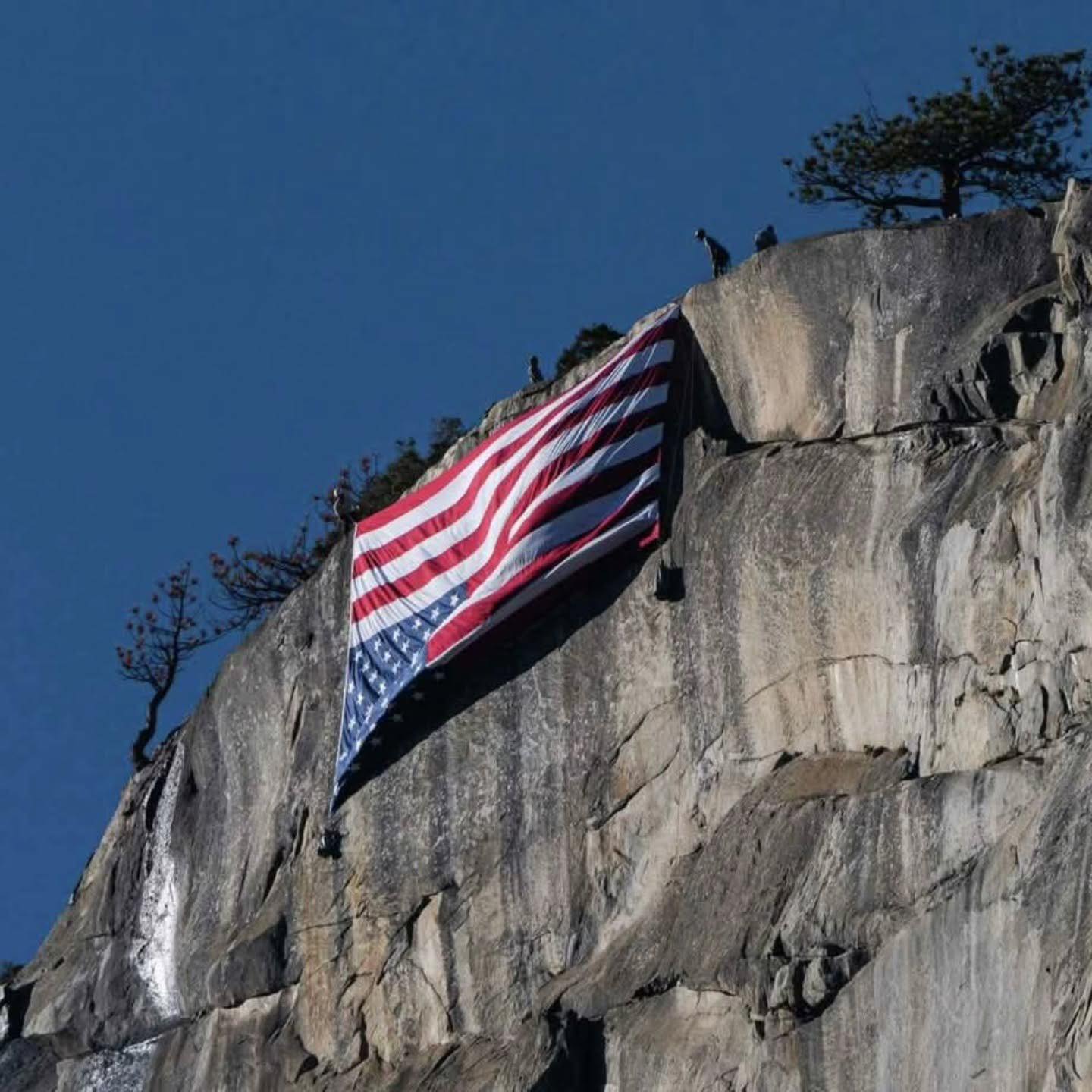
An image shared by the Alt National Park Service on Facebook shows an upside down U.S. flag in Yosemite National Park, a recognized international signal of distress: NAJ screen shot
The Big Picture –
By Glynn Wilson –
As the United States marks its 250th anniversary, only 33 percent of adults in the United States say they are “extremely proud” to be an American, the lowest reading in Gallup’s polling history.
Only 20 percent say they are “very proud,” according to the latest poll on the subject.
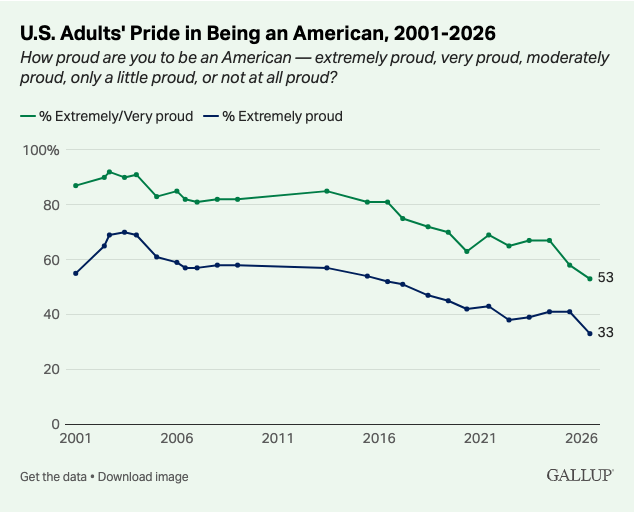
Another 22 percent say they are “moderately proud,” 15 percent say they are “only a little proud” and 9 percent say they are “not at all proud.”
When Gallup first asked this question in 2001, 55 percent of adults in the U.S. said they were extremely proud to be Americans. Pride surged after the attacks on the World Trade Center and the Pentagon on Sept. 11, 2001, with up to 70 percent of Americans expressing extreme pride into 2004.
Extreme pride declined after that but held at majority levels through 2017, until Donald Trump was sworn in as president. Since 2018, when Democrats took over a majority in Congress, no more than 47 of U.S. adults have said they are extremely proud.
The latest figure, from a June 1-15 poll, is down eight percentage points from last year and is tied for the largest year-over-year change in the trend, along with 2004-2005, about the time George W. Bush’s war in Iraq was revealed as a disaster and the economy began to teeter toward the Bush Great Recession.
Looking at “extremely proud” and “very proud” responses combined, roughly nine in 10 Americans expressed high levels of pride in the early years of the trend. That reading slipped into the 80 percent range in 2005, fell to 70 percent in 2019 and has been below 60 percent since last year, when Trump was elected again.
Partisan Divide
Throughout the timeline, Republicans have been more likely than Democrats and independents to say they are proud to be Americans. Even when Republican pride dipped during President Joe Biden’s administration, Republicans remained the most likely of the three groups to express extreme pride.
“This partisan divide persists and has been larger the past two years with Republican Donald Trump as president,” Gallup points out.
Yet only 70 percent of Republicans, 28 percent of independents and 14 percent of Democrats say they are extremely proud to be Americans.
Extreme pride has edged down seven points since last year among Republicans and six points among Democrats, but it is about the same among independents.
This drop among Democrats is similar to their shift during Trump’s first administration. The percentage of Democrats who are extremely proud to be American has been lower in Trump’s second term than in his first, however, when it bottomed out at 22 percent in 2019.
The current 56-point gap between Republicans’ and Democrats’ reported extreme pride is similar to last year’s 57-point difference, the highest on record.
When combining “extremely proud” and “very proud” responses, 93 percent of Republicans express high levels of pride, compared with 51 percent of independents and only 27 percent of Democrats.
Gender Divide
Extreme pride has fallen sharply among women since last year, down 13 points to 26 percent, while men are essentially unchanged at 42 percent. Significant declines are also seen among Americans aged 18 to 34 (down 10 points to 14%) and those aged 35 to 54 (dropping 12 points to 30%), but not among those aged 55 and older, who are similar to last year (down four points to 48%).
Race Divide
Feelings of pride are also lower this year among people of color (down 10 points to 20%) and those who do not have a college degree (down 10 points to 35%). Non-Hispanic White adults and college graduates show more modest declines.
Looking at combined pride, less than half of women, adults under 35 and people of color say they are extremely or very proud to be American. In contrast, majorities of men, adults aged 35 and older, and White adults say the same.
Flag Divide
One of the most common expressions of national pride is to display the American flag, something 43 percent of adults in the U.S. say they do outside their home on national holidays. This reading is identical to one taken 40 years ago.
It is lower than the 59 percent of Americans who reported flying the flag in 1991, however, in the wake of the U.S. victory in the first Persian Gulf War.
“In 1991, there was little difference between party groups in displaying the flag,” Gallup says, “but that is not the case today.”
Republicans, 69 percent, are currently far more likely than independents, 42 percent, or Democrats, 26 percent, to report displaying the American flag. In 1986, Republicans (50%) were more likely than Democrats (42%) and independents (36%) to fly a flag.
Age Divide
In addition to differences by party identification, displaying the flag rises steadily with age, from 25 percent among adults aged 18 to 34 to 57 percent among those aged 55 and older. White adults (48%) are also significantly more likely than people of color (33%) to display the American flag outside their home.
As might be expected, Americans’ reported national pride has a significant effect on their likelihood to display the flag, with those expressing the most pride being most likely to display the flag at home (69%).
Gallup Bottom Line
“American national pride has never been lower in Gallup’s trend dating back to 2001. Pride has been falling for two decades, but the pace has quickened in recent years, with the latest reading down eight points from last year alone, one of the largest single-year drops in the trend,” analysts say. “This casts some uncertainty over how Americans will engage with the country’s 250th anniversary festivities.”
___
If you support truth in reporting with no paywall, and fearless writing with no popup ads or sponsored content, consider making a contribution today with GoFundMe or Patreon or PayPal.










Combat veterans can attest that we were the first to be sent to the front lines but the LAST to receive injury compensation for our wounds while NON-veteran vulture capitalist multinational corporations pay little to no taxes, reap non-taxable benefits and never put their lives on the line for anything and are far more valued than we are! So, are “we” proud-proud of WHAT?