



The Big Picture –
By Glynn Wilson –
There was a time when Americans believed that the future would be better than the past. Technology would make life easier. Science would solve our problems. Education would make us wiser. Journalism would keep the public informed, and democracy would provide a peaceful way to settle our differences.
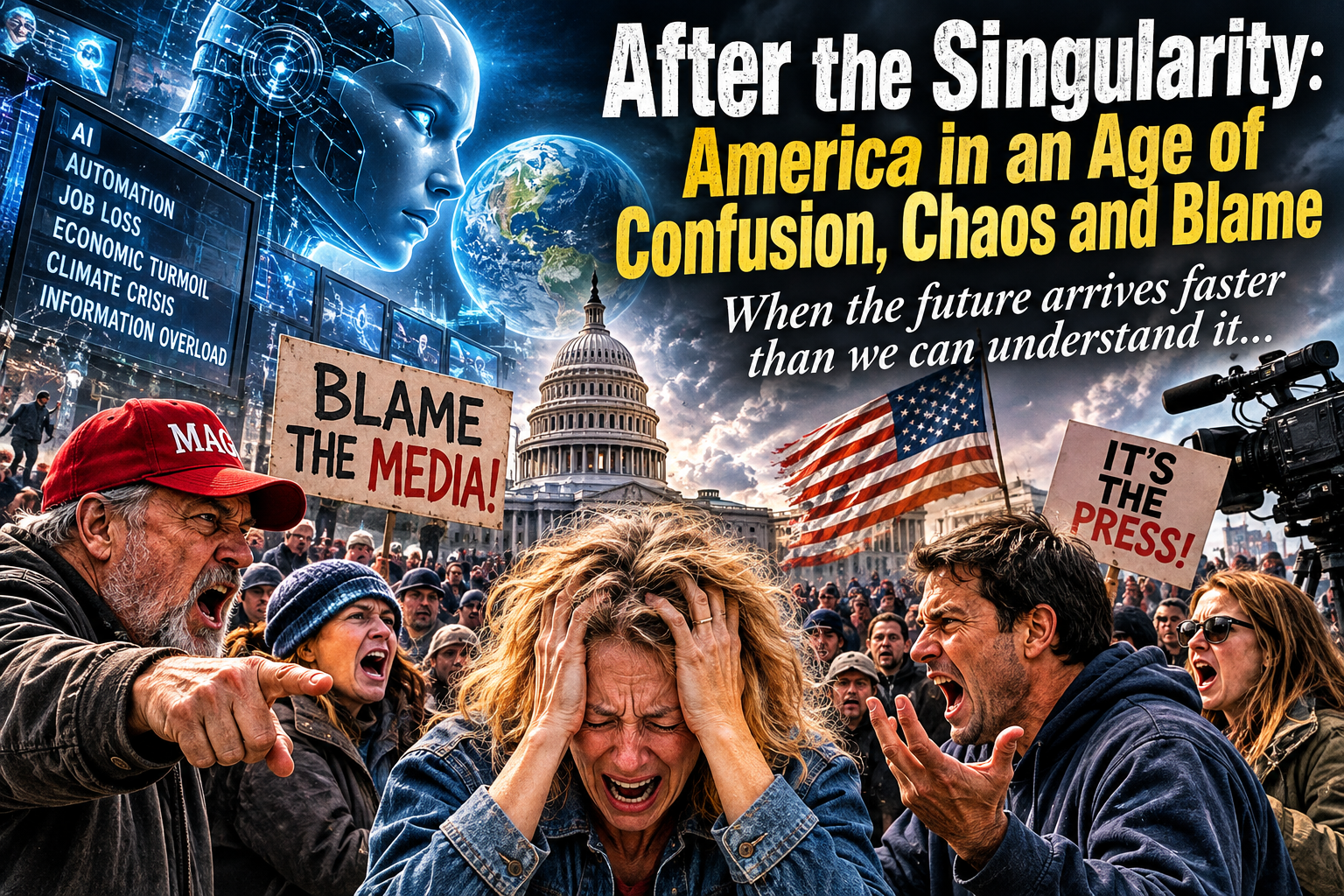
But somewhere along the way, the future arrived faster than our ability to understand it.
We find ourselves living in what might be described as a post-singularity world: a time when artificial intelligence, accelerating technological change, economic disruption, political polarization and an overwhelming flood of information have combined to fundamentally alter the way human beings experience reality.
The technological singularity, once a distant concept discussed primarily by scientists, futurists and science-fiction writers, has become a serious subject of public conversation. Artificial intelligence is advancing at an extraordinary pace, machines are learning to perform tasks once thought uniquely human, and the boundaries between fact, fiction, reality and manufactured illusion are becoming increasingly difficult to recognize.
Yet the greatest danger may not be the technology itself. It may be what happens to human beings when the world changes faster than they can emotionally, intellectually and socially adapt.
Look around.
People are stressed out, economically anxious, politically divided and increasingly distrustful of one another. Families argue. Neighbors become enemies. Communities fracture along ideological lines. People who once shared a common sense of belonging increasingly view those who disagree with them as threats.
Instead of trying to understand what is happening, too many people are looking for someone to blame. And when the problems become too complicated, the messenger becomes the target.
Blaming the Messenger
Throughout American history, a free press has served an essential function in a democratic society: telling people what is happening, investigating abuses of power, challenging official explanations and bringing uncomfortable truths into public view.
Journalists have never been universally popular. That is hardly surprising. Good journalism often makes powerful people uncomfortable.
But something more troubling has developed in recent years. Rather than debating the facts, people increasingly attack the institutions and individuals reporting them. The press becomes the enemy. Reporters become political targets. Investigative journalism is dismissed as propaganda whenever its findings challenge someone’s preferred version of reality.
This is a convenient escape from confronting difficult truths.
If the economy is struggling, blame the media. If the government makes mistakes, blame the reporters who expose them. If scientific evidence contradicts deeply held beliefs, attack the scientists. If the messenger delivers bad news, shoot the messenger.
The problem, of course, is that making the messenger disappear does not make the underlying problem disappear.
A thermometer does not cause a fever. A newspaper does not cause an economic crisis. A journalist reporting on corruption does not create the corruption.
And an artificial intelligence system does not create all the social and economic inequalities that existed before it arrived.
Confusing the messenger with the source of the problem is one of the most dangerous forms of intellectual avoidance.
The Psychological Cost of Too Much Change
Human beings evolved in relatively small communities, where information traveled slowly, relationships were personal and the pace of change was measured in generations.
Today, a person can wake up to dozens of alarming headlines, spend the morning arguing with strangers on social media, encounter hundreds of contradictory claims before lunch and finish the day watching a manufactured video of an event that never happened.
The human brain was not designed for this environment.
We are exposed to more information than ever before, but more information does not necessarily produce greater understanding. In fact, the constant bombardment of information can produce exhaustion, confusion and an almost permanent state of emotional emergency.
Artificial intelligence adds another dimension to this problem. It can generate convincing images, videos, voices, political messages and entire narratives at a speed and scale that traditional systems of verification were never designed to handle. The distinction between authentic evidence and manufactured persuasion becomes increasingly difficult for ordinary citizens to navigate.
When people cannot agree on what is real, it becomes difficult to agree on what should be done.
And when fear replaces reason, human beings often retreat into tribes. They seek reassurance from people who share their beliefs and become suspicious of everyone else.
The result is a society increasingly divided not merely by political opinions, but by entirely different understandings of reality.
Economic Insecurity and the Search for Someone to Blame
Behind much of the anger lies something very real: economic insecurity.
For millions of Americans, the promise of prosperity has become increasingly difficult to recognize in everyday life. Housing costs, health care, education, food and basic necessities consume an ever-larger portion of household budgets for many families.
People work hard and still struggle. Younger generations question whether they will ever own a home. Older Americans worry about retirement and medical expenses. Rural communities watch businesses disappear, while technological and economic changes threaten traditional employment.
At the same time, enormous wealth and technological power are concentrated in relatively few hands.
Artificial intelligence could eventually produce extraordinary benefits in medicine, education, scientific research, manufacturing and environmental protection. But it could also disrupt employment, concentrate economic power and widen existing inequalities if its benefits are not broadly shared.
These are legitimate public policy questions.
Yet instead of having a serious national conversation about how to manage this transformation, Americans often find themselves caught in an endless cycle of partisan accusations.
Neighbors blame neighbors. Workers blame immigrants. Rural communities blame urban populations. Urban populations blame rural communities. Political factions blame one another, while the underlying structural problems remain unresolved.
It is easier to find a scapegoat than to develop a solution. And it is particularly easy to blame people who have less power than the institutions making the decisions.
Democracy in an Age of Manufactured Reality
Democracy depends on more than elections. It requires a reasonably informed public, a willingness to accept evidence, an independent press, functioning institutions and some basic agreement about the rules of civic life. None of these conditions can be taken for granted.
The information revolution has created an extraordinary contradiction. We have more opportunities to communicate than any previous generation, yet meaningful communication seems increasingly difficult. Social media platforms reward attention, and outrage often attracts more attention than careful explanation. Political messaging can be tailored to individual fears and prejudices. Algorithms can reinforce existing beliefs, creating information bubbles in which people rarely encounter arguments they are willing to consider.
Artificial intelligence could intensify these tendencies.
The ability to manufacture convincing political propaganda, impersonate public figures and flood communication networks with fabricated information presents serious challenges for democratic institutions.
The danger is not simply that people will believe something that is false. It is that people will eventually lose confidence in the possibility of knowing what is true at all. That is a profoundly dangerous condition for a free society.
A democracy cannot function indefinitely when citizens regard every inconvenient fact as a conspiracy and every independent institution as an enemy.
We Need to Stop Turning on Each Other
Perhaps the most important question facing America is not whether artificial intelligence will become more powerful than human beings in certain fields. It is whether human beings can develop the wisdom to manage the power they are creating.
Technology is not inherently good or evil. Its consequences depend on the values, incentives and institutions that shape its development and use.
The same artificial intelligence that could help discover cures for diseases could also be used to manipulate public opinion. The same robotics that could assist firefighters and disaster-relief workers could displace people from their livelihoods. The same information networks that connect humanity could become instruments of surveillance, manipulation and social division.
We need thoughtful regulation, public accountability, independent scientific research, responsible journalism and an economic system that allows ordinary people to share in technological progress.
But we also need something less tangible and perhaps more difficult to achieve: a renewed commitment to basic human decency. We need to relearn how to disagree without becoming enemies. We need to recognize that our neighbors are not necessarily responsible for our problems simply because they vote differently, worship differently, live differently or believe something we do not. We need to stop treating every disagreement as an existential threat.
And we need to defend the people whose job it is to investigate, question and report what is happening, even when the information makes us uncomfortable.
A free press is not infallible. Journalists make mistakes, and media organizations deserve scrutiny. But the answer to imperfect journalism is better journalism, not the destruction of independent reporting.
Likewise, the answer to imperfect government is accountability and reform, not the abandonment of democratic principles.
The Human Singularity
Perhaps we should rethink what the singularity really means.
The popular technological definition describes a future in which artificial intelligence advances beyond human capabilities in ways that fundamentally transform civilization.
But there is another kind of singularity worth considering: a moment when humanity must decide whether its social, political and moral development can keep pace with its technological achievements.
We have learned how to split the atom, explore outer space, manipulate the building blocks of life and build machines capable of extraordinary intellectual work.
But have we learned how to live together?
Have we developed the patience to listen, the humility to admit when we are wrong, the compassion to help people who are struggling and the collective wisdom to put the long-term interests of civilization ahead of short-term political and financial advantages?
These questions are no longer philosophical luxuries. They are becoming essential to our survival.
America does not need more manufactured outrage, more scapegoating or more attacks on the people trying to explain an increasingly complicated world. It needs more curiosity, more critical thinking, more honest conversation and a renewed commitment to the common good.
The future is not something that simply happens to us. It is something we collectively create through our decisions, our institutions and the values we choose to defend.
If we allow fear, confusion and anger to turn us against one another, we risk becoming a society technologically advanced but socially and morally diminished.
If we can learn to manage our differences, regulate powerful new technologies responsibly, preserve independent journalism and remember that we share a common human destiny, there is still an opportunity to make this extraordinary period of change work for the benefit of humanity.
The greatest danger in a post-singularity world may not be that machines become more intelligent than people. It may be that people, overwhelmed by change and manipulated by fear, forget how to use the intelligence they already possess.
And perhaps the first step toward finding our way out of this chaos is to stop shooting the messenger, start listening to one another and finally begin addressing the problems that brought us here.
The world is changing. We can either learn to navigate that change together, or spend the rest of our lives blaming our neighbors for the storm.
___
If you support truth in reporting with no paywall, and fearless writing with no popup ads or sponsored content, consider making a contribution today with GoFundMe or Patreon or PayPal.











These are great topics that need individual examination, something not taught to me in secondary school and only at the college graduate level-which at one time did mean something. Think about it! What one group singularily benefits from all this chaos and disunity? WHY ARE WE TOO WILLFULLY IGNORANT TO SEE THIS? Working together in harmony is the ONLY solution!