The Big Picture –
By Glynn Wilson –
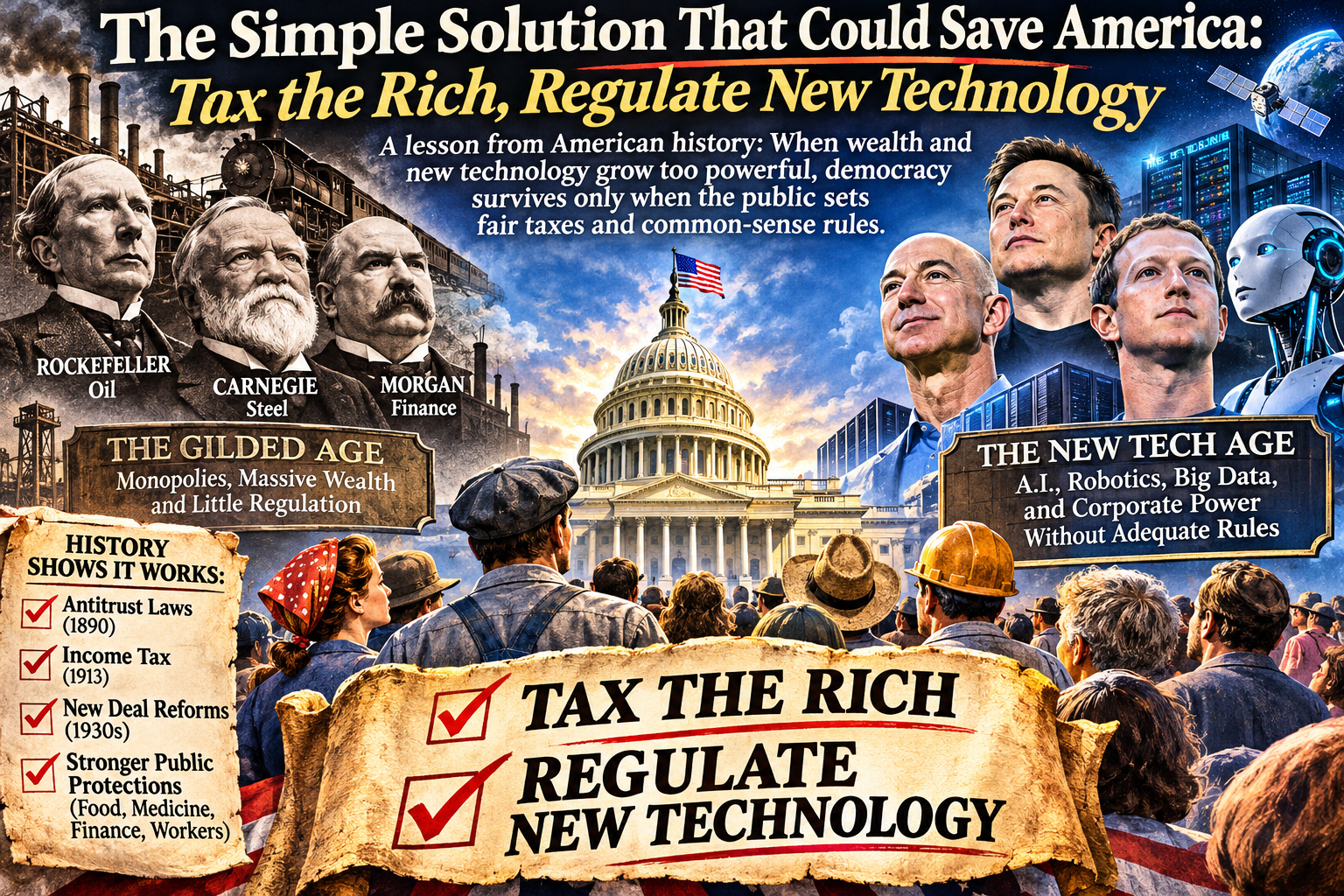
There is something almost amusing about how complicated American politics has become. We have armies of economists, lobbyists, think tanks, political consultants, billionaires, and politicians arguing over how to fix a country that once understood two relatively simple principles: those who benefit most from the economic system should contribute their fair share, and powerful new technologies must serve the public interest rather than be allowed to run wild.
Neither idea is particularly radical. In fact, both are deeply rooted in American history.
The United States did not become the world’s largest economic power by leaving everything to the whims of wealthy individuals and unregulated corporations. Nor did it build the modern middle class by allowing all the benefits of economic growth to flow to the top.
America’s history offers a different lesson: prosperity depends on a balance between private enterprise, public investment, fair taxation and democratic oversight.
The story begins in the late 19th century, when America was experiencing another period of extraordinary technological and economic transformation. Railroads, steel mills, oil companies, banking empires, and industrial corporations were creating enormous fortunes. Men such as John D. Rockefeller, Andrew Carnegie, and J.P. Morgan accumulated wealth on a scale previously unimaginable.
But the prosperity was not evenly distributed. Workers endured dangerous conditions, farmers struggled against powerful railroad monopolies, and small businesses found themselves competing against industrial giants with enormous political influence. The country was experiencing rapid economic growth, but it was also experiencing growing inequality and concentrated corporate power.
Sound familiar?
America has been here before.
The Original American Solution
The response came through the Progressive Era, a period of political reform that recognized a fundamental problem: capitalism could generate extraordinary wealth, but without rules, economic power could become concentrated in ways that threatened competition and democratic government.
In 1890, Congress passed the Sherman Antitrust Act, establishing the federal government’s authority to challenge monopolistic business practices. In 1914, Congress created the Federal Trade Commission and strengthened antitrust protections with the Clayton Act.
Meanwhile, the debate over taxation was reaching a turning point. The 16th Amendment, ratified in 1913, gave Congress the constitutional authority to impose a federal income tax without apportioning it among the states. The idea had been championed by farmers, labor reformers, and progressive politicians who believed the wealthiest Americans should contribute more to the country that made their fortunes possible.
It was an important change in the American economic philosophy. The country was beginning to recognize that private wealth and public responsibility were not mutually exclusive.
The Greatest American Economic Experiment
The next major chapter came during the Great Depression. After the stock market collapse of 1929, millions of Americans lost their jobs, homes, savings and confidence in the economic system. Banks failed. Businesses collapsed. Families went hungry.
President Franklin D. Roosevelt’s New Deal introduced a series of reforms designed to stabilize the economy, provide relief, rebuild infrastructure, and establish safeguards against another financial catastrophe. The federal government expanded Social Security, unemployment protections, minimum wage requirements and the 40 hour work week, as well as financial oversight and public works programs.
During and after World War II, the United States also developed a highly progressive federal income tax structure. The top marginal income tax rate reached approximately 91 percent during much of the 1950s. That number is frequently misunderstood. It did not mean wealthy Americans surrendered 91 percent of their entire fortunes to the government. It applied only to income above a particular threshold, and deductions and other provisions meant actual effective tax rates were considerably lower.
Nevertheless, the period offers an important historical lesson. America experienced tremendous industrial expansion, rising wages, growing homeownership, major infrastructure development, and the emergence of a large middle class.
Many factors contributed, including postwar industrial strength, public investment, education, and favorable international economic circumstances.
The historical record does challenge the argument that asking the wealthiest Americans to contribute more necessarily destroys economic growth, as politicians on the political right have been saying, falsely, for the past 50 years.
The Other Half of the Solution: Regulate Technology
There is another important lesson from American history. Whenever a new technology transforms society, government eventually faces the responsibility of establishing rules to protect the public.
The automobile industry provides one example. Also aviation, telecommunications, pharmaceuticals, nuclear power and the financial industry.
Consider food and medicine.
At the beginning of the 20th century, Americans could purchase dangerous patent medicines and contaminated foods with little meaningful federal protection. Investigative journalism, public outrage, and political pressure helped produce the Pure Food and Drug Act of 1906, signed by President Theodore Roosevelt.
Following another public health disaster in 1937, Congress strengthened federal protections through the Food, Drug and Cosmetic Act of 1938. That legislation gave the government new authority to require evidence of drug safety before marketing.
The principle was straightforward: just because a company can manufacture and sell something does not automatically mean it should be allowed to do so without safeguards.
Today, America faces a technological transformation potentially more consequential than the industrial revolution. Artificial intelligence, robotics, genetic engineering, autonomous weapons, mass surveillance and increasingly sophisticated digital platforms are changing how people work, communicate, conduct business and even understand reality.
These technologies offer enormous opportunities. They could improve medicine, scientific research, education, manufacturing, transportation and environmental protection in the long run.
But they also create serious questions. Who is responsible when an artificial intelligence system causes harm? Who owns the information collected from millions of Americans? How do we protect workers whose jobs are displaced by automation? What happens when a handful of corporations control the most powerful computing systems and the information infrastructure on which society depends?
And perhaps most importantly, who gets to decide how these technologies are used?
Leaving every decision to the companies developing the technology is not a viable option. Establishing reasonable public safeguards, independent oversight, transparency, and accountability is the only solution that makes any sense.
But we must have the political will to overcome a generation of anti-government and anti-regulation rhetoric from the political right in the United States.
The challenge is to regulate genuine risks without freezing innovation or protecting established corporations from new competition.
The Problem with Modern American Capitalism
Somewhere along the way, the American conversation about economic responsibility became increasingly polarized. One side often portrays taxation and regulation as threats to freedom and enterprise. The other emphasizes the dangers of concentrated wealth, corporate influence and inadequate public protections.
History suggests these ideas do not have to be mutually exclusive. A functioning market economy requires rules. Property rights, enforceable contracts, honest financial markets, consumer protections, and competition laws are all products of public institutions.
Businesses benefit from educated workers, public roads, ports, airports, scientific research, courts, police protection and a stable society.
Those things do not materialize out of thin air. They are supported by taxpayers.
And when extraordinary wealth is accumulated through an economic system supported by public investment, the question of how much the wealthiest beneficiaries should contribute is a legitimate subject of democratic debate.
There is also a practical distinction between taxing productive investment and ensuring that enormous fortunes, capital gains, inheritances and corporate profits are not treated more favorably than ordinary working people’s income.
Tax reform should address loopholes, avoidance, and the ability of individuals and corporations to use their resources to escape responsibilities that apply to everyone else.
Likewise, technology regulation should be carefully designed, transparent, enforceable and responsive to scientific evidence rather than political favoritism.
A New Social Contract for the Technological Age
The United States is approaching another historic crossroads. Artificial intelligence could produce extraordinary economic wealth. Robotics could transform manufacturing. Scientific advances could improve human health and extend our understanding of the universe.
But technological progress does not automatically translate into human progress. That depends on how the benefits are distributed, who controls the technology and whether democratic institutions can keep pace with private economic power.
If automation produces enormous productivity gains while workers lose their livelihoods, society will have to address the consequences.
If artificial intelligence creates unprecedented corporate fortunes, the tax system will have to confront questions about how those gains contribute to the public good.
If technology threatens privacy, personal freedom, public safety or democratic institutions, reasonable safeguards will be necessary.
The goal should not be to punish success, discourage entrepreneurship, or prevent technological advancement. It should be to make sure that progress benefits more than a relatively small circle of investors and corporate executives. That is the essential argument behind the two ideas that have repeatedly appeared throughout American history:
Tax the rich. Regulate powerful new technologies.
Neither proposition is a complete economic program by itself. Tax policy must be carefully designed, and regulation must be intelligent enough to encourage innovation while protecting the public. But together, they describe an approach to balancing private enterprise with public responsibility.
America has faced similar questions before. During the Progressive Era, during the New Deal, and throughout the postwar economic expansion, Americans debated the proper relationship between wealth, government, business and the public interest.
The answers were never perfect. But the country repeatedly found ways to adapt.
Perhaps the real question facing America today is not whether we can afford to tax great wealth or regulate powerful new technologies. It is whether we can afford not to have that conversation.
Because the purpose of an economy should ultimately be more than producing billionaires, bigger corporations and increasingly sophisticated machines. It should be about producing a better life for the people who make the country work.
And that may be the simplest idea in American history worth remembering. As the Democrats take over both houses of Congress in January, let’s hope someone up there has the smarts to tell them this is the way for America to come back from Trumpism.
__
Historical references for this article include the National Archives, the Congressional Research Service, the Federal Trade Commission, the Food and Drug Administration and many years of education and experience covering American politics.
___
If you support truth in reporting with no paywall, and fearless writing with no popup ads or sponsored content, consider making a contribution today with GoFundMe or Patreon or PayPal.