



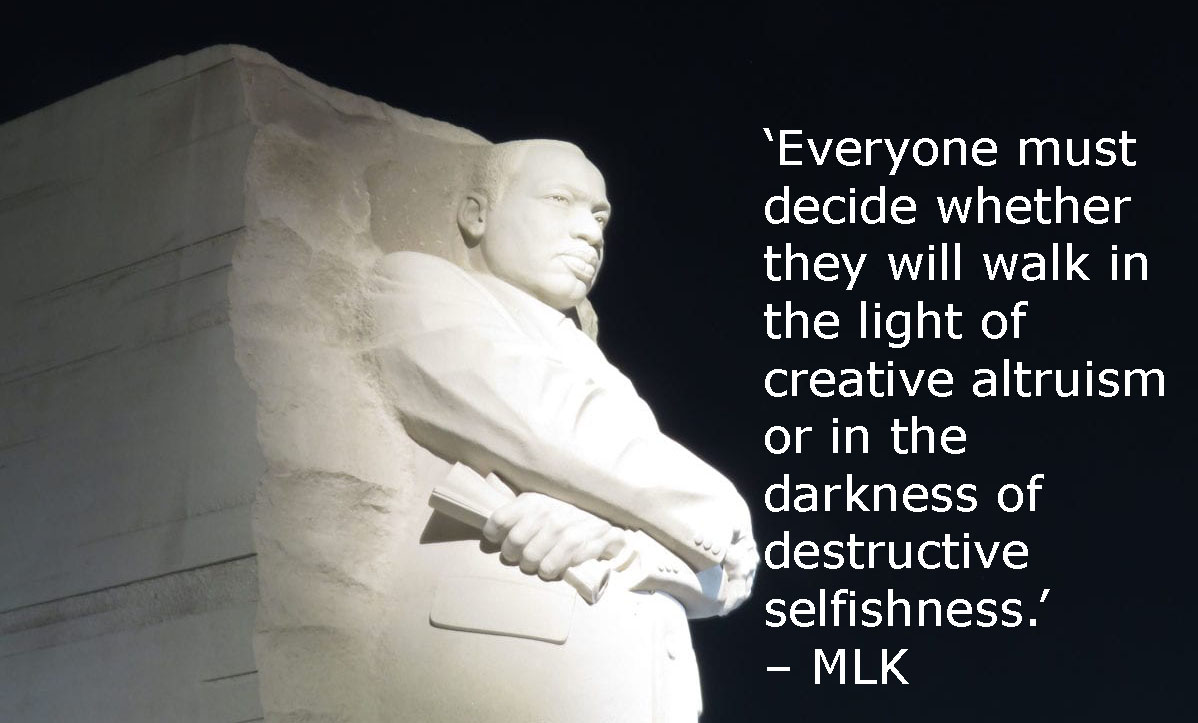
I took this picture of the MLK memorial in Washington, and found the speech containing this quote before anyone else was using it: By Glynn Wilson
Under the Microscope –
By Glynn Wilson –
SAN FRANCISCO, Calif. – Why does this seem so hard for some people to grasp?
Perhaps it is a lack of leadership?
While sitting in a bar recently having an intelligent conversation with a good friend who understands, through the swinging doors entered a stressed out woman. She sat down at the bar, ordered a beer, and launched into a tirade against “fraud” in our country.
What prompted this?
“What fraud?” I asked.
“Every day when I get home from work and turn on the TV, there are all these stories about fraud. I never knew there was so much fraud going on in our country.”
Puzzled by this (I no longer watch news on The Tube. It pollutes the mind, causes stress and prevents original thought), I asked.
“What fraud?”
She went on to say she saw Trump’s Health Secretary Robert F. Kennedy Jr. talking about fraud in the health care field. Yes, the same Kennedy who is against vaccines, claims he had a worm in his brain, and is now persona non grata in his own political family).
I knew then she was talking about watching Fox News.
I tried to change the conversation to something that was on my mind: The fundamental human struggle between the selfish gene and the trait of altruism.
Our society is polluted these days by out of control selfishness. It is pumped up on steroids, driven by social media and the narcissist-in-chief in the White House and all the minions trying to copy his tactics in politics.
What is needed to counter this?
Remind people that altruism is the answer to combating selfishness.
She had no idea what I was talking about.
“What is altruism?” she asked.
She was not even familiar with the word. How then could we successfully communicate with one another?
I tried to simplify what I meant by selfishness in society.
“Think of the selfie on Facebook,” I said. “Everyone these days, aiming the camera at themselves.”
“Oh,” she said, then blowing it off.
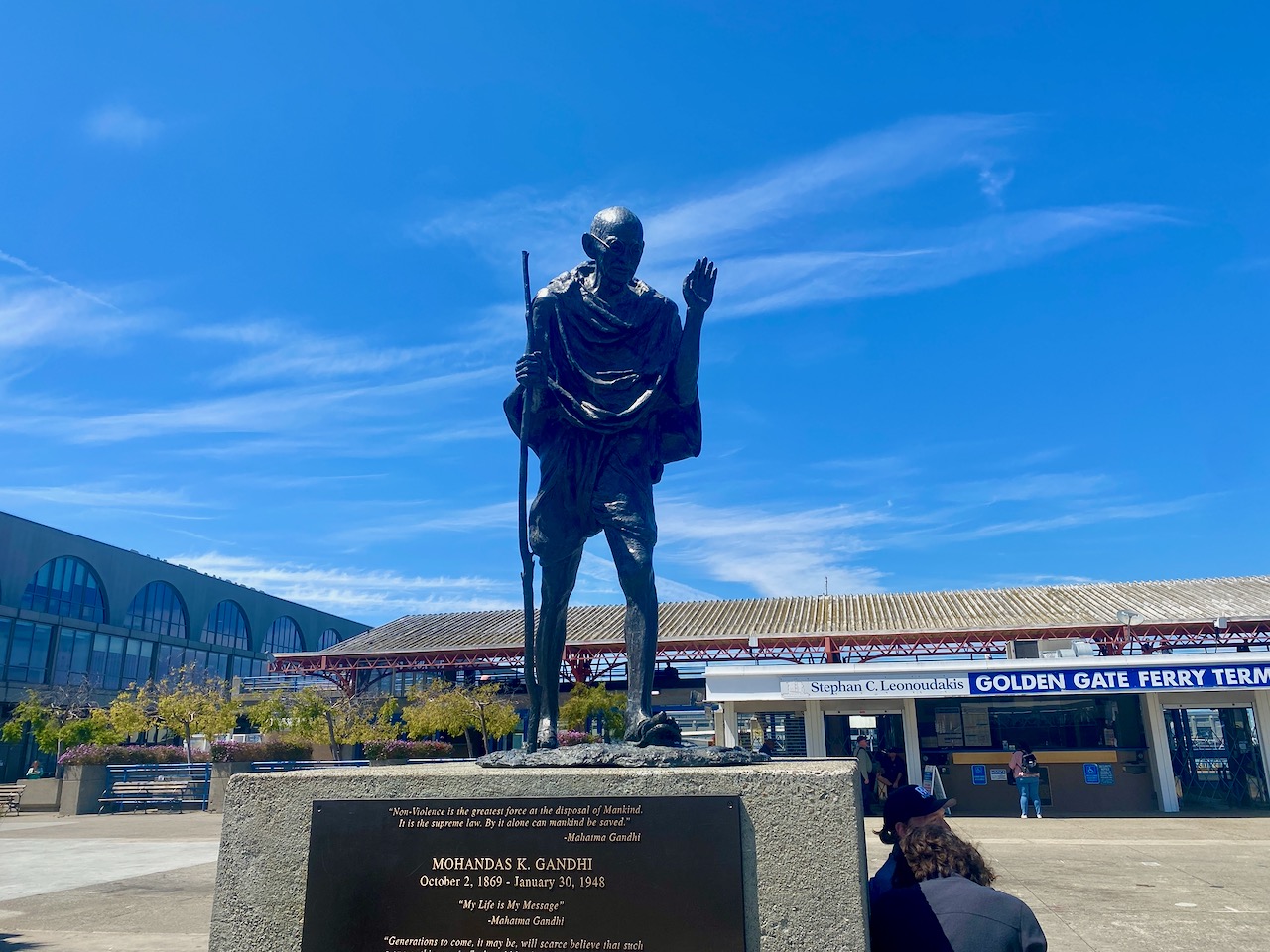
Mahatma Gandhi sculpted by Zlatko Paunov and Steven Lowe, located in the plaza by the San Francisco Ferry Building. By Glynn Wilson
What is altruism?
In evolutionary terms, a field that often occupies my thoughts, I said.
“Think of early humans, hunting for meat and gathering fruits and nuts, working together as a community to chase down and kill a woolly mammoth with spears made from sticks and arrowheads, so the entire family or tribe could eat.”
“Hmmm,” she said, seeming confused and uninterested, and went back to talking about the stories about fraud on TV.
I gave up and left.
This is a problem for news organizations and politicians. If people are just going to be selfish, and ignore the problems of their neighbors and communities and focus on the fake problems being reported on certain biased TV channels, the only economic choice for them is to cover and promote the sensational clickbait that people are concerned about because they saw it on TV or social media.
There is no time to reflect on what might be the root cause of our collective distress, and that might actually involve taking the time to read.
Oh my god no, we have no time for that these days, and why should we, when a talking head, a preacher, a politician or a bot will do the reading and thinking for us?
Oh well.
Today I was Googling around about this and discovered an interesting online magazine dedicated to exploring and explaining the subject.
Greater Good magazine is published by the Greater Good Science Center at the University of California, Berkeley. Since 2001, the GGSC has been at the fore of a new scientific movement to explore the roots of happy and compassionate individuals, strong social bonds, and altruistic behavior.
In other words, the science of a meaningful life.
Here are some key excerpts about altruism, slightly edited.
What Is Altruism?
Altruism is when we act to promote someone else’s welfare, even at a risk or cost to ourselves. Though some believe that humans are fundamentally self-interested, recent research suggests otherwise: Studies have found that people’s first impulse is to cooperate rather than compete; that toddlers spontaneously help people in need out of a genuine concern for their welfare; and that even non-human primates display altruism.
Science
Evolutionary scientists speculate that altruism has such deep (genetic) roots in human nature because helping and cooperation promote the survival of our species. Indeed, Darwin himself argued that altruism, which he called “sympathy” or “benevolence,” is “an essential part of the social instincts.”
Darwin’s claim is supported by recent neuroscience studies, which have shown that when people behave altruistically, their brains activate in regions that signal pleasure and reward, similar to when they eat chocolate (or have sex).
This does not mean that humans are more altruistic than selfish; instead, evidence suggests we have deeply ingrained tendencies to act in either direction. Our challenge lies in finding ways to evoke the better angels of our nature.
I would add that our challenge is to learn how to promote altruism to fight the selfish gene, to get it under control in society and find an equilibrium.
Why Practice It?
Nice guys finish last? Hardly. More and more, research suggests that practicing altruism enhances our personal well-being — emotionally, physically, romantically, and perhaps even financially. It’s also crucial to stable and healthy communities, and to the well-being of our species as a whole.
Still need to be convinced to be kind? Read on.
Altruism makes us happy: Researchers have consistently found that people report a significant happiness boost after doing kind deeds for others. Some studies suggest giving to others makes people feel happier than spending money on themselves; this has even been found among kids. These good feelings are reflected in our biology: Giving to charity activates brain regions associated with pleasure, social connection, and trust. Scientists also believe that altruism may trigger the release of endorphins in the brain, giving us a “helper’s high.”
Altruism is good for our health: Spending money on others may lower our blood pressure. People who volunteer tend to experience fewer aches and pains, better overall physical health, and less depression; older people who volunteer or regularly help friends or relatives have a significantly lower chance of dying. Researcher Stephen Post reports that altruism even improves the health of people with chronic illnesses such as HIV and multiple sclerosis.
Altruism is good for our bottom line: Studies suggest that altruists may reap unexpected financial benefits from their kindness because others will feel compelled to reward their kindness; other research has found that donating money to charity might make corporations more valuable. Across the animal kingdom, animals that cooperate with each other are more productive and survive longer.
Altruism is good for our love lives: When researcher David Buss surveyed more than 10,000 people across 37 cultures, he found that kindness was their most important criterion for a mate and the single universal requirement for a mate across all cultures. Altruists also have more sex.
Altruism fights addiction: Studies have shown that addicts who help others, even in small ways, can significantly improve their chances of staying sober and avoiding relapse; this is true among adults and adolescents alike.
Altruism promotes social connections: When we give to others, they feel closer to us, and we also feel closer to them.
“Being kind and generous leads you to perceive others more positively and more charitably,” writes positive psychologist Sonja Lyubomirsky in her book The How of Happiness, and this “fosters a heightened sense of interdependence and cooperation in your social community.”
Altruism is good for education: High-quality service learning programs, where students complement their classroom learning with real-world community service, improve academic performance and make students feel more connected to their school. And when students engage in “cooperative learning,” where they must work together to complete a project, they are more likely to have positive relationships, better psychological health, and are less likely to bully. Teens who volunteer to help younger children can decrease their risk factors for cardiovascular disease.
Altruism is contagious: When we give, we don’t only help the immediate recipient of our gift. We also spur a ripple effect of generosity through our community.
Research by James Fowler and Nicholas Christakis has shown that altruism can spread by three degrees—from person to person to person to person.
“As a result,” they write, “each person in a network can influence dozens or even hundreds of people, some of whom he or she does not know and has not met.”
How to Cultivate Altruism
Studies show that kids behave altruistically even before they’ve learned to talk. But too often, we don’t act on our propensities for kindness as we get older. Here are some specific, science-based activities for cultivating altruism from our new site Greater Good in Action:
Random acts of kindness: How to feel happier by doing things for others.
Feeling Connected: A writing exercise to foster connection and kindness.
Put a human face on suffering: When reading the news, look for profiles of specific individuals and try to imagine what their lives have been like.
Eliciting altruism: Create reminders of connectedness.
Here are some broader ways to nurture our own altruistic instincts — and help motivate altruism in others.
Get connected: Feeling connected to other people — even by just reading words like “community” and “relationship” — makes us more altruistic. Reminders of connection can be very subtle: In one study, when toddlers simply saw two dolls facing each other in the background of a photo, they were three times more likely to be helpful than when they saw the dolls in other poses. More broadly, kids who are raised in an environment of warmth and support give more to others when they’re adults.
Get personal: We’re more altruistic when we see people as individuals, not abstract statistics. So if you want to encourage aid to people in need, give their problem a human face — and recognize that many factors outside their control could have led them to be in need. By the same token, people (including kids) respond more altruistically when they feel personally responsible for a problem: Bystanders to a crisis are much more likely to respond if singled out individually—“Hey, you in the striped shirt, can you help me?”—than if they hear a general appeal for help.
See yourself in others: In general, people are much more likely to help members of their own group — but research has shown that who we think belongs to our “in-group” can be very malleable. Finding a thread of similarity with someone else — even something as simple as liking the same sport or sports team — can motivate altruistic action toward that person, in some cases overcoming group rivalries in the midst of war.
Cultivate empathy: Research by Jamil Zaki and Jason Mitchell suggests that the skills involved in empathy —taking someone’s perspective and sharing in their feelings — may underlie altruistic behavior.
Give thanks: Grateful people are more generous, perhaps because they’re paying forward the gifts they appreciate receiving from others. Receiving gratitude can also encourage altruism — for instance, when a server writes “thank you” on a restaurant bill his or her tip goes up by as much as 11 percent.
Lead by example: People who consistently display altruism encourage others to follow suit. Simply reading about extraordinary acts of kindness makes people more generous, perhaps because they experience the warm, uplifting feeling psychologists call “elevation,” which we get when we see unexpected acts of goodness. This is an especially important tip if you’re caring for kids: Research suggests altruistic children have parents or other caregivers who deliberately model helpful behavior or stress altruistic values. Organizations who give may inspire their followers to give, as well.
Put people in a good mood: Feeling happy makes people more generous. And because being generous seems to make people happy, researcher Lara Aknin sees a “positive feedback loop” to altruism that might benefit charitable organizations: “Reminding donors of earlier donations could make them happy, and experiencing happiness might lead to making a generous gift.”
Encourage collaboration and emphasize shared goals: When kids have to work together on a task, they’re much more likely to share the fruits of their efforts evenly. When students participate in “cooperative learning” exercises in small groups, they’re more likely to show kindness toward their classmates in general.
Acknowledge giving — but not with rewards: People are more likely to be altruistic when others will know of their good deeds, perhaps because they assume their kindness will be reciprocated down the line. But too much acknowledgment can backfire: Young kids who receive material rewards for kindness become less likely to help in the future. When the opportunity to give arises, simply reminding kids of their past kindnesses can inspire more giving.
Learn to love giving: Make giving a choice, not something you force your kids (or yourself) to do. Learning more about where need exists and where they can have the most impact may help inspire kids to give and to see giving as part of their identity.
Get time on your side: In seminal studies by Daniel Batson and John Darley, when people saw someone slumped on a sidewalk, their decision to help depended on a single factor: whether they were late to an appointment. They were altruistic only when they felt like they had the time to be — which offers important lessons for our increasingly busy culture: slow down, don’t overschedule, and make time to be mindfully aware of your surroundings.
Help build a supportive community: One study found that neighborhoods with more support structures for kids, like extracurricular activities and religious institutions, had teens who were more altruistic. The amount of wealth in their neighborhood wasn’t a factor. This suggests volunteering doesn’t just make you feel good — it also helps build a more altruistic community.
Fight inequality: Studies suggest that when people feel an inflated sense of status, they become less generous. Perhaps that’s why wealthier people in the United States give a lower percentage of their income to charity, especially when they live in neighborhoods with a high proportion of other wealthy people. But when high-status people are made to feel a compassionate connection to others, or feel their status dip, they become more generous.
Cultivate awe: Various experiments suggest that feeling awe may lead us to be more helpful and generous toward others.
It’s true. Ever been to Yosemite? Everyone seems nice in a national park, in my experience, including 10 years as a National Park Service volunteer.
News and Politics
Where are the news media sources and politicians telling this story? If they are not talking about it, why not?
How are people supposed to know what to do if no one is telling them the story?
___
If you support truth in reporting with no paywall, and fearless writing with no popup ads or sponsored content, consider making a contribution today with GoFundMe or Patreon or PayPal.











A most excellent definition! From a moral point of view, it should be the guiding principle for all religions. For a variety of personal gains (of course) during the 1930s, Mussolini legislated the Catholic church to be Italy’s state religion; Hitler engineered an associated “understanding” with German Catholics showcasing clergy who also had positions in the German military. This came as an ultimate sacrifice for some “others” deemed unworthy to live. Today these same points are being demonstrated by Islamic extremists and Christian nationalists who think they have a monopoly on what our Creator Deity seems to think. The fundamental Teaching of Jesus revolved around loving our enemies and wanting more for our neighbors than ourselves. Simple, straightforward but more often than not-ignored as this line of thinking threatens the bottom line for the special interest that truly set national and global policy. True altruism, practiced by governments, would actually solve all the world’s problems. To quote Rev. Ike (so NOT a joke, but is an indicator of who we actually are) “What could Jesus possibly know? He didn’t like money!”