



“One touch of nature makes the whole world kin.”
— Though originally from Shakespeare (Troilus and Cressida), John Muir often used and adapted this phrase in his writings.
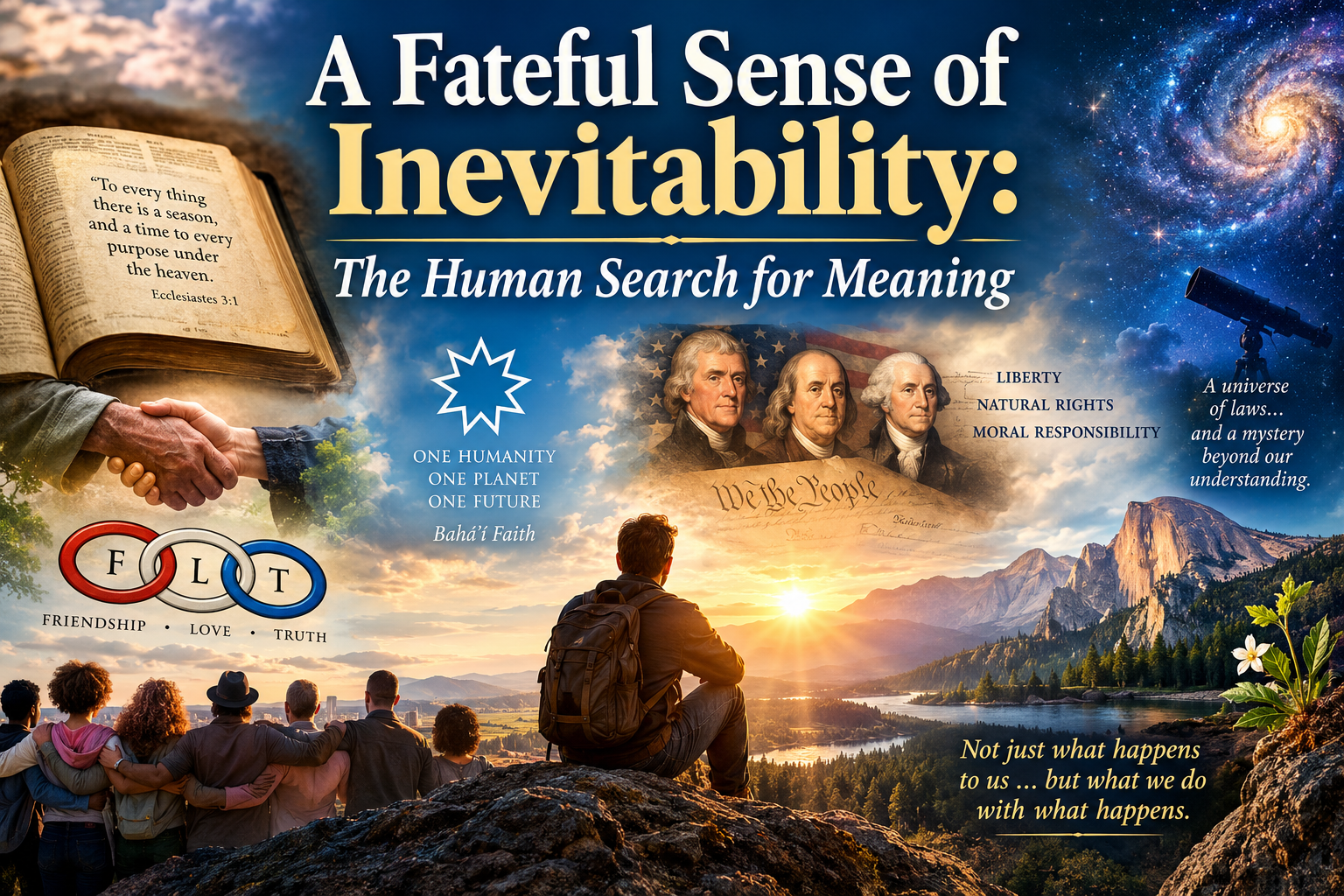
“The battle for conservation must go on endlessly. It is part of the universal warfare between right and wrong.”
— John Muir, Son of the Wilderness
Tales From the MoJo Road –
By Glynn Wilson –
YOSEMITE NATIONAL PARK, Calif. – There are moments in life when the past seems to converge upon the present with such extraordinary precision that we begin to wonder whether our lives are governed by forces beyond our understanding.
A chance encounter, a sudden loss, an unexpected opportunity, or a decision made long ago may eventually reveal consequences we could never have anticipated. Looking backward, the events can appear almost inevitable, as though the road we traveled had been laid out before us all along.
Is this the hand of God? The unfolding of destiny? The workings of natural law? Or is it simply the human mind searching for meaning in the vast, expanding universe?
The question has occupied philosophers, theologians, mystics, and ordinary people since the beginning of recorded history. It lies at the intersection of biblical faith, the fraternal philosophy of the Independent Order of Odd Fellows, the spiritual teachings of the Bahá’í Faith, and the Deist principles that influenced many of America’s Founding Fathers.
Each offers a different perspective on the relationship between fate and freedom, providence and personal responsibility, and the possibility that our lives are part of something larger than ourselves.
Perhaps the deepest wisdom lies not in deciding that everything is predetermined, but in recognizing that we are participants in a mysterious process whose ultimate meaning we cannot fully comprehend.
The Biblical Paradox: A Time for Everything
The Bible offers some of the most enduring reflections on the apparent inevitability of human experience. Its pages are filled with stories of people whose lives seem shaped by divine purpose, even when they themselves cannot see the destination.
The Book of Ecclesiastes begins with a sobering acknowledgment of life’s recurring patterns and the limits of human control. In one of its most famous passages, the writer declares:
“To every thing there is a season, and a time to every purpose under the heaven.”
— Ecclesiastes 3:1, King James Version
The verses that follow describe the opposing experiences that define human existence: birth and death, planting and harvesting, mourning and dancing, keeping and casting away, silence and speech.
The passage does not necessarily mean that every event is predetermined. Rather, it recognizes that life unfolds through seasons, many of which we cannot control. We may resist change, but time continues to move. We may cling to what we love, but eventually we must confront loss. We may pursue happiness, yet suffering arrives without asking our permission.
There is a kind of inevitability in this rhythm of existence.
The biblical understanding of divine providence appears even more explicitly in Proverbs:
“A man’s heart deviseth his way: but the LORD directeth his steps.”
— Proverbs 16:9, King James Version
Here is the central paradox. Human beings make plans, exercise judgment, and pursue ambitions. Yet the final destination may differ dramatically from what they imagined.
The verse can be interpreted as an expression of divine guidance, but it also speaks to the limits of human foresight. We act with incomplete knowledge. We cannot see every consequence of our decisions, and we rarely understand how the actions of others will intersect with our own.
The New Testament offers another perspective through Paul’s words in Romans:
“And we know that all things work together for good to them that love God, to them who are the called according to his purpose.”
— Romans 8:28, King James Version
This is not a promise that everything that happens is good. Human history offers overwhelming evidence to the contrary. War, cruelty, injustice, disease, and natural disasters have caused suffering on an unimaginable scale.
Rather, the verse expresses a faith that goodness may emerge even from circumstances that initially appear meaningless. A tragedy may inspire compassion. A failure may redirect a life toward a more worthwhile purpose. An injustice may awaken a community to the necessity of change.
The danger comes when we use providence to excuse suffering or injustice, as though whatever happens must therefore be right. A belief in divine purpose should not absolve human beings of responsibility for the harm they cause.
The biblical challenge is more demanding: to accept what we cannot change while working courageously to change what we can.
The Odd Fellows: Friendship, Love, and Truth
The Independent Order of Odd Fellows offers a different but complementary philosophy. Emerging from the tradition of fraternal societies, the Odd Fellows developed a moral vision centered on the principles of Friendship, Love, and Truth.
Its teachings encourage members to look beyond self-interest and recognize their obligations to fellow human beings. Compassion for the suffering, assistance to those in need, and the cultivation of moral character are central to this tradition.
The Odd Fellows do not require us to believe that every event has been divinely ordained. Their philosophy is valuable precisely because it directs attention toward what human beings can do, regardless of whether the universe has a predetermined plan.
We cannot always choose our circumstances, but we can choose how we respond to them.
We may not prevent every misfortune, but we can refuse to abandon those who suffer. We may not understand why one person enjoys good fortune while another encounters relentless hardship, but we can work to make the world more equitable.
The Odd Fellows’ emphasis on friendship is especially meaningful in an age when loneliness, political hostility, and social fragmentation threaten the bonds that hold communities together.
Love, in this tradition, is not merely a private emotion. It is a practical obligation. Truth is not simply a collection of facts, but a commitment to honesty, integrity, and the refusal to deceive ourselves or others.
Seen in this light, the fateful events of our lives may become opportunities to practice these principles.
A chance meeting may lead to a lifelong friendship. An unexpected hardship may bring neighbors together. A personal disappointment may teach us to recognize suffering in others. What initially appears to be an unfortunate turn of events can become the beginning of a more compassionate way of living.
The Odd Fellows’ philosophy suggests that the meaning of destiny is not found solely in what happens to us. It is also found in what we do for one another.
If there is a purpose running through human existence, perhaps it is revealed less by the events themselves than by the character we develop in responding to them.
The Bahá’í Faith: The Oneness of Humanity and the Purpose of Existence
The Bahá’í Faith offers a spiritual vision that reaches beyond the boundaries of individual religions and national identities. Founded in nineteenth-century Persia by Bahá’u’lláh, it teaches the oneness of God, the essential unity of humanity, and the progressive nature of religious revelation.
One of its most important contributions to the question of destiny is its understanding that human life has a spiritual purpose, even when that purpose is not immediately apparent.
Bahá’u’lláh wrote:
“The earth is but one country, and mankind its citizens.”
This principle challenges the divisions that human beings have constructed around race, nationality, religion, class, and political ideology. It invites us to consider whether our individual lives are connected to a larger process of human development.
From this perspective, the apparent inevitability of certain events may be less important than the opportunities they create for spiritual growth.
The Bahá’í teachings emphasize the development of virtues such as justice, compassion, honesty, humility, and service. Human beings are not merely passive observers of history. They have a responsibility to participate in the advancement of civilization.
This is a crucial distinction between destiny as a fixed script and destiny as an unfolding possibility.
If every event were predetermined in a way that rendered human choices meaningless, there would be little reason to struggle against injustice, educate the young, relieve poverty, or work for peace. Yet the Bahá’í vision calls for precisely these efforts.
The future is shaped, in part, by the moral decisions people make in the present.
The faith also offers a perspective on suffering and the apparent unfairness of life. Its teachings recognize that earthly circumstances differ enormously, while encouraging believers to understand life as more than material success or failure.
A person may possess wealth, power, and social standing yet remain spiritually impoverished. Another may experience hardship while developing extraordinary generosity, courage, and wisdom.
This does not mean suffering should be romanticized or that people should accept preventable misery. Rather, it suggests that material circumstances alone cannot measure the ultimate significance of a human life.
The Bahá’í emphasis on progressive revelation also provides an intriguing historical perspective. Religious traditions, according to this understanding, emerge in different historical circumstances and contribute to humanity’s evolving spiritual and social development.
The implication is that no single generation possesses the whole truth in a form that makes further learning unnecessary.
Humanity is still becoming what it has the potential to be.
Perhaps the fateful sense of inevitability arises when we begin to recognize that our private lives are inseparable from this larger human story. We inherit the consequences of previous generations, participate in the struggles of our own time, and leave a world that future generations must inhabit.
We are both the recipients of history and its authors.
America’s Founding Fathers: Providence, Liberty, and Moral Responsibility
The philosophy of America’s Founding Fathers introduces another dimension to the debate: the possibility that human liberty and a larger moral order can coexist.
The founders were not united by a single religious doctrine. They included conventional Christians, religious skeptics, and men influenced by Enlightenment rationalism and Deism. Their disagreements over religion, government, and human nature were substantial.
Nevertheless, many shared a conviction that political authority should be constrained by moral principles and that human beings possess rights that governments do not simply grant at their discretion.
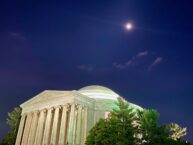
The Declaration of Independence, adopted in 1776, famously appeals to the “Laws of Nature and of Nature’s God.” It also declares that human beings are endowed with certain unalienable rights.
These phrases reflect the influence of natural law, Enlightenment philosophy, and religious ideas about a moral order that exists beyond the will of any particular ruler.
Thomas Jefferson, the principal author of the Declaration, believed that reason was essential to examining religious claims. He rejected many traditional Christian doctrines while maintaining a belief in a creator and the importance of morality. Benjamin Franklin similarly expressed views that combined skepticism toward some religious teachings with a belief in providence and the value of ethical conduct.
George Washington, meanwhile, frequently invoked Providence in public statements, although the precise character of his personal religious beliefs remains a matter of historical debate.
Their views should not be collapsed into one common creed. But they illustrate a recurring idea: human freedom does not necessarily mean living without moral obligations.
Liberty comes with responsibility.
The founding generation confronted a fundamental question that remains unresolved: If human beings possess freedom, what prevents liberty from degenerating into selfishness, exploitation, or the rule of the powerful over the weak? What happened to altruism and its crucial role in humans cooperating in the never ending struggle for survival?
The answer cannot be simply that history will take care of itself. Nor can it be that a supposedly inevitable destiny will guarantee justice.
The American constitutional experiment was built on the recognition that human beings are fallible. Political institutions therefore require checks and balances, public accountability, and mechanisms for correcting abuses of power.
This is a practical philosophy of uncertainty. Instead of trusting that good outcomes are inevitable, it attempts to construct institutions that make better outcomes possible.
The founders’ language of Providence also reflected the belief, common in their era, that human affairs might exist within a larger moral framework. Yet the idea that a nation is favored by God can become dangerous when it is used to justify conquest, inequality, or unquestioned authority.
The more defensible interpretation is that a belief in a moral order should place greater demands on a nation, not fewer.
If liberty and equality are universal principles, they must apply even when doing so is inconvenient to those who hold power.
The deepest lesson of the founding ideal may be that history offers no guarantee of progress. Freedom must be defended, institutions must be improved, and every generation must decide whether it will live up to the principles it has inherited.
Deism: A Clockwork Universe and the Limits of Human Knowledge
Deism offers perhaps the most intriguing philosophical interpretation of the fateful sense of inevitability.
Influenced by the scientific revolution and Enlightenment thinkers, Deists generally believed that the universe was created by an intelligent source whose existence could be understood through reason, observation, and the study of nature. Many rejected the idea that God continually intervenes in the world through miracles or supernatural revelations.
In one influential metaphor, the universe resembles an extraordinarily complex clock. A creator establishes the natural laws, and the machinery of existence proceeds according to those laws.
This metaphor appealed to people who saw scientific discovery as evidence of order rather than chaos. The regular movement of the planets, the predictable behavior of physical forces, and the intricate relationships within nature suggested a universe governed by intelligible principles.
If the universe operates according to consistent laws, one might wonder whether human life follows a similarly determined course.
Modern physics makes the question more complicated. Classical mechanics often permits highly accurate predictions when the relevant conditions are known, but quantum mechanics introduces fundamental limits on certain predictions. Neither fact establishes that human destiny is predetermined, and scientific uncertainty does not itself prove that human beings possess free will.
The relationship between physical causation, consciousness, and human choice remains a difficult philosophical problem.
Still, the Deist perspective offers an important insight: a universe governed by natural laws does not need to be understood as a universe without meaning.
A person can believe that nature operates according to consistent principles while also recognizing the extraordinary importance of human experience, moral judgment, and the relationships that give life significance.
Deism also challenges the assumption that every coincidence must be a supernatural message.
When two people meet at precisely the right moment, when an unexpected opportunity changes the direction of a life, or when a series of circumstances appears to converge toward a particular outcome, the experience may feel like destiny.
But feeling destined and being predetermined are not the same thing.
Human beings are pattern-seeking creatures. We look backward and construct narratives that connect events that once seemed unrelated. Sometimes those connections reveal genuine causal relationships. Sometimes they reflect the meaning we have assigned to experiences after the fact.
Either way, the experience can change how we live.
The Deist tradition encourages us to examine the world with both wonder and reason. It leaves room for reverence without requiring us to abandon critical thought.
Perhaps the universe is more mysterious than we can comprehend. Perhaps our lives emerge from an intricate web of causes and consequences that no individual could ever fully understand.
The appropriate response need not be certainty. It can be humility.
The Strange Feeling That Something Was Meant to Happen
Most people have experienced moments when life seems to possess a direction of its own.
We meet someone by accident and later discover that the encounter changed everything. We lose a job and eventually find work that proves more meaningful. We move to a new town for reasons that seem entirely practical, only to discover friendships, responsibilities, and opportunities that reshape our understanding of who we are.
Looking back, we may say that things happened for a reason.
But what does that really mean?
Perhaps we are recognizing chains of cause and effect that were invisible to us at the time. Perhaps our unconscious minds were responding to circumstances we had not yet learned to articulate. Perhaps the choices of other people, combined with our own decisions, created possibilities that none of us could have anticipated.
Or perhaps there is a dimension of existence that our present understanding cannot adequately explain.
The honest answer is that we do not know.
The danger lies in confusing a powerful personal conviction with proof that the future has already been written. Believing that every event is inevitable can encourage passivity. It can lead us to tolerate injustice, neglect opportunities, or assume that our decisions no longer matter.
Yet the opposite extreme is equally unsatisfying: the belief that we are entirely independent individuals who control our own destinies without being shaped by history, nature, family, circumstance, or the actions of others.
Our lives occupy the space between these extremes.
We inherit conditions we did not choose. We experience events we cannot prevent. We encounter people whose decisions affect us profoundly. Within those circumstances, however, we retain some capacity to choose, to learn, to resist, and to act.
We may not control the road that brought us to a particular crossroads, but we can still participate in deciding which direction to take.
When Destiny Becomes a Moral Obligation
Consider what these philosophical traditions share.
The Bible speaks of seasons, providence, and the limits of human understanding. The Odd Fellows emphasize Friendship, Love, and Truth. The Bahá’í Faith calls humanity toward unity and spiritual development. The American founding tradition places liberty within a framework of natural rights and moral responsibility. Deism encourages contemplation of an ordered universe while relying on reason to understand its workings.
Their differences are real, but a common question runs through them: What should a human being do with the life that has been given?
The most constructive answer is not to wait for destiny to reveal itself.
It is to live as though our decisions matter, because their consequences are real whether or not the universe has a predetermined purpose.
If we encounter suffering, we can relieve it. If we witness injustice, we can challenge it. If we find ourselves in a position to help another person, we can act without demanding proof that the encounter was divinely arranged.
A belief in fate should never become an excuse for cruelty. A belief in Providence should never be used to silence those who seek justice. And a belief in individual freedom should never become an excuse to disregard our obligations to others.
Perhaps the most meaningful expression of spiritual maturity is the willingness to accept uncertainty while continuing to do what is right.
The Odd Fellows’ principles become especially powerful here. Friendship connects us to others. Love moves us beyond indifference. Truth demands that we confront reality rather than retreat into comforting illusions.
The Bahá’í ideal of humanity as one people extends those obligations beyond our immediate circle. The biblical command to love our neighbors challenges us to recognize the dignity of people whose lives, beliefs, and circumstances differ from our own.
And the American ideal of liberty reminds us that freedom is not merely the ability to pursue private desires. It also involves defending the conditions under which other people can live with dignity and exercise their own freedom.
If our lives are connected by a larger pattern, then perhaps our greatest responsibility is to ensure that the pattern we create is worthy of those who come after us.
The Final Inevitability
There is one inevitability that no philosophy can entirely remove from human existence: our lives are finite.
We are born without choosing the circumstances of our birth. We grow older, encounter changes we cannot reverse, and eventually face the reality of death. The people we love will not remain with us forever. The buildings we construct, the institutions we establish, and even the civilizations we celebrate will change or disappear.
Knowing that life is temporary can make our time more precious. Recognizing that we cannot control everything can teach us humility. Understanding that we will never possess complete knowledge can make us more willing to listen to others.
And knowing that our actions affect people beyond ourselves can give ordinary decisions a significance that extends far beyond the moment in which they are made.
Perhaps this is where the different traditions begin to converge—not in a single explanation of how destiny works, but in a shared recognition that the quality of a life cannot be measured solely by its length, wealth, status, or success.
A life can be meaningful because of the suffering it alleviates, the knowledge it contributes, the beauty it creates, the truth it defends, or the love it gives to others.
We may never know whether a particular encounter was inevitable. We may never determine whether Providence guided us to a particular place or whether the apparent pattern emerged from the countless interactions of natural forces and human choices.
But we can decide what to do with the experience. And perhaps that is the most important distinction of all.
The fateful sense of inevitability need not mean that everything has already been decided. It can mean that we have finally recognized the significance of where we stand, the people whose lives intersect with our own, and the responsibilities we can no longer pretend not to see.
The past has brought us here. The future remains uncertain. Between them lies the present moment—the only place where we can act.
If there is a divine purpose, a moral order, or a deeper pattern unfolding through human history, perhaps we discover it not by waiting for the future to prove that everything was meant to happen, but by choosing to make something worthwhile happen now.
And when the end finally comes, perhaps the question will not be whether our lives followed a predetermined path. Perhaps it will be whether, along the way, we practiced friendship, love, and truth; whether we treated our fellow human beings with dignity; whether we defended freedom and justice; and whether we left the world a little better than we found it.
That is a destiny worth choosing, even if we can never know how much of it was written in advance.
Personal Experience
Since I was a small child, and more and more as I grew older and wiser by pursuing an education through reading, conducting research, teaching and yes writing, I rebelled against the notion that a creator controlled human events on Earth. Free will seemed to be the only form of control, and using the human brain was the only mechanism for our individual and collective survival.
The more I traveled around in a camper van on a mission to see, explore and experience America’s natural wonders, however, and as technological and societal changes made living in this capitalist country and world harder, I experienced a series of epiphanies that made it seem as if I was no longer in control of my own destiny. Higher forces seemed to be at work somehow.
Something as transforming as slowing down in daily life and looking up at the stars in a dark night sky made the realization hit home that we are only tiny creatures passing through this short life in a rapidly changing, expanding universe.
As time went by, I too succumbed to some extent to the feeling that something inevitable was going on here, and I was not in total control of my own fate or Destiney. I’ve always believed in luck, as anyone will tell you who has experienced success in life.
I’ve also to some extent believed in a form of Karma, the universal law of cause and effect in Indian philosophy, Hinduism, Buddhism, and Jainism, where every physical or mental action creates a consequence that shapes an individual’s future and cycle of rebirth (samsara). The word comes from the Sanskrit term meaning “action” or “deed.”
So I’ve strived to live my life in a way that did not threaten my own Karma, building it in fact like a type of MoJo, with charisma or guided luck, treating other people with dignity and equality. Call it the Golden Rule if you must. Treat others as you would like to be treated yourself and perhaps the universe will return the favor.
One of the reasons I volunteered with the National Park Service was that it seemed to me that National Park Service rangers are a very special class of professional, literally an American invention that has spread the world over, who embody this way of thinking. Watching them dealing with each other and the public in practice was great training, even perhaps at times when I didn’t always achieve perfection in dealing with people myself. Every human being is flawed in some way. I humbly acknowledge that I am also human, and yes, flawed. Anyone who doesn’t is fooling themselves, and will most likely pay the price somewhere down the road.
A couple of years ago, for example, I went through a year of therapy for “transitional anxiety” since I knew my time in D.C. was going to be up at some point and I needed a plan for what to do next. Dealing with the Covid pandemic had been traumatic, for everyone. Many of my friends in Maryland and Virginia and New York had therapists, so what did I have to lose by trying it? The Biden administration was allocating more money for mental health.
After going through my entire life and resume, we determined that I have never suffered from the same kind of depression many other people face, in some cases chemical imbalances or family difficulties growing up.
My occasional melancholia is caused more by economic insecurity than anything else. And the way I’ve lived my life without selfishness or greed mean I’m not rich, and never wanted to be famous anyway. Who would want that these days?
The famous are constantly and even violently attacked on social media no matter how good they try to be. I’m quite happy to hide out in the mountains to avoid that, do my writing on the web, and build a small social media following of people who agree with most of what I say and do. I have always moderated comments, from the very beginning of the blogging era, when allowing crazy trolls to attack me publicly would have probably generated more traffic and potential revenue.
When I finally got a contract in place to leave D.C. and travel to Arkansas, a 10 year run in a Dodge Roadtrek camper van came to a screeching halt. After making it through the Allegheny Mountains in Virginia and into West Virginia and crossed the The Kanawha River, a tributary of the Ohio, in Charleston, the van began to shake. I found an RV mechanic shop on the iPhone Apple map and pulled off to have it checked out. Without going into all the mechanical details of what happened next, the guys there were responsible for burning the motor out. So my home and transportation for a decade died there by that river.
I kept my cool and did not yell at them or threaten to sue. I just talked to the owner/manager about “divine providence” like George Washington, and he gifted me his old Ford van so I could get on down the road with my stuff.
But before that happened, while I was plugged in to power with internet access in a campsite on the property, I felt it was perhaps the end of the line for me as well as the van. I started praying for help and mercy, and put out a call for funds from my friends, fans, followers and family.
People came through in an amazing way and my prayers were answered. It seemed as if some power up there still had a use for me down here and found a way to help me keep going to fulfill more of my purpose as a journalist and life’s Destiney.
My fans know the rest of this story and how I ended up fulfilling a lifelong dream to make it to California.
Now the artist Walter Simon has joined me, and we will be spending some time in the national park over the next few days and weeks, taking and painting pictures, and communing with nature and Mother Earth. Come by and see us in the Yosemite Arts and Crafts Center on your way to Yosemite.
Mariposa Yosemite Symphony Orchestra Kicks Off 25th Year With Concert in the Ahwahnee Hotel
More Quotes From John Muir from the National Park Service
___
If you support truth in reporting with no paywall, and fearless writing with no popup ads or sponsored content, consider making a contribution today with GoFundMe or Patreon or PayPal.









Fascinating, thank you. Solomon spoke of life as an “illusion,” Jesus mastered quantum physics, different religions offer pathways to enlightenment while other “religions” find ways to justify extermination and aggression. It has been taught (by many) that the Kingdom of God is within YOU. I think this article promotes this truth.