



Is American Health Care Losing the Doctor-Patient Relationship to Corporate Medicine? –
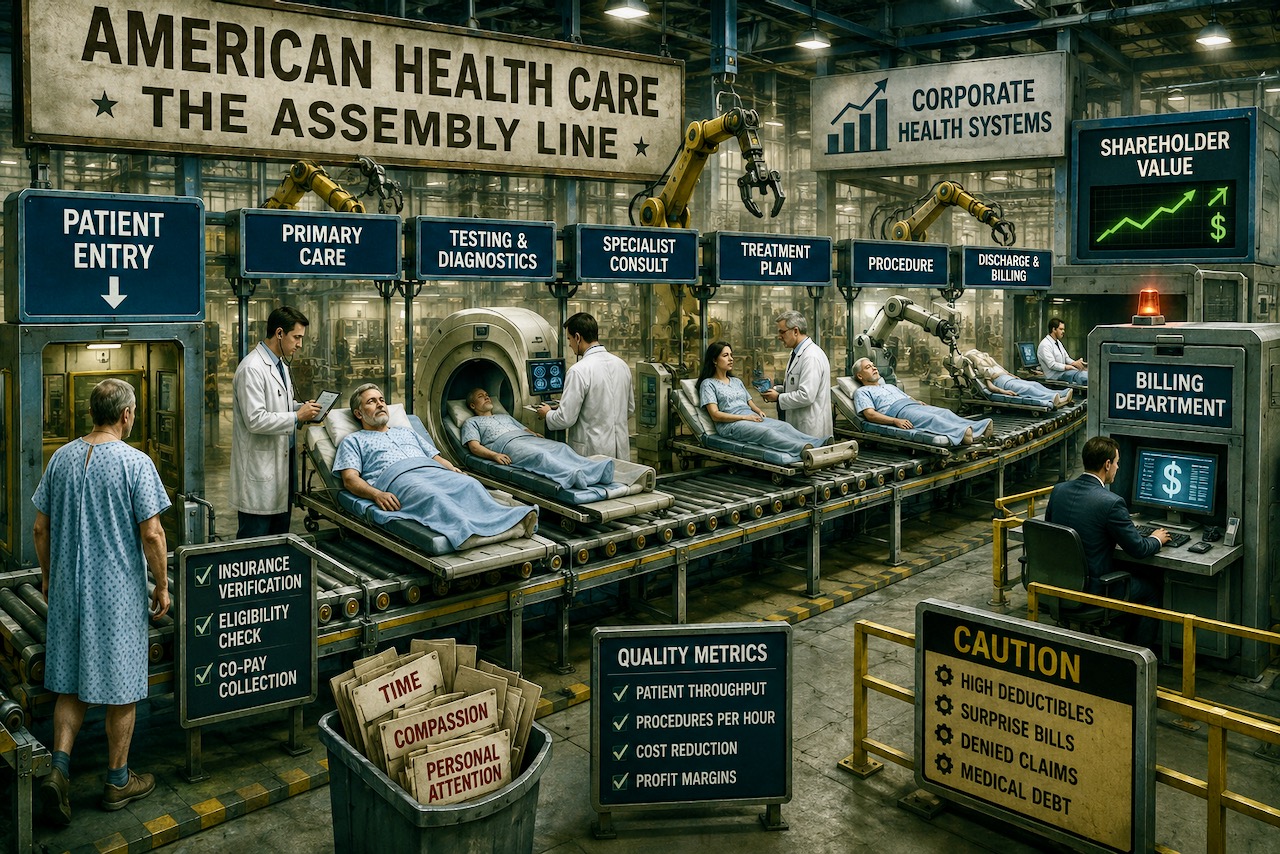
NAJ graphic
The Big Picture –
By Glynn Wilson –
There was a time when going to the doctor meant going to your local doctor, a member of your community who you knew personally.
You knew the physician. The physician knew you.
Your medical history wasn’t simply a collection of electronic records, billing codes and performance metrics. The relationship itself was part of the medicine.
That model hasn’t necessarily disappeared. But it is becoming less common.
American medicine is undergoing a profound transformation in which independent physicians and small practices are increasingly being replaced by corporate chain hospitals, health care “systems,” private insurance companies, private-equity firms and other corporate owners.
The result is a health-care system that can sometimes feel less like an old-fashioned medical practice and more like an industrial production system and a factory assembly line.
The Numbers Tell the Story
According to the American Medical Association’s 2024 Physician Practice Benchmark Survey, only 42.2% of physicians were working in private practices in 2024, compared with 60.1% in 2012.
That’s an extraordinary change in just 12 years, only 14 years after passage of the Affordable Care Act.
At the same time, the percentage of physicians working in practices owned by corporate chain hospitals or health “systems” rose to 34.5%, while another 12% were employed directly by or contracted directly with chain hospitals.
Private equity has also become a growing force. About 6.5% of physicians reported working in private-equity-owned practices in 2024, up from roughly 4.5% in 2020 and 2022.
The Government Accountability Office reached a similar conclusion after reviewing the research through 2025. It found that at least 47% of physicians were employed by or affiliated with hospital systems in 2024, compared with less than 30% in 2012.
The trend is unmistakable.
American doctors are increasingly becoming employees inside larger organizations.
Cardiology Is on the Front Line
The trend is particularly relevant to the cardiology story in the U.S. and California.
Only 30.7% of cardiologists were working in private practices in 2024, according to the AMA.
That means nearly seven out of every 10 cardiologists were working in some arrangement other than a traditional physician-owned private practice.
This helps explain why cardiology is increasingly organized around large hospital systems, cardiovascular institutes and integrated networks.
There are legitimate advantages. A large system can afford expensive imaging equipment, catheterization laboratories, surgical facilities, electronic medical-record systems and teams of specialists that a small independent practice could never afford.
It can coordinate care, while keeping patients inside a single system.
It can also provide 24-hour emergency coverage.
Those are real benefits.
But consolidation also creates a different problem.
Who ultimately controls the doctor’s decisions?
The Assembly Line
Imagine a factory. Raw materials come in. Workers perform standardized processes. Each step is measured. Productivity is tracked. Managers monitor throughput. Costs are calculated. Targets are established.
The objective is to produce more output, more efficiently and at lower cost.
Now imagine applying that philosophy to medicine.
A patient arrives. A nurse enters vital signs. A medical assistant updates the medication list. The physician finally enters the room. The electronic medical record displays a series of alerts.
The doctor asks a predetermined series of questions. Tests are ordered. Diagnosis codes are entered. The patient is moved through the system.
Another patient is waiting. And another.
The physician has a schedule to maintain.
The organization has productivity targets.
Insurance companies have authorization requirements.
Administrators monitor performance.
The doctor eventually moves on to the next patient.
That doesn’t mean the physician doesn’t care.
Quite often, the doctor may be fighting the system in order to care for the patient.
The Doctor’s Time Has Become a Commodity
This may be the most important change of all.
When physicians work inside large organizations, their time becomes an economic resource that can be measured.
How many patients can be seen? How many procedures can be performed? How many tests are ordered? How quickly are appointments completed? How much revenue does a physician generate?
Those aren’t necessarily unreasonable questions. Hospitals have enormous costs. Medical equipment is expensive. Nurses and technicians have to be paid. Buildings have to be maintained. Insurance companies have to be billed.
But when productivity becomes the dominant measure of medical performance, something potentially valuable can be squeezed out:
Time.
The time to listen. The time to explain. The time to notice something unusual. The time to think of and ask the question that isn’t on the checklist. The time to know the patient as a person rather than as a diagnosis.
Why Doctors Leave Private Practice
There is another side to the story.
It would be unfair to portray corporate medicine as something doctors simply chose because they wanted bigger salaries or less responsibility. The economics have pushed many physicians in that direction.
The AMA reports that doctors cited inadequate payment rates, rising practice costs and burdensome regulatory and administrative requirements among the longstanding pressures driving physicians away from independent practice. Medicare physician payment, after adjusting for inflation in practice costs, has fallen substantially over the past quarter-century.
In other words, the independent doctor may be getting squeezed from both directions.
The doctor has to deal with insurance companies. Government regulations. Electronic records. Malpractice insurance. Staffing. Rent. Technology. Billing. Prior authorization. And declining reimbursements.
A large health system can absorb those costs. A solo physician often cannot. So consolidation becomes a survival strategy.
The Corporate Answer
The corporate solution is familiar.
Buy the practice. Hire the physicians. Centralize billing. Centralize purchasing. Standardize procedures. Create a common electronic-record system. Build centralized scheduling. Measure performance. Negotiate with insurers.
And of course, increase market share.
From a business perspective, it makes perfect sense. But medicine isn’t manufacturing.
A heart isn’t a widget. A patient isn’t raw material.
And a cardiologist, for example, isn’t supposed to be merely a highly trained production worker. The same goes for nurses.
Consolidation Can Raise Prices
There is another uncomfortable part of the story.
Consolidation is often justified as a way to make medicine more efficient. But the research doesn’t consistently show that consolidation produces cheaper care.
KFF’s review of the evidence found that hospital and physician consolidation generally leads to higher health-care prices, while the evidence does not demonstrate clear improvements in access or quality.
The organization becomes bigger. The negotiating power becomes greater.
But the patient’s bill doesn’t necessarily become smaller. In some circumstances, the opposite happens.
A physician practice that once operated independently may become part of a hospital system. The same basic service can then be billed under a hospital outpatient structure, potentially producing higher reimbursement than when the service was delivered in an independent physician office.
Private Equity Takes It Another Step
Private equity introduces another economic philosophy.
A private-equity firm typically invests money with the expectation of eventually generating a financial return.
That doesn’t automatically mean bad medicine. Investment can provide capital for technology, expansion and improved facilities.
But health care is unusual because the person receiving the service is often not the person paying the bill.
The physician may be making the clinical decision. The hospital may be billing for it. The insurance company may be paying for it. And an investment company may ultimately own the organization.
Those competing incentives can become complicated.
The federal GAO concluded in 2025 that private-equity ownership of physician practices remains a relatively small but growing share nationally, although its presence varies considerably by specialty and geography.
The Patient Becomes the Last Person in the Room
There is an irony here.
America has developed extraordinary medical technology. We have robotic surgery. Advanced cardiac imaging. Artificial valves. Genetic testing.
And now, Artificial Intelligence, or A.I.
This can help increase the precision of medical care, with procedures that would have seemed like science fiction a generation ago.
Yet the basic complaint heard from many patients is remarkably old-fashioned:
“My doctor didn’t have time to listen to me.”
That may be the central paradox of modern American medicine.
The system can perform increasingly sophisticated procedures while simultaneously making the human relationship between doctor and patient more difficult to maintain.
Is Corporate Medicine All Bad?
No. That would be too simplistic.
Large systems can provide capabilities that small practices cannot. They can keep specialists, emergency departments, surgeons, nurses and diagnostic facilities connected. They can negotiate better contracts. They can invest millions of dollars in technology. They can provide services in rural communities that might otherwise disappear.
And some physicians may actually prefer employment because it removes the burden of running a small business.
The question isn’t whether corporations should have any role in medicine. They already do.
The question is:
How much corporate control is compatible with medicine remaining a profession rather than becoming primarily an industry?
What Should We Measure?
If American medicine wants to know whether the system is working, perhaps it should measure more than revenue.
For instance, how much time does a physician actually spend with each patient?
How many patients does a doctor see in a day?
How often are appointments delayed, and how much time do patients spend waiting?
How frequently are unnecessary tests performed?
How much time do doctors spend on electronic records rather than patients?
How often do patients see the same physician?
How quickly can someone obtain an appointment?
What are the actual outcomes?
What are the complication and readmission rates?
And perhaps most importantly:
Do patients feel that somebody in the system actually knows them?
Medicine needs systems. But patients need doctors.
And the challenge for American health care in the coming decade may be figuring out how to build enormous medical organizations without losing the very human relationship upon which the profession was founded.
Because when health care begins to resemble an assembly line, the danger isn’t necessarily that the machines will replace the doctors. The danger is that the system will leave too little time for the doctors to be doctors.
__
Next, we will report on how the Affordable Care Act changed American health care. Then we will show how the Trump administration is changing it again. And finally, we write about what the world will be like in 10 years, when there will be nine billion people on a planet devastated by climate change.
Part I – Facts Matter: The State of Health Care in America
Part III – The Affordable Care Act and the Corporate Transformation of American Medicine
Part IV – Trump’s Changes to American Health Care
Part V – Nine Billion People on a Warming Planet: Humanity’s Next Great Test
___
If you support truth in reporting with no paywall, and fearless writing with no popup ads or sponsored content, consider making a contribution today with GoFundMe or Patreon or PayPal.










It doesn’t take a genius to realize the healthcare system we choose in this country is in trouble. However, I have it better than most as I, like every member of Congress, have SOCIALIZED medicine (not available to the masses because that would mean corporations would have to pay taxes). My veteran healthcare providers, when I was in Alabama, gripped to me that they had 20 minutes to see and evaluate me; write prescriptions; and do their patient report before seeing the next veteran on the assembly line. This put them under a great deal of stress. My primary care physician called me into the examining room while he was finishing the paperwork on the last veteran. I could tell he was stressed when he asked the question, as he was actively writing, “How are you doing. What brings you in here today.” I decided to conduct a test and clearly answered “When I walk out of this room, I will probably kill the first six people I meet.” His reply was “Un-Huh” as his eyes were glued on the report he was writing about the last patient. This pretty much sums up the system we allow politicians to give us.