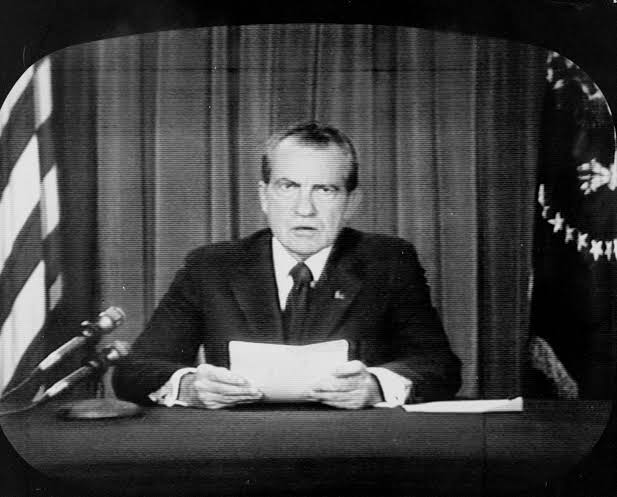
President Richard Nixon resigns on national television on August 8, 1974. NAJ screen shot
The Big Picture –
By Glynn Wilson –
YOSEMITE NATIONAL PARK, Calif. – In yet another blatant attempt to rewrite American history to favor corruption of the United States government, the Trump administration is now promoting a ridiculous conspiracy theory that a “deep state” brought down Republican President Richard Nixon.
The fact is he resigned as president on August 8, 1974 facing inevitable impeachment in the House for his crimes leading up to and including the Watergate scandal. He also faced nearly certain conviction in the Senate and removal from office.
He could have also been the first president to face a public trial and jail time had he not been pardoned by Gerald Ford, his Vice President who was sworn in as president but lost reelection to Georgia Democrat Jimmy Carter in 1976.
In an extraordinary editorial in the New York Times, 10 members of a Watergate Special Prosecution Force argue that this “deep state” conspiracy is absurd.
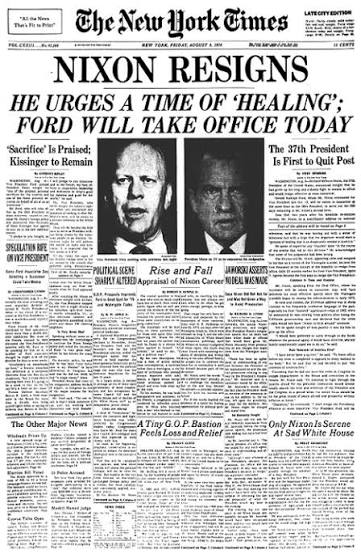
The New York Times front page banner headline when Nixon resigned the presidency. NAJ screen shot
One of President Richard Nixon’s longtime defenders recently gave a presentation to Justice Department officials, arguing that Nixon and a clutch of his lieutenants were mistreated in the Watergate investigation. In June, Vice President JD Vance claimed that the “deep state took down” Nixon, adding, “It’s not all that different from what the same groups of people, the same institutions, tried to do to Donald Trump.”
In July, The Wall Street Journal reported that Nixon, who left office in disgrace, is enjoying something of a revival on the political right.
But the authors who served on the Watergate Special Prosecution Force say: “There is, however, no justifiable rationale for relitigating Watergate or absolving Nixon.”
The ‘Deep State’ Didn’t Take Nixon Down. Nixon Did.
“As lawyers who helped conduct the Watergate investigation, we can attest that Nixon, not some mythical ‘deep state,’ was the cause of his own political demise and his henchmen who went to prison did so because of overwhelming evidence of their guilt. Indeed, the principal sources of this evidence were the testimonies of former members of Nixon’s staff and Oval Office recordings. Any suggestion that the former president and his aides got a raw deal or that Watergate was an anti-Nixon plot is nonsense.”
Mark Felt: Deep Throat

It is mere coincidence that the night before this op-ed dropped, I watched the movie “Mark Felt: The Man Who Brought Down the White House,” an American biographical political thriller film released in 2017. It was written and directed by Peter Landesman, and based on the 2006 autobiography of FBI agent Mark Felt, written with John O’Connor.
The film depicts how Felt became the anonymous source nicknamed “Deep Throat” for reporters Bob Woodward and Carl Bernstein as well as Time magazine and helped them in their investigation of the Watergate scandal, which resulted in Nixon’s resignation.
If you want to know the truth about Nixon and Watergate, this film would be a good place to start. It stars Liam Neeson, Diane Lane, Tony Goldwyn, and Maika Monroe and premiered at the Toronto International Film Festival on September 8, and was theatrically released on September 29, 2017, by Sony Pictures Classics. It is also the fourth film on the Watergate scandal, following “All the President’s Men” (1976), “The Final Days” (1989), and “Dick” (1999).
The movie starts on April 11, 1972. Nixon’s advisers at the White House ask Mark Felt how to ask J. Edgar Hoover to step aside as the FBI director. Some days later, Hoover dies. Nixon appoints Pat Gray as acting FBI director. In June 1972, several ex-C.I.A. and F.B.I. agents burglarize the Watergate hotel to bug the headquarters of the Democratic National Committee.
After members of the Weather Underground bomb the Pentagon, Nixon’s Attorney General Richard Kleindienst announced that the Watergate investigation concluded without the White House or CREEP (Nixon’s Committee to Elect the President) being implicated.
Nixon’s appointee to run the F.B.I. was Pat Gray, but his Senate confirmation hearings got derailed when it came to light that he was sending the F.B.I. investigative files to the White House against F.B.I. policy as an independent law enforcement agency.
In the Times editorial, the attorneys summarize the Watergate scandal.
In June 1972 a group of operatives broke into the offices of the Democratic National Committee at the Watergate complex in Washington. Evidence later came to light that some of Nixon’s advisers had played a role in the scheme and that Nixon and several senior White House staff members had tried to cover it up.
This wasn’t the only Nixon scandal. Some of the same figures were convicted in connection with a break-in at the office of the psychiatrist of Daniel Ellsberg, the whistle-blower who had disclosed the Pentagon Papers.
The Nixon scandals also included a raft of high-dollar illegal contributions to his re-election campaign, a White House-linked effort to disrupt the 1972 Democratic presidential campaign and wiretaps of journalists and White House staff members.
In March 1973, after being convicted in the Watergate burglary case, James McCord — a former security coordinator for Nixon’s re-election committee — wrote a letter to John Sirica, the chief judge of the U.S. District Court for the District of Columbia, asserting that additional unnamed individuals had also been responsible for the break-in and that “political pressure” had been applied to cover up their involvement.
In June 1973, Jeb Magruder, a former deputy director of Nixon’s re-election committee, testified before a Senate committee that former Attorney General John Mitchell, Nixon’s re-election committee chair, had approved the Watergate break-in.
The case against Nixon and his confederates became even stronger when, a few days later, John Dean, Nixon’s former White House counsel, told senators that Nixon and his chief of staff, H.R. Haldeman, played central roles in the cover-up.
In July 1973 it was disclosed in Senate testimony that Nixon tape-recorded nearly all of his Oval Office conversations. Those tapes allowed the jury in the cover-up trial to hear Nixon and others discussing efforts to thwart the Watergate investigation. They included the “smoking gun” tape on which Nixon is heard discussing, just days after the break-in, using the C.I.A. to sidetrack F.B.I. investigators.
In July 1974, in a series of bipartisan votes, the House Judiciary Committee resolved to send articles of impeachment against Nixon to the full House. In the days that followed, the G.O.P. stalwart Senator Barry Goldwater and other leading congressional Republicans conveyed to Nixon that his chances of avoiding impeachment by the House and conviction by the Senate were all but hopeless. Nixon resigned and was later pardoned by his successor Gerald Ford.
In January 1975, Mr. Mitchell; Mr. Haldeman; John Ehrlichman, a former assistant to the president; and Robert Mardian, a former assistant attorney general, were convicted of cover-up-related crimes. They went on to appeal their convictions to the U.S. Court of Appeals for the District of Columbia. Only Mr. Mardian’s conviction was overturned, and the Supreme Court declined to hear further appeals. Gordon Strachan, a former Haldeman aide, was indicted, but the charges against him were eventually dropped. Kenneth Parkinson, a lawyer for Nixon’s re-election committee, was acquitted at trial. Charles Colson, a former special counsel to Nixon, pleaded guilty to a crime related to the break-in at Mr. Ellsberg’s psychiatrist’s office.
Clearly today there is an effort to redeem Nixon by rewriting history. Some of his defenders have questioned Mr. Dean’s credibility and the ethics of Watergate prosecutors,” the attorneys argue. “One argument goes something like this: Prosecutors improperly withheld internal special prosecutor’s office memos that assessed Mr. Dean’s testimony — an allegation with no basis.
Defense lawyers were provided with the underlying materials that the prosecutors used in preparing the internal memos. And defense lawyers were able to use these materials to cross-examine Mr. Dean at trial. But while prosecutors are legally required to provide such materials to the defense, prosecutors aren’t required to turn over their internal analyses of those materials — and they aren’t required to do defense attorneys’ work for them.
Some of Nixon’s defenders also contend that the cover-up trial was prejudiced by pretrial meetings between the special prosecutor Leon Jaworski and Judge Sirica. That allegation also has no basis. (And it whistles past a crucial detail: Mr. Jaworski became the special prosecutor only after Nixon abruptly ordered the firing of his predecessor Archibald Cox over a legal dispute about disclosure of the tapes.)
Grand jury proceedings, unlike those of trial juries, are conducted by prosecutors under the supervision of a judge and do not involve defense counsel. Some meetings involved procedural matters such as the timing of indictments. Others dealt with an unusual issue: how to appropriately present a report of the grand jury’s findings on Nixon — who was not indicted — to the House Judiciary Committee.
In March 1974, Judge Sirica ordered that the report be sent to Congress, and his decision was upheld by the Court of Appeals.
At one point in the case, the defendants tried to disqualify Judge Sirica, maintaining that he was biased in favor of prosecutors. But in July 1974 five judges on the Court of Appeals rejected the disqualification effort, with one judge dissenting.
To our knowledge, none of the pretrial meetings involved inappropriate discussion of evidence or trial tactics, and we are aware of no evidence to the contrary. And it bears mentioning the obvious: It was the trial jurors, not Judge Sirica, who found Mr. Mitchell, Mr. Haldeman and Mr. Ehrlichman guilty beyond a reasonable doubt.
Having been directly involved in such a pivotal chapter in American history, we welcome any good-faith revisiting of the facts. Sadly, the recent history of the Justice Department leaves little doubt that its leadership is bent on advancing whatever narrative suits President Trump and cannot be depended on to provide such a review. In light of that and Mr. Vance’s comment, it is not unreasonable to be concerned that the purpose of any review by this department is to twist the Watergate story to bolster the idea that Mr. Trump has been the victim of a “deep state” conspiracy akin to what Mr. Vance has said about Nixon.
What we know is that in Watergate, on the basis of the evidence, Congress proceeded toward an impeachment of Nixon as provided in the Constitution and that the cover-up defendants were afforded the due process of law that our Constitution requires.
The Watergate investigations are not an example of injustice. They are, rather, an example of the rule of law being vindicated.
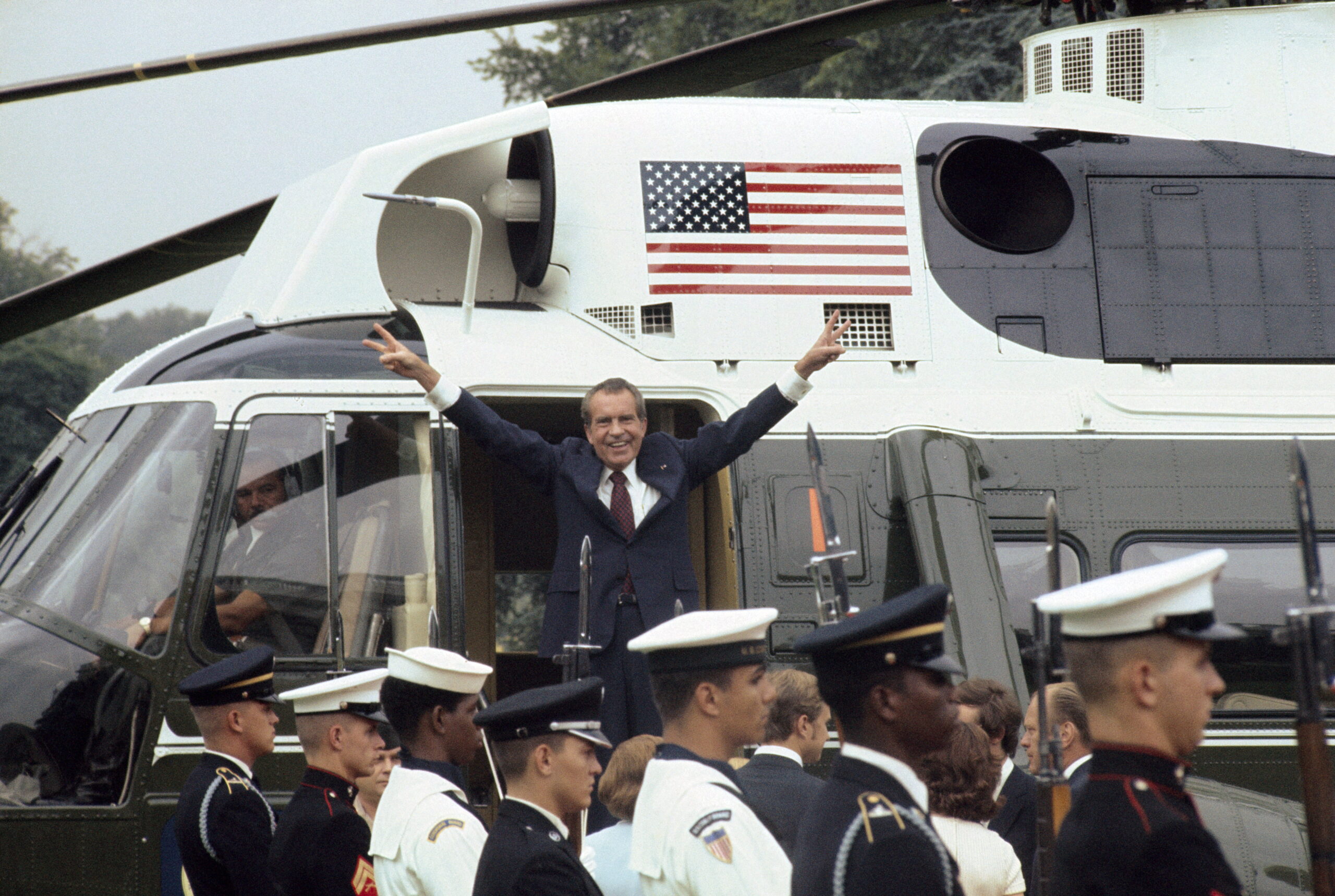
As he boards the White House helicopter Marine One after resigning the presidency, Richard Nixon smiles and gives the victory sign even in defeat. NAJ screen shot
Voters to the Polls
Americans will go to the polls on Nov. 3 to vote in the midterm elections. We do not believe that this administration’s attempt to exonerate Nixon will help their cause with voters. We have a chance here and now to hold this administration to account for Trump’s crimes.
We will see on Tuesday and the following days whether American democracy still has a chance to survive in a world gone mad, ensconced in chaos, confusion and scandals far more grave than those that plagued this country in the Nixon years. Vote like our lives depend on it. They do.
___
If you support truth in reporting with no paywall, and fearless writing with no popup ads or sponsored content, consider making a contribution today with GoFundMe or Patreon or PayPal.