




The Big Picture –
By Glynn Wilson –
While I was off-grid camping in Yosemite, The New York Times began running a series marking its 175th anniversary.
The New York Times at 175: A series exploring an active legacy of independent, eyewitness reporting.
Perusing the story headlines gave me an idea. If you are a paying subscriber, you might try it. Search the amazing online archives for the front page of the daily newspaper on the day you were born.
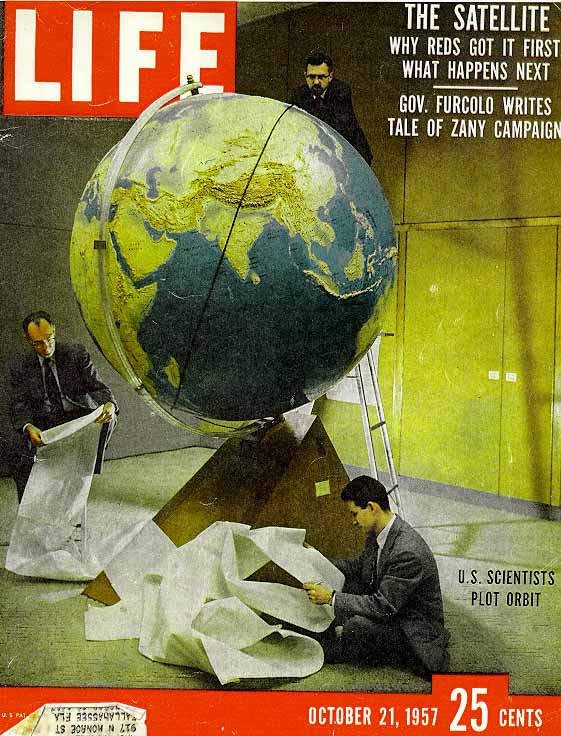
In my case, that would be Tuesday, October 15, 1957. Scanning the front page stories for that day, one jumped out, a followup story about Russia’s Sputnik satellite launched to orbit the Earth on Oct. 4. Scientists and historians now point to the Russian first as the event that launched the space race and accelerated the arms race.
The cover of Life magazine for October had a picture of it and a story about the event.
Trump Administration Admits for the First Time that the U.S. Has Deployed Weapons in Space
Now what makes this particularly interesting today is that just last week, the Times carried a story about the Trump administration’s unilateral decision to place perhaps nuclear weapons in space, a first that was carried out without any advance warning to American allies or adversaries, Congress or the American people.
U.S. Has Deployed Weapons in Space, Air Force Secretary Says
Now do you believe me when I write that we are living in a crazy world gone mad?
This May Be Our Last Chance to Save the World
The United States has stationed weapons in Earth’s orbit, Air Force Secretary Troy E. Meink said on Monday, the first such public acknowledgment by a Pentagon official after years of preparations to counter potential deployments by Russia and China.
“We are increasing readiness against existing threats, and the United States has on-orbit space control weapons capable of defending the Joint Force against hostile adversary action,” he said at a convention in Maryland, according to a news release published on the Air Force’s website.
Meink did not provide details about the type of weapons or say when they had been deployed. He made his remarks in a keynote speech at the Air, Space and Cyber Conference in National Harbor, Md., an annual forum hosted by the Air and Space Forces Association, a nonprofit organization for members of both services.
The Space Force did not immediately respond to a request for comment late Monday.
The Pentagon has long feared that China and Russia are making advances in space operations that could threaten U.S. ground forces as well as American satellites.
No proof of this was offered.
Guo Jiakun, a spokesman for China’s Foreign Ministry, said on Tuesday in response to a question about Mr. Meink’s comments that China opposed an “outer space arms race.”
“We urge the U.S. side to stop expanding its military force and preparing for war in outer space,” he said in a regular news briefing.
Dmitri S. Peskov, the Kremlin spokesman, said on Tuesday that Russia would seek an international consensus on the demilitarization of space.
“We believe that space must be free of any weapons,” he said at a news briefing, according to state media, although Russia’s dictator president Vladimir Putin is just as untrustworthy as Caeser wannabe Donald Trump.
The Trump Dividend and the Bribe of Gold by Roman Emperor Commodus as the Roman Empire Falls
The New York Times reported in 2024 that American intelligence agencies had raised concerns that Russia could be planning to put a nuclear weapon in space, a threat that could disrupt satellite networks that are vital to everything from communications to military operations.
But no one provided any evidence that this had actually happened.
Shortly after Trump returned to the White House last year, he signed an executive order to expand American air defenses, including the development and deployment of “space-based interceptors.” The project, named the Golden Dome, would be designed to guard against weapons such as hypersonic missiles, which Russia has deployed in Ukraine.
In May, Trump said that Gen. Michael Guetlein, the vice chief of space operations at the Space Force, would oversee the project.
The United States, Russia and China began testing weapons capable of destroying satellites decades ago, but the United States has since disavowed such arms because they leave destructive debris fields in orbit.
In recent years, the Air Force started developing “low-debris-causing weapons” capable of disrupting or disabling enemy satellites, Frank Kendall, who served as Air Force secretary under President Joe Biden, told The Times in a 2024 interview.
Gen. Chance Saltzman, who served as the Space Force’s chief of space operations during the Biden and second Trump administrations until his retirement last month, told a Senate committee in 2023 that the new space weapons systems would be fully operational by 2026.
Neither Kendall nor Gen. Saltzman specified how the systems would work. Other former Pentagon officials have said they likely would include lasers, high-powered microwave systems or even U.S. satellites that can grab or move enemy satellites.
Kendall said in 2024 that it was prudent to recognize that space “is a place that can be used for military advantage.”
“The threat is there,” he said at the time. “It’s a domain we have to be competitive in.”
Treaties
But the U.S., Russia, China and other nuclear countries have long abided by the Outer Space Treaty written, negotiated and signed in 1966.
Key Provisions
Weapons of Mass Destruction: Article IV bans countries from placing nuclear weapons or other weapons of mass destruction (WMD) in Earth’s orbit, on celestial bodies like the Moon, or stationing them in space in any other way.
Celestial Bodies: The Moon and other celestial bodies must be used exclusively for peaceful purposes. Building military bases, testing any weapons, or conducting military maneuvers on them is strictly forbidden.
The Loophole: The treaty does not explicitly ban conventional weapons, electronic jamming equipment, or anti-satellite systems in Earth orbit, creating legal gray areas that major spacefaring nations continue to navigate.
Related Agreements
Limited Test Ban Treaty (1963): Prohibited nuclear weapon tests in the atmosphere, underwater, and in outer space.
Anti-Ballistic Missile (ABM) Treaty (1972): Previously restricted space-based missile defense systems.
But it became null when the George W. Bush administration withdrew the United States in 2002 after Putin did the same in Russia.
Sputnik Launched in 1957
What’s really interesting about the Times story from Oct. 15, 1957, is that it mentions a U.S. proposal agreed to by Britain at the United Nations to “discuss means to insure that outer space be used solely for peaceful purposes.”
There was pressure from Democrats in Congress on Republican President Eisenhower to speed up the development of intercontinental ballistic missiles, satellites, anti-submarine and anti-ballistic missile programs.
“There had better be a speedup if the United States is to remain a free nation,” said Senator Stuart Symington, a Democrat from Missouri and a member of the Senate Armed Services Committee and Secretary of the Air Force in the Truman Administration.
Isn’t it interesting how history repeats itself, with a twist?
___
If you support truth in reporting with no paywall, and fearless writing with no popup ads or sponsored content, consider making a contribution today with GoFundMe or Patreon or PayPal.












Eisenhower began Operation Blue Book shielding we commoners from what was actually happening in space and that misinformation discrediting campaign has been the government standard since. Reagan came close to releasing some of the truth but instead attempted to get some type of global Star Wars defense system deployed using possible threats from “the Russians” as an excuse. Chile, China, and to an extent other nations as Peru have more open national space policies that include, without intimidation or stigma, all interested element of society. Maybe one day America will get to this point?