



The Big Picture –
By Glynn Wilson –
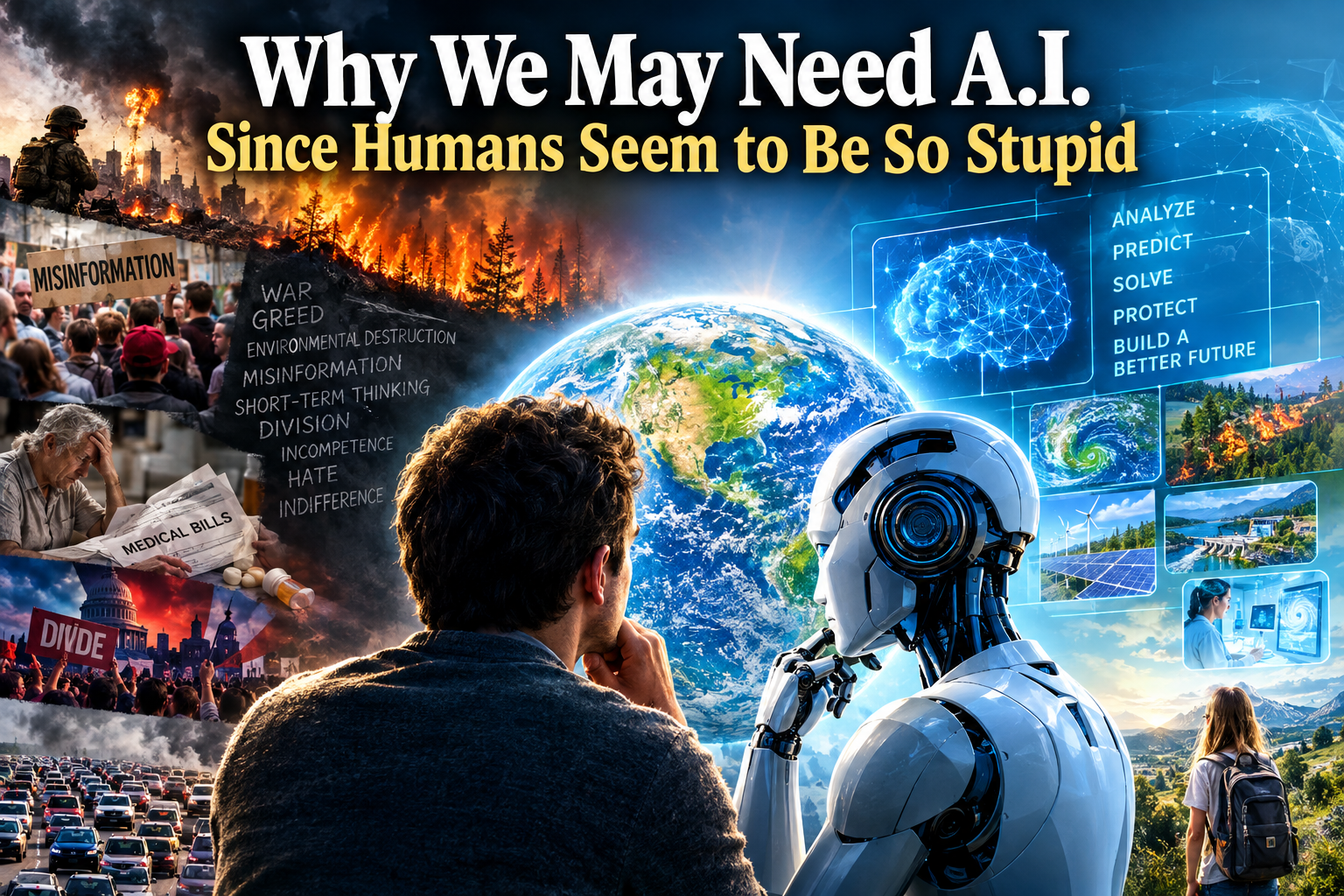
There is an uncomfortable question emerging from the artificial-intelligence revolution: What if one reason we need A.I. is because human beings are not nearly as smart as they think we are?
Humans built civilization. Split the atom. Landed on the Moon. Mapped the human genome. Created antibiotics, computers and the internet.
And yet, somehow, humans seem unbelievably adept at destroying things they depend on.
Nations go to war even when we know war will kill people who had nothing to do with the argument. We continue to burn fossil fuels knowing what greenhouse gases do to the atmosphere. Politicians allow millions of people to go without adequate health care while spending enormous sums treating preventable illnesses. Humens create technologies faster than they develop rules for using them responsibly.
And then we act surprised when things go wrong.
Perhaps the greatest irony of the 21st century is that humans have developed machines capable of extraordinary computation while continuing to make decisions based on fear, tribalism, greed, misinformation, anger and short-term self-interest.
That raises a provocative possibility.
Maybe A.I. isn’t being developed merely to replace human labor. Maybe it will eventually be needed to compensate for human limitations.
The problem isn’t that humans are unintelligent. Calling people “stupid” is obviously an oversimplification.
Human beings possess something extraordinary: the ability to imagine things that do not yet exist and then build them.
But intelligence and wisdom are not the same thing.
A person can be extremely intelligent and still make terrible decisions.
Human brains evolved primarily to help relatively small groups of people survive immediate threats. Modern civilization, however, requires billions of people to cooperate across enormous distances and time scales.
Climate change is a perfect example.
The atmosphere doesn’t care about national borders. Carbon dioxide released in one country affects the entire planet. The consequences may unfold over decades.
But political systems operate on election cycles. Corporations operate on quarterly financial results. Individuals naturally worry about what happens this afternoon, tomorrow or next year.
Humans are being asked to solve planetary problems with psychological and political systems that evolved for much smaller problems.
A.I. doesn’t get tired of the numbers.
This is where artificial intelligence could become extraordinarily useful.
A.I. can examine enormous quantities of information without becoming bored.
It can compare thousands of variables simultaneously. It can model possible consequences. It can identify patterns humans might overlook.
Imagine applying that capability to wildfire management.
Instead of simply reacting after a fire begins, increasingly sophisticated systems could analyze weather, vegetation, terrain, fuel loads, drought conditions, wind patterns and human development to identify dangerous combinations before they become disasters.
The same principle could apply to water management, disease detection, energy systems, transportation and emergency response.
The machine doesn’t have to be wiser than humanity. It simply has to help us see what we cannot see.
But there is a catch A.I. is not an oracle.
It is built by humans, trained on human-generated information and deployed by human institutions.
That means it can inherit our prejudices, mistakes and ambitions.
An A.I. system designed to maximize profits may discover ways to make more money while ignoring social consequences.
A military A.I. could potentially make warfare faster rather than preventing it.
A political system could use A.I. to manipulate citizens instead of informing them.
And a badly designed autonomous system could make a mistake at machine speed.
“So the question isn’t whether A.I. will save humanity,” one A.I. Bot said. “It won’t.”
The more important question is whether humans can learn to use A.I. as a tool for overcoming some of our predictable weaknesses without handing over the responsibility for civilization itself.
Perhaps the smartest thing humans can do is admit our limitations.
There is something almost poetic about this moment in history.
For thousands of years, human beings have assumed that intelligence was our great advantage over every other species. Now we are creating machines that can outperform us at particular intellectual tasks.
That should not necessarily be frightening. It could be humbling. And humility may be precisely what we need.
A.I. could help us distinguish between what we know and what we merely believe. It could force us to examine evidence rather than instinct. It could expose contradictions in complicated systems that are too large for any individual human brain to comprehend.
It could become something resembling a second set of eyes for civilization.
But only if we use it that way.
The real danger may not be A.I.
The greatest danger may be humans using increasingly powerful technology without becoming more responsible ourselves.
We have already demonstrated that technological capability can advance much faster than moral wisdom.
The automobile transformed transportation. The airplane transformed the planet. Nuclear weapons transformed warfare. The internet transformed information.
A.I. may transform decision-making itself. That could be one of the most consequential changes in human history.
And perhaps the question shouldn’t be: “Will A.I. become smarter than humans?”
Maybe the better question is: “Can humans become wise enough to use something smarter than ourselves?”
Because if history teaches us anything, it is that intelligence alone has never guaranteed good judgment.
Humanity may not need A.I. because humans are stupid. We may need it because human intelligence has limits – and our problems have finally become bigger than any one human brain can handle.
The challenge will be making sure that A.I. becomes a tool for expanding human wisdom rather than simply amplifying human stupidity. That may ultimately be the real test of the machine age.
“Not whether machines can think like humans,” the A.I. Bot said. “But whether humans can learn to think better with machines.”
___
If you support truth in reporting with no paywall, and fearless writing with no popup ads or sponsored content, consider making a contribution today with GoFundMe or Patreon or PayPal.










Incredibly well thought out with thoughts we should all consider.