



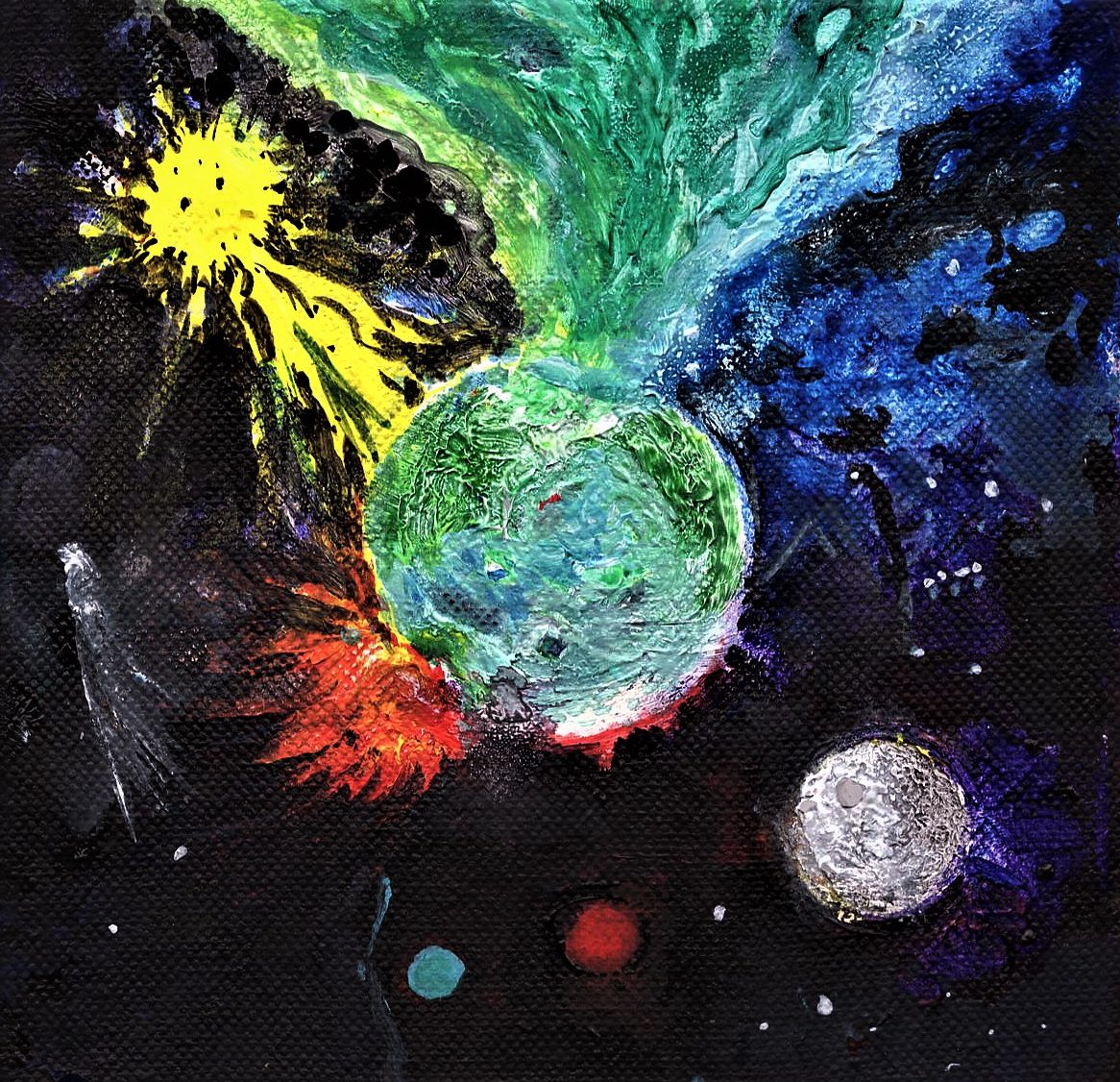
Earth Hanging in the Balance – A New American Journal graphic by Walter Simon [Art Market Place]
You don’t have to read this. You can listen and watch on YouTube.
The Big Picture –
By Glynn Wilson –
From the forests of northern Canada to the mountains of California and the hills of southern Europe, smoke has become one of the defining images of summer.
Wildfires that were once considered seasonal disasters are increasingly becoming year-round emergencies, driven by hotter temperatures, prolonged drought and changing weather patterns associated with human-caused climate change due to global warming from the burning of fossil fuels.
Scientists reached an overwhelming consensus many years ago that the Earth’s climate is changing and warming primarily because of greenhouse gases released from burning coal, oil and natural gas. As the atmosphere warms, it draws more moisture from soils and vegetation, creating the dry conditions that allow fires to ignite more easily and spread more rapidly. This also destroys natural sinks that soak up and store carbon that is heating up the planet when released into the atmosphere.
Climate change does not cause every wildfire, but it significantly increases the likelihood of extreme weather and lengthens the fire season. The numbers tell a sobering story.
In the United States, more than 3.9 million acres had burned by late July 2026, according to the National Interagency Fire Center, with dozens of large fires still actively burning across the West.
Canada has endured another severe wildfire season. By late July, roughly 3 million hectares — about 7.4 million acres — had burned across the country, with hundreds of active fires continuing to produce smoke that drifted thousands of miles into the United States, causing bad air and making people sick.
Across the European Union, the Copernicus Emergency Management Service reported more than 254,000 hectares burned by late July — approximately 628,000 acres — already above the long-term average. Greece, Spain, France, Italy and Portugal have all battled destructive fires fueled by record heat and drought, and political inaction.
The consequences extend far beyond burned forests. Smoke degrades air quality for millions of people. Entire communities have been evacuated. Wildlife habitat is destroyed. Watersheds are damaged, increasing the risk of floods and mudslides long after the flames are extinguished. Firefighters are stretched to their limits as seasons grow longer and fires become more intense.
Yet despite increasingly visible evidence, public response often appears muted.
Researchers who study climate communication point to several reasons. Climate change unfolds over decades, making it difficult for many people to perceive it as an immediate personal threat. People also experience “normalcy bias,” the tendency to assume tomorrow will resemble yesterday even when evidence suggests otherwise. Economic concerns, political identity and information overload can all reduce public engagement.
Another factor is the modern information environment. For decades, some political leaders, advocacy groups, and organizations with ties to fossil fuel interests have questioned or minimized the scientific consensus on climate change, while on the other side, many have emphasized the urgency of reducing greenhouse-gas emissions. Studies in political science and communication have found that conflicting messages from influential leaders can increase public confusion and polarization, making collective action more difficult. That does not mean misinformation is the only reason people fail to act, but researchers consider it one significant contributor alongside economic interests, institutional barriers and psychological factors.
The science itself has become increasingly clear. Thousands of peer-reviewed studies, summarized by international scientific bodies, conclude that continued emissions of greenhouse gases increase the frequency and intensity of heat extremes that contribute to severe wildfire conditions.
The debate today is no longer whether the climate is changing. The more pressing questions are how rapidly societies reduce emissions, how communities adapt to worsening conditions, and whether governments can prepare for a future in which catastrophic fire seasons become increasingly common.
Each summer now brings another reminder that climate change is not a distant forecast. It is visible in smoke-filled skies, record-breaking temperatures, shrinking snowpacks and forests burning across continents.
When politicians, funded by the oil and gas lobby, call it a hoax, and cut funding for climate science, this only sets back any attempt to address the underlying problems or prepare communities and the public for the inevitable coming disasters.
As one friend recently posted on Facebook.
“… scientists (and journalists) actually warned us about bad air quality and skies darkening from wild fires occurring hundreds of miles away. The current administration in the US poopoos it all away – stops funding – eliminating climate & health scientists as being nothing but liberal alarmists & communists and then the head of our government egregiously and hatefully attacks our neighbors to the north in what are now normal & embarrassing reactions to anything that he can’t take a bow for or explain away as being Joe Biden’s fault. His ignorance and incompetence is being ignored, excused, and we are being forced into accepting this as a serious and healthy agendas for every American when the reality is that it’s in total lockstep with corporate greed.
“Trump and his MAGA money supporters – those who constructed and pushed out Project 2025 – the very same people who claimed that it didn’t exist and that it was nothing but liberal lies and propaganda….🤔
“Trump’s answers: Raking & Tariffs.”
Say what you will about the job Joe Biden did as president, and how the 2024 campaign played out. He did manage to get a bipartisan $1.2 trillion infrastructure bill through Congress to fund green energy projects all over the country.
Congressional Passage of the $1.2 Trillion Infrastructure Investment and Jobs Act is Huge
Trump and Elon Musk canceled them all and apparently stole the money legally allocated by Congress.
We’ve had many chances to come together as a country and a world to deal with this. But progress has faced so many setbacks over the past four decades that we missed our best chances to prevent some of it from happening. Now the disasters seem inevitable and there does not seem to be much we can do about it, without massive direct action on the part of a concerned public.
Watching YouTube video podcasts and posting about it on Facebook seems to have no effect on overall public opinion.
History of Coverage
There was a time when the press could influence public opinion on issues, including environmental issues. It’s not like this story has not been covered by the press in this country and around the world. It’s just not featured these days on all the well funded, right-wing propaganda media networks that now control much of the information the masses see on TeeVee and social media.
In 1989, in the wake of the massive Exxon Valdez oil spill in Prince William Sound, Alaska, I was hired by a chain of newspapers on the Gulf Coast to cover the environment as a specialty beat. I became one of the first so-called environmental news reporters in the country. Ted Turner’s CNN also developed a special team for this in the early 1990s. They disappeared when he was forced off the Time Inc. board. CNN has never been the same.
To cover that beat back then, I needed sources of information. So one of the things I did was to seek out and hookup with the Sierra Club, which by then had a media expert on global warming. His name was Daniel Becker. He traveled all the way from San Francisco to Mobile and Baldwin County, Alabama, and spoke to the state Sierra Club chapter at its annual conference about global warming at an Episcopal camp. This was well before anyone started using the term climate change.
Now that I am living and writing in California, I do not have on hand a copy of that story clip. It ended up in a landfill like all my paper files when I had to clean out and sell our house in Birmingham in 2014. I offered my papers to a local college, but they had mold in their library and could not take any new material.
Even after I left that job, I taught journalism for a decade, including environmental journalism, in Knoxville, Tennessee while working on a Ph.D.
In the mid-1990s, I researched and wrote a Master’s Thesis on how the press influences public opinion on the environment, demonstrating the peak of public concern on the 20th anniversary of Earth Day in 1990.
Public Attitudes and Press Coverage of the Environment, 1968-1996
Even after that, I continued to freelance and write about it. Here’s one clip for The Dallas Morning News out of New Orleans.
Global Warming Makes Saving Louisiana’s Wetlands Hard
Going Forward
These days as I sit here reading about the world burning (I can’t listen or watch), I feel at a loss that anything can be done about it. We had our chances. We blew it.
Would it do any good to aim the camera at myself and join the legions of bloggers and podcasters who continue to rant about it? I doubt it, and I do not have the energy anymore to tilt at a windmill that is already broken and has failed.
Would it do any good to pray to a god about it? Millions of people already tried that. It seemed to have no effect on reality.
So the only thing I know how to do is to urge people to come together in their communities to support one another in these times that try our souls to the core.
This message seems simple to me, but it appears to go right over everyone’s head, even my smartest, most educated friends.
The answer lies in promoting altruism to combat the selfish gene that is now out of control on steroids in our society.
I realize that no one likes to read anymore. The press itself is partly responsible for this. Most real news sites are now blocked by popup ads and paywalls.
But I wrote about this in-depth back in 2020, with no popup ads or a paywall.
Part I: Can Altruism Trump Selfishness to Save Democracy and Planet Earth?
Part II: How Existential Anxiety Leads to Authoritarianism
Part III: How to Create a Functioning Communications System to Save Democracy and the Planet
Not enough people listened. Now we are where we are.
If you want me to do more, this has to be funded somehow. At this time I offer these options.
__
If you like this story and independent radio news service you can help Fund Yosemite Radio, KNHA 100.9 FM with GoFundMe.
___
If you support truth in reporting with no paywall, and fearless writing with no popup ads or sponsored content, consider making a contribution today with GoFundMe or Patreon or PayPal.






For whatever bizzarro reason, the GOP (Government Oppressing People) made climate science a political football and the so-called Christian nationalist have made climate science a “religious” issue but not in the manner in which one might think i.e. if you read their publications, as I do, they explain perfectly their point of view: “God” created climate change…if man “corrects” it, man is going against “God’s” will and therefore man is condemned to hell. This is the reason Church and State should never co-exist, just look at the Middle East and note the number of “religious” crimes punishable by death.