



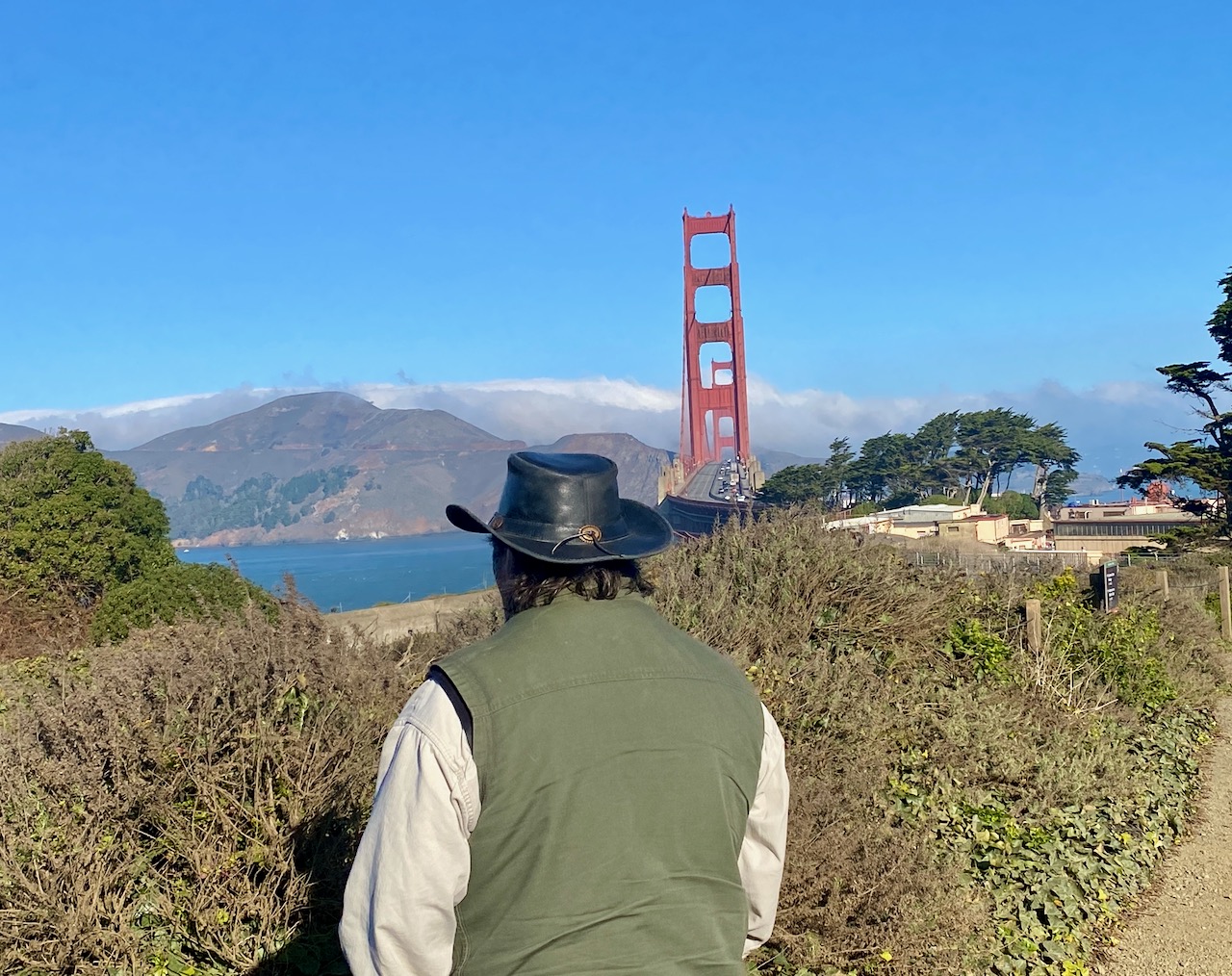
That’s me looking at the Golden Gate Bridge and San Francisco Bay from the south: By Tab Gilbert
The Big Picture –
By Glynn Wilson –
SAN FRANCISCO, Calif. – American writer Mark Twain, who spent two years in San Francisco writing for newspapers from 1864 to 1866, is often quoted as saying, “The coldest winter I ever spent was a summer in San Francisco.”
It’s apparently not true. He never said it, or at least he never wrote it that any historian or journalist can find in his published works.
But the sentiment makes sense, and now I can personally attest to why he may have said such a thing.
When I left Coulterville Monday morning, it was projected the high would hit 101 that day. When I arrived in the big city on Monday afternoon and took a walk in Golden Gate Park, it was 63 degrees. For the past few weeks in the Sierra Mountain foothills near Yosemite, the highs have topped 101 with lows at night only in the mid-70s.
It looks like San Francisco is the only place in America that is not blazing hot or on fire. It is not a bad place to be to ride out the August heat anyway.
When I checked the headlines Tuesday morning, a wildfire along Central California’s celebrated Big Sur coast about 150 miles south of here was spreading rapidly, prompting evacuation orders in Monterey County. The Timber fire started Sunday in the Los Padres National Forest near Loma Vista, a Monterey County community about 100 miles south of San Jose. By Monday evening, the blaze had burned more than 1,700 acres and was only 5 percent contained.
According other headlines, the financial toll is mounting up from this brutal summer of heat, fires, smoke and storms and has frustrated businesses and households around the world. July was the hottest month on record in the contiguous United States, according to federal data, and Western Europe experienced its hottest June-to-July average ever recorded.
“Economists have long studied the worsening impact of climate change on economic growth, inflation and employment. Most estimates for damage caused to date have been moderate, while projections for damage over the long run become more drastic. But the past year has delivered climate-related shocks that are becoming impossible for businesses to avoid,” according to reporting from the New York Times.
Good News
There is some good news on the environmental front out of the federal appeals courts, however.
Ten judges on the U.S. Court of Appeals for the District of Columbia Circuit upheld an earlier injunction that said the Environmental Protection Agency could not terminate $20 billion in climate grants, and that the recipients should have access to the funds as their case proceeds.
Appeals Court Says E.P.A. Cannot Block Billions in Climate Grants
If the E.P.A. does not appeal the decision to the Supreme Court in the next seven days, the judgment will effectively reinstate much of the Greenhouse Gas Reduction Fund, a Biden-era “green bank” initiative that supports low-cost loans and investments for renewable energy projects across the country.
“It’s screamingly good news for the plaintiffs,” said Michael Gerrard, director of the Sabin Center for Climate Change Law at Columbia University, though he said the legal process could continue to drag on for a long time.
Last February, the E.P.A. administrator appointed by Trump, Lee Zeldin, attempted to claw back $20 billion in climate grant funding that the Biden administration had awarded to eight nonprofit groups. Zeldin suggested the program was vulnerable to waste, fraud and abuse, citing a hidden-camera video released by the right-wing group Project Veritas in which a former E.P.A. staff member likened the outgoing administration’s spending to throwing “gold bars” off the Titanic.
Despite investigations by the agency’s inspector general, the Justice Department and the F.B.I., the government never substantiated these claims. Several of the nonprofits sued to force the money out, and in April 2025, U.S. District Judge Tanya Chutkan of the District of Columbia issued a preliminary injunction preventing the E.P.A. from canceling the grants and allowing the groups to access the money during the litigation. But the E.P.A. appealed that decision, and the program has been in limbo since.
The delay has taken a toll on the grant recipients, which relied on the funds for basic expenses like payroll and office rent. Beth Bafford, the chief executive of the lead plaintiff, Climate United, left the organization in March and was not replaced. Other groups have laid workers off.
Power Forward Communities, which received $2 billion in grants, was down to two employees earlier this year.
On Tuesday, the nonprofit plaintiffs celebrated the judgment. Representatives for Justice Climate Fund and the Coalition for Green Capital said they were looking forward to moving forward with their work.
“Today, the D.C. Circuit Court judges affirmed what we have always known: E.P.A. took actions to unlawfully freeze and dismantle the National Clean Investment Fund grant program,” Climate United said in a statement. “Despite efforts to harm the awardees with false allegations and misinformation, there remains no legal basis for terminating our grant award and clawing back funds that were already disbursed in our bank accounts.”
My sources say the national disaster in this is threefold. One, the Trump administration canceled many wind and solar energy projects that were already under construction. They vowed to use taxpayer money to refund the money companies had invested, and then demanded that they reinvest the money in fossil fuel energy projects, apparently mainly new natural gas power plants to be used for powering the Artificial Intelligence data centers across the country, a growing plague upon humanity and the Earth.
“This is a national travesty of epic proportions, and totally corrupt,” one source told me.
___
If you support truth in reporting with no paywall, and fearless writing with no popup ads or sponsored content, consider making a contribution today with GoFundMe or Patreon or PayPal.










Before I shipped out for Vietnam (1968) I had to spend time in San Francisco-I remember some graffiti that read “There may not be a heaven, but there is a San Francisco.” That was true then but not so much anymore. When I returned a year later, severely addicted to opium and mentally broken, I found San Franscisco to be in much worse shape. I would live there another decade before cashing out. I always enjoy reading your articles from that region and especially embrace Mark Twain’s philosophy. I also have an unrelated concern about your recently posted Doug Jones banner. Doug Jones is an honorable man and a firm believer in human rights, not too popular in that region. When he was elected senator, to their credit, many “Christian” GOP voters could not bring themselves to vote for an alleged child molester. Although Jones’ margin of victory was the exact percentage of Republican voters who did not cast a vote, the (primarily black) Alabama Democratic Party took immediate credit and began pounding their chests about a “New Day” in Alabama. Doesn’t take a genius to see a backlash coming. When Jones ran for reelection, he was not known as the “Human Rights” guy but the “Negro Loving” guy (I was there, I saw this.) Now he is running against a carpetbagger who certainly is not a “Negro Lover” and I fear the same results. I have always found it to be amazing how certain groups of people will continue to vote against their own best interest as long as another, “more inferior,” group remains disenfranchised.