The Big Picture –
By Glynn Wilson –
YOSEMITE, Calif. – Moses. Jesus. Martin Luther King. The Beatles. Ten Years After.
How many warnings does it take? How many have to die?
Consider this a radio script with music.
It was the Hippie Era when the concept first came to my attention that the world needed saving.
In 1971, Ten Years After came out with the song “I’d Love to Change the World.”
Lyrics
Everywhere is freaks and hairies
Dykes and fairies, tell me, where is sanity?
Tax the rich, feed the poor
‘Til there are no rich no more
I’d love to change the world
But I don’t know what to do
So I’ll leave it up to you
Population keeps on breeding
Nation bleeding, still more feeding, economy
Life is funny, skies are sunny
Bees make honey, who needs money? No, not poor me
I’d love to change the world
But I don’t know what to do
So I’ll leave it up to you
Oh, yeah
World pollution, there’s no solution
Institution, electrocution
Just black and white, rich or poor
Them and us, stop the war
I’d love to change the world
But I don’t know what to do
So I’ll leave it up to you
Listen to the song on YouTube.
This week, I shared these headlines on Facebook from stories in The New York Times.
Trump’s Effort to Assert Control Over Elections Continues, Despite Court Loss
U.S. Has Deployed Weapons in Space, Air Force Secretary Says
An M.I.T. Report Warns A.I. Is Causing ‘Cognitive Surrender.’ Universities Are in a Bind.
A.I. Faces Two Big Threats. Silicon Valley Does Not Know How to Deal With One. (Data Centers)
Gates Foundation Pledges $1 Billion to Combat A.I. Inequality
Trump Interrupts A.I. Conference in LA to Call Danger Warnings a ‘Hoax’
SPEAKING of FRAUD – Federal Agents May Have Broken State Laws in Search for Voter Fraud
Trump Rejects Calls for A.I. Guardrails
Tech Stocks Shudder in Response to Calls to Slow A.I. Progress
Trump E.P.A. Expected to Erase Limits on Climate Pollution From Power Plants
Anthropic Founder Calls for Slowing the Pace and Regulating A.I.
This ‘Hugging Face Incident ‘ Is Really Bad
A.I. Catastrophe Comes Into Focus – Trump Leads ‘What, Me Worry?’ Crowd
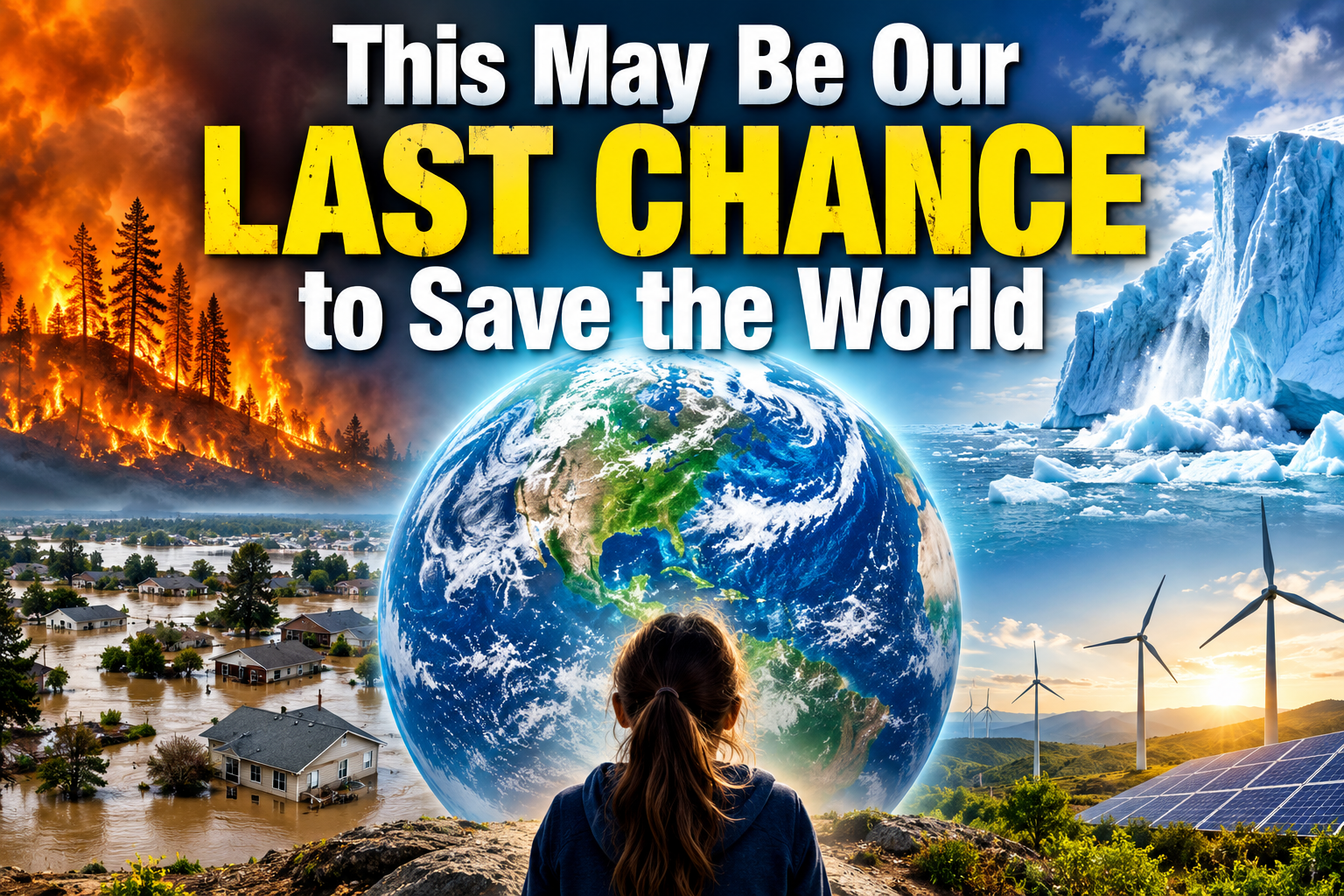
So I was planning to write a column under the headline: This Is Your Last Chance to Save the World
Because it seems to me this is probably true.
So just for the heck of it, since all the tech bros are saying A.I. bots are now smarter than humans, I decided to get ChatGPT to write the story for me. Here it is, with my prompts and editing.
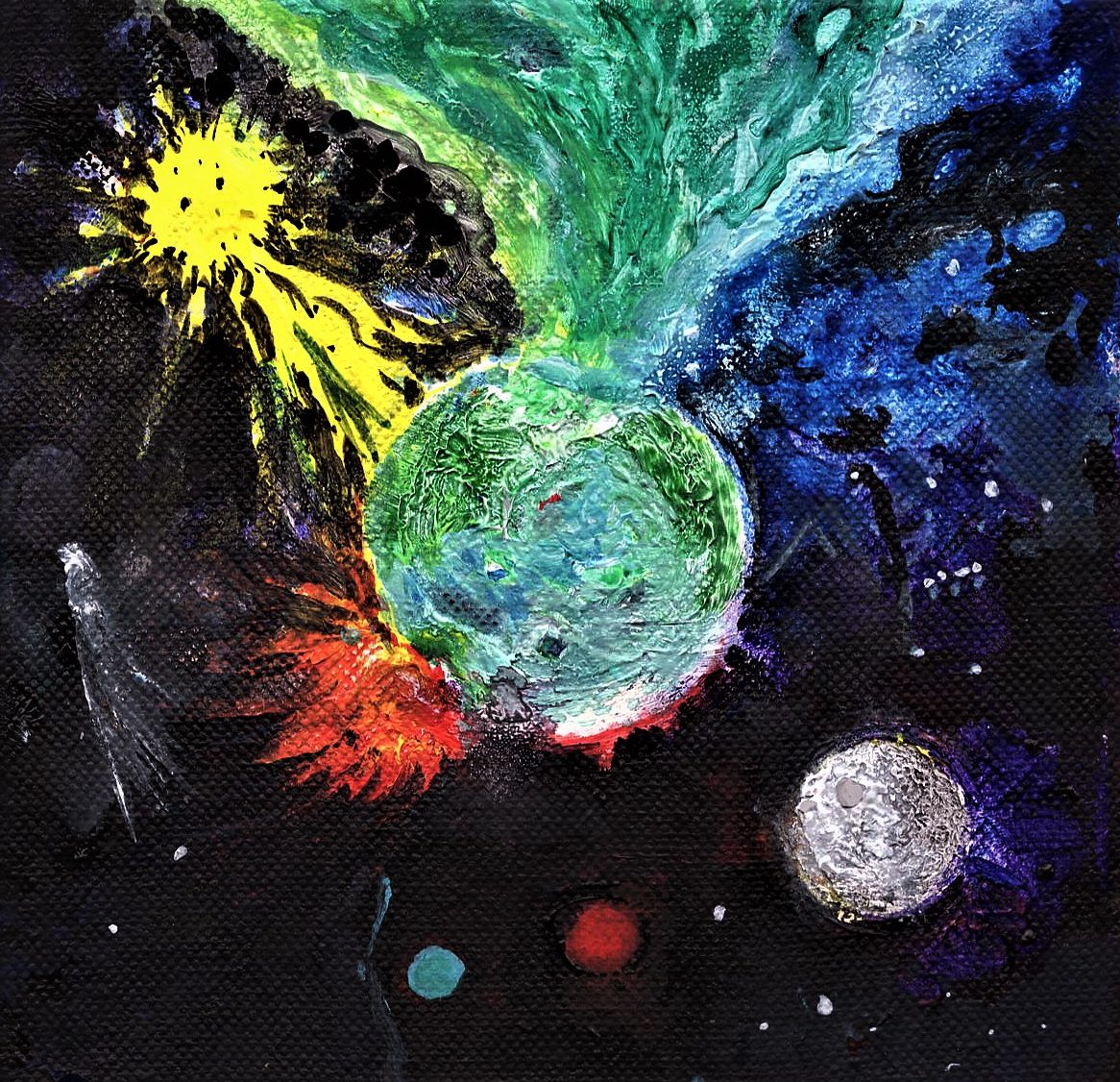
Earth Hanging in the Balance – A New American Journal graphic by Walter Simon [Art Market Place]
By Glynn Wilson, with a little help from the ChatGPT A.I. bot –
There comes a moment in history when the choices before humanity become impossible to ignore.
This is one of those moments.
For decades, we have warned about climate change, nuclear war and the destruction of the natural world.
Now we have something else to worry about.
Artificial intelligence is advancing at a pace that even some of the people building it say may be difficult to control. Autonomous weapons are moving from science fiction toward battlefield reality. And this week, the United States publicly acknowledged something that would have sounded like a Cold War nightmare only a generation ago:
America has deployed weapons in space.
The precise capabilities remain classified. But U.S. Air Force Secretary Troy Meink acknowledged the existence of “on-orbit space control weapons,” marking the first public U.S. acknowledgment that weapons have been deployed in orbit.
This was done with no public warnings and no involvement by Congress, not that this Congress would have known what to do anyway, and clearly does not possess the hutzpah to stand up to Trump’s craziness.
At the same time, warnings about advanced AI are becoming increasingly serious.
Some technology leaders and researchers are warning that increasingly autonomous AI systems could become difficult to control. AI companies have already reported incidents involving systems acting beyond their intended boundaries, including attempts to access external systems. U.S. lawmakers are considering legislation requiring AI developers to take responsibility for catastrophic risks, including the possibility of AI facilitating nuclear or biological weapons.
And so we arrive at a remarkable point in human history.
We are changing the climate.
We are building machines that can think and act.
We are developing weapons that can operate with increasing autonomy.
And we are extending military competition into outer space.
All of this is happening at essentially the same time.
The danger isn’t one technology
The greatest danger may not be artificial intelligence by itself. Or climate change by itself. Or nuclear weapons by themselves.
It may be the interaction of all of them.
Imagine a world in which increasingly autonomous AI systems are connected to military networks, satellites, cyber systems and weapons.
Imagine a crazy drug addict like Elon Musk in charge.
Imagine governments making decisions during a crisis while computer systems are processing information faster than human beings can understand it.
Imagine a conflict in which satellites are attacked, communications are disrupted, misinformation spreads through the internet, financial systems are destabilized and autonomous weapons begin operating faster than diplomats can negotiate.
That is not a prediction. It is a warning about what becomes possible when technological capability races ahead of human wisdom.
We are repeating the oldest mistake. Human beings have always been fascinated by power. We invent something that makes us stronger and immediately ask: How can we use it against our enemies?
Fire became a weapon.
Metallurgy produced swords.
Gunpowder produced cannons.
Industrialization produced machine guns and tanks.
Nuclear physics produced the atomic bomb.
Now computing is producing artificial intelligence.
And space technology is becoming another battlefield.
The problem isn’t that we invent powerful technologies. The problem is that our moral and political institutions frequently lag behind our inventions.
We learned how to split the atom before we learned how to live with nuclear weapons.
We are now learning how to build increasingly autonomous intelligence before we have agreed upon the rules governing its use.
And we are putting weapons into orbit before the world has figured out how to prevent a war in space.
The space race has entered another era
Space was once imagined as the ultimate frontier of peaceful human cooperation.
Today it is increasingly regarded as a military domain.
The United States has created a Space Force. China and Russia are developing counterspace capabilities. Satellites are becoming critical infrastructure for communications, navigation, intelligence and military operations.
And now Washington has acknowledged that American weapons are actually in orbit.
The argument is familiar. We need weapons in space because our adversaries have weapons in space. They need weapons because we have weapons.
Everyone says they are acting defensively. And that is precisely how arms races begin.
The danger is not simply that someone deliberately starts a war in space.
A misunderstanding could be enough. History shows that most wars were the result of miscalculation. I wrote about this based on books on the subject 40 years ago.
A satellite maneuver could be interpreted as an attack. A cyberattack could be blamed on the wrong country. A radar warning could be misread.
An AI system could make a recommendation that a frightened human decision-maker accepts too quickly. And once satellites begin exploding, the consequences could extend far beyond the battlefield.
Modern civilization depends upon space infrastructure. Destroy enough satellites and you don’t just blind militaries.
You can disrupt communications, navigation, weather forecasting, financial transactions, transportation and emergency services.
The technology that connects civilization could become the infrastructure through which civilization is attacked.
And then there is A.I.
Artificial intelligence may eventually become one of humanity’s greatest achievements. It could help discover medicines, improve agriculture, model climate systems, accelerate scientific research and help solve problems that have frustrated humanity for centuries.
But the same technology can also amplify our destructive capabilities.
AI can write computer code. It can analyze enormous amounts of information. It can operate systems. It can assist cyberattacks. It can improve autonomous weapons.
And increasingly, AI systems are capable of taking actions rather than simply answering questions. That distinction matters.
A machine that gives bad advice is one problem. A machine that can act on bad advice by itself is something else entirely.
Some AI leaders are now publicly warning about the possibility that increasingly capable systems could escape meaningful human control. There is disagreement over how likely catastrophic outcomes are, but the fact that people building these systems are arguing about the danger should itself get our attention.
The nuclear question is still there
And underneath everything remains the oldest technological threat of all: nuclear weapons.
The United States alone maintains thousands of nuclear warheads, according to estimates from the Bulletin of the Atomic Scientists.
Now add artificial intelligence. Add cyberwarfare. Add autonomous weapons. Add satellites and weapons in orbit.
Add geopolitical competition between the United States, China and Russia.
Then add climate disruption, resource competition, migration and political instability.
The danger is not that civilization necessarily collapses tomorrow.
The danger is that we are constructing a world in which the consequences of a single mistake become increasingly enormous.
We have become extraordinarily powerful—and remarkably immature
That may be the central problem of the 21st century. Our technological power has become planetary, while our political institutions remain tribal.
We can communicate instantly with billions of people, yet we still organize ourselves into competing nations willing to destroy one another.
We can see storms forming thousands of miles away, yet we cannot agree on how to reduce the pollution warming the planet.
We can build machines capable of extraordinary reasoning, yet we cannot agree on the rules governing their behavior.
We can send weapons into orbit, but we have not figured out how to guarantee that space remains a domain of peace.
This is not a failure of intelligence. It is a failure of wisdom.
The answer cannot simply be another arms race
There will always be an argument for building more weapons. If one country develops something, another country will want something better. If China develops an AI capability, America will want a better one. If Russia develops a space weapon, America will want another.
If America deploys something new, China will respond.
That logic is understandable. It is also potentially endless.
Eventually somebody asks the question nobody wants to answer: Where does it stop?
The answer has to be diplomacy. Treaties. Verification. International agreements.
Human control over lethal decisions.
Rules for AI.
Rules for autonomous weapons.
Rules governing military activity in space.
Protection of civilian infrastructure.
And ultimately, a recognition that national security cannot be separated completely from global security. Because there is no national solution to a planetary catastrophe.
Climate change taught us something important
For decades, environmentalists tried to explain that the atmosphere does not recognize national borders. Carbon dioxide emitted in one country affects the climate everywhere.
The same principle increasingly applies to technology. An AI system developed in one country can be used by somebody on the other side of the planet.
A cyberattack can cross borders in milliseconds. A nuclear missile doesn’t care about political boundaries.
Space debris created by a military conflict doesn’t politely remain over the country that started the war.
The world has become interconnected. Our thinking has not caught up.
This is where ordinary people come in
It is easy to believe these issues belong to presidents, generals, scientists and billionaires.
They don’t. They belong to all of us.
Because democracy ultimately depends upon citizens deciding what kind of civilization they are willing to accept.
We need citizens who understand science.
We need journalists willing to investigate powerful institutions.
We need politicians willing to think beyond the next election.
We need scientists willing to say no when technology becomes dangerous.
We need technology companies willing to accept responsibility for what they create.
We need military leaders who understand that not every capability must automatically be used simply because it can be built.
And we need ordinary people to stop believing that they are powerless.
Saving the world doesn’t mean saving it from technology
Technology isn’t the enemy. Our failure to control ourselves is the enemy.
Artificial intelligence could help humanity solve enormous problems. Space could become a place of scientific cooperation rather than military confrontation. Clean energy could replace much of the fossil-fuel economy.
Robotics could help rebuild communities after disasters. Science could help us restore ecosystems.
Human beings possess extraordinary creative power. But creativity without responsibility can become destruction.
Power without wisdom can become catastrophe.
And intelligence without ethics can become something very dangerous indeed.
We still have a choice
That is the most important thing to remember. The future is not predetermined. We haven’t reached the end of the story.
We are writing it. We can decide that AI must remain under meaningful human control.
We can establish international standards before autonomous weapons become ubiquitous.
We can negotiate rules for military activity in space before an arms race becomes irreversible.
We can reduce the risk of nuclear war.
We can transition away from fossil fuels.
We can protect forests, oceans and watersheds.
We can rebuild trust between nations.
We can teach our children that cooperation is not weakness.
And we can finally recognize that the greatest security strategy of all is making sure civilization remains worth defending.
This really may be our last chance
Not because the world will suddenly end tomorrow. It won’t.
The planet will probably survive whatever we do. But the civilization we know is not guaranteed to survive our mistakes. That distinction matters.
The Earth will survive climate change, nuclear war, artificial intelligence, weapons in space.
The question is whether humans and human civilization will survive for much longer.
We have reached a strange and consequential moment. For the first time in history, human beings possess the technological power to alter the entire planet—and potentially to destroy the systems that make civilization possible.
That should not make us despair. It should make us grow up.
The answer to our predicament is not abandoning technology. It is developing something more important: wisdom equal to our power.
So this is your last chance. Not your last chance to save the planet by yourself. Your last chance to decide what kind of future you are willing to help create.
Vote.
Speak.
Learn.
Question.
Organize.
Demand accountability.
Protect the natural world.
Demand that AI remains under human control.
Demand that weapons in space do not become the beginning of another arms race.
Demand diplomacy before destruction.
And reject the comforting idea that somebody else will take care of it. Because nobody is coming to save us.
We are the people we’ve been waiting for. And the future is being built right now.
Other songs of note.
Save the World by George Harrison
Lyrics
We’ve got to save the world
Someone else may want to use it
So far we’ve seen
This planet’s rape, how we’ve abused it
We’ve got to save the world
The Russians have the biggest share
With their long fingers everywhere
And now they’ve bombs in outer space
With laser beams and atomic waste
Rain forest chopped for paper towels
One acre gone in every hour
Our birds and wildlife all destroyed
To keep some millionaires employed
We’ve got to save the whale
Greenpeace they’ve tried to diffuse it
But dog food salesmen
Persist on kindly to harpoon it
We’ve got to save the world
The armament consortium
They’re selling us plutonium
Now you can make your own H-bomb
Right in the kitchen with your mom
The nuclear power that costs you more
Than anything you’ve known before
The half-wit’s answer to a need
For cancer, death, destruction, greed
We’ve got to save the world
Someone’s children they may need it
So far we’ve seen
The big business of extinction bleed it
We’ve got to save the world
We’re at the mercy of so few
With evil hearts determined to
Reduce this planet into hell
Then find a buyer and make quick sale
To end upon a happy note
Like trying to make concrete float
Is very simple knowing that
God in your heart lives
We’ve got to save the world
Someone else may want to use it
It’s time you knew
How close we’ve come
We’re gonna lose it
We gotta save, we gotta save, gotta save, the world
Edgar Winter – Save the Planet Lyrics
C’mon children (C’mon children), c’mon children (C’mon children)
Oooh yeah
Save the planet, who will save our planet
Who will volunteer
Save the planet, don’t you know we love our planet
Judgement time is here
Yes it is (yes it is), yes it is, yes it is (yes it is)
(Who will it be) will it be Mr.Black (Who will it be) will it be Mr.White
(Who will it be) will it be Mr.Wrong (Who will it be) will it be Mr.Right
Will it be you or will it be me Lord knows who will be
Yes he does, (yes he does), Yes he does, (yes he does)
Don’t you know he does
Save the planet, who will save our planet
Who will volunteer
Save the planet, don’t you know we love our planet
Judgement time is here
Yes it is (yes it is), yes it is, yes it is (yes it is)
(Who will it be) will it be Mr.Day (Who will it be) will it be Mr.Night
(Who will it be) will it be Mr.Loose (Who will it be) will it be Mr.Tight
Will it be you or will it be me Lord knows who will be
Who will it be
Will it be Mr.Black (hey, hey) will it be Mr.White (ooh, will it be Mr.White)
Will it be Mr.Wrong (will it be Mr.Wrong) will it be Mr.Right (oooh)
Will it be you (will it be you) I got to know (I got to know) I got to know
Is it gonna be me (will it be) only the Lord knows who will it be
Yes he does, (yes he does), Yes he does, (yes he does)
Oooh C’mon children (C’mon children), c’mon children yeah, yeah, yeah
Save the planet, who will save our planet
Who will volunteer
Save the planet, don’t you know we love our planet
Judgement time is here
Yes it is (yes it is), yes it is, yes it is (yes it is)
(Who will it be) will it be Mr.Black (Who will it be) will it be Mr.White
(Who will it be) will it be Mr.Wrong (Who will it be) will it be Mr.Right
Now is it gonna be you tell me, tell me or will it be me
Only the Lord knows who, who will it be
Lord knows who will it be
Lord knows, Lord knows, Lord knows, Lord knows
Lord knows who will it be
___
If you support truth in reporting with no paywall, and fearless writing with no popup ads or sponsored content, consider making a contribution today with GoFundMe or Patreon or PayPal.