“We must never forget that art is not a form of propaganda; it is a form of truth.”
– President John F. Kennedy, 1963
“Artists are here to disturb the peace.”
– James Baldwin
The Big Picture –
By Glynn Wilson –
COULTERVILLE, Calif. – When people talk about defending democracy, they usually think about the right to vote, free and fair elections, armies fighting on battlefields against oppressive forces hellbent on tyranny.
But wars have often been fought on the battlefield of culture, the center piece of human civilization. If you study any of the oppressive dictatorships in history, perhaps most notably Hitler’s Nazi Germany, you will discover attempts to manipulate the hearts and minds of people by confiscating and destroying art.
Paintings on museum walls, statues in public squares, buildings in historic districts, music we pass from one generation to the next, are all stories told about who we are as a people, a country.
Art as well as written history constitute one of the ways human beings remember who they were, understand who they are and imagine who they might become. Bad men seem to think they can take control of such things for their own selfish ends.
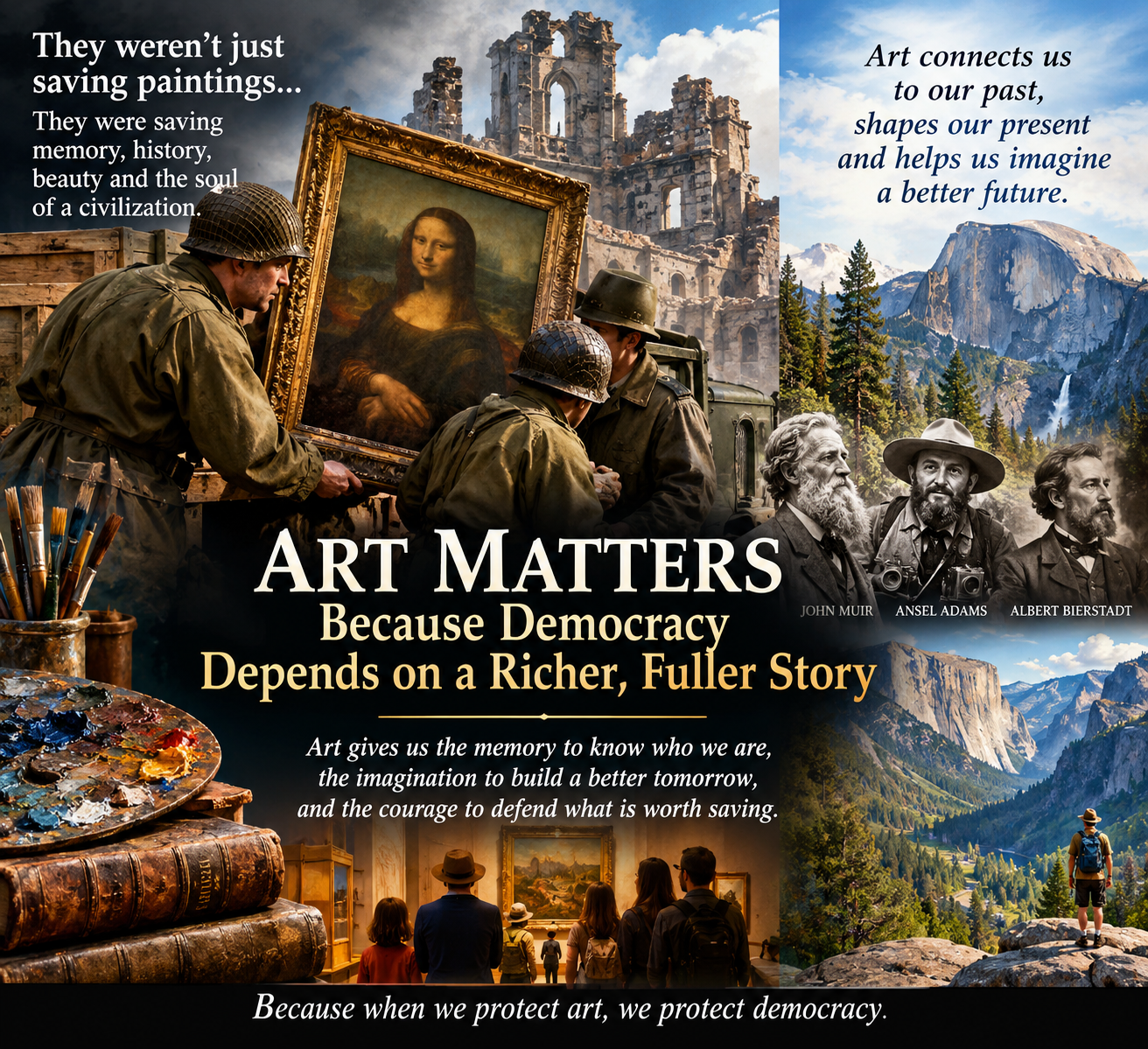
Not many movies make me cry, but this is one of the great lessons of “The Monuments Men,” the 2007 book by Robert M. Edsel and the 2014 film directed by George Clooney, which I just rewatched on Amazon Prime Video. As a writer, musician and now curator of an arts and crafts center, this is close to my heart.
You probably know something of the story. During World War II, a small group of American and European art experts, museum directors, architects, scholars and others became known as the Monuments Men, their mission to protect Europe’s cultural heritage from destruction by recovering works of art stolen by the Nazis and return those treasures to their rightful owners. The Russians tried taking them as reparations for the hundreds of thousands of men lost in battle.
Europe was burning. Cities bombed. Hundreds of thousands of people died.
But to those involved in the business of the arts, they knew that preserving art as part of the human record was as important as winning the war. If evil men could steal and destroy the human record, they believed they could rule the world for a thousand years.
Adolf Hitler and the Nazi regime understood something about art that some modern societies may forget, and this is where the story becomes relevant to what is happening today in the United States, Russia and in technology with the drive to create Artificial Intelligence.
Culture Has Power
The Nazis didn’t merely steal paintings because they were valuable. They systematically looted Europe’s cultural treasures because controlling culture was part of controlling history and ruling.
Art could be used to define what Germany was supposed to be, to glorify racial mythology, erase inconvenient histories and establish the cultural superiority of one racial group over another.
The Nazis also attempted to destroy art they considered “degenerate.”
Authoritarian governments frequently believe that controlling culture helps control people. If you can decide which books may be read, which paintings may be displayed, which monuments may remain standing, which historical figures may be remembered and which stories may be told, you can begin to control how people understand reality itself.
The Trump administration is undoing 250 years of freedom of expression in the arts and humanities, freedom from government using the arts for propaganda, according to numerous sources, including the Authors Guild.
“It is doing it by fiat, through a series of unconstitutional executive orders usurping congressional powers, deportations, bullying, threats of criminal action against journalists who report truth, defunding of institutions that permit free speech, and now cancelling congressionally-funded programs in the arts and sciences,” the group says on its website.
Taking over the Kennedy Center for the Performing Arts was part of this effort, as well as messing with the Smithsonian Institute’s museums and changing what the National Park Service can focus on in its ranger programs.
As I’ve written before, if Donald Trump, Vice President JD Vance, the Heritage Foundation and the MAGA movement wants a different form of government, they should come out and say that and let’s have a transparent debate about it. If a democratic republic is just too messy, and you really believe we should go back to having an unelected Emperor in league with a specific religion, let’s put it to a vote.
They won’t do it because they know they would surely lose.
If you really believe in some form of democracy, then stop trying to suppress the vote, censor free speech and the press, distort history, and try to control art and culture for racist and fanatical religious views.
A democratic society needs the freedom to remember, to question, yes even the president, to criticize the government and interpret the past.
That requires the freedom to create art, read and write what you believe, make music that everyone may not like.
Consider the work of artists such as Leonardo da Vinci, Rembrandt, Francisco Goya, Vincent van Gogh or Pablo Picasso. Their work tells us something about the societies in which they lived, but also something about the human condition.
The paintings of Albert Bierstadt helped Americans see the grandeur of the American West. The photographs of Ansel Adams helped generations of Americans see Yosemite and other landscapes not simply as scenery, but as places worthy of protection. John Muir did the same with the written word.
Related Coverage
The Mission Born at Yosemite: How We Can Preserve It
Artists, photographers and writers helped create the cultural imagination that eventually made the preservation of America’s national parks possible, and made us a better people and a better country, for example.
Art can influence public policy. It can influence what people value.
Imagination
Democracy is often described as a system of government based on laws, elections and majority rule. But democracy requires something deeper: imagination.
A great book or movie can make us care about someone whose life is completely different from our own, and realize why life can be grand, or tragic.
Songs can unite strangers.
A monument can remind an entire community of something it has promised never to forget.
This is why authoritarian regimes so often fear independent artists.
Artists ask questions. They challenge assumptions, preserve inconvenient memories, and help people see things differently.
And once people begin seeing differently, they may begin thinking differently.
The men and women portrayed in “The Monuments Men” were not simply trying to save valuable objects. They risked their own lives to save the cultural inheritance of millions of people. The objects they recovered represented generations of human creativity.
A painting stolen from a Jewish family was not merely a commodity. It represented a family, a history and a life that the Nazis were trying to erase.
The destruction of cultural heritage is therefore often part of the destruction of people themselves. This is why the recovery of stolen art after the war mattered.
It was an act of restoration. It said that the people who had been murdered had existed, along with their families, communities and culture. And that someone remembered.
One of the greatest dangers facing any society is cultural amnesia, and this is where social media and A.I. come into the picture.
When people forget history, they become vulnerable to people who are willing to rewrite it.
That does not mean that history should never be reconsidered. A healthy democracy should constantly reconsider its history, keeping in mind historical fallacies. There is an enormous difference between reconsidering history and destroying the evidence of history.
Museums, libraries, archives, historic buildings, monuments, photographs, paintings and works of literature provide societies with the raw material necessary to have those arguments. Without them, the loudest person in the room can simply declare what happened.
Art gives us something against which propaganda can be measured. It provides evidence, memory, and sometimes, it provides a voice for people who no longer have one.
Art Belongs to Everyone
There is another important lesson here. Art is sometimes treated as something belonging exclusively to wealthy people, museums, collectors and intellectuals. That is a mistake.
Art belongs to the public because culture belongs to the public, just as national parks and forests belong to the public, not just the government.
A child visiting a museum may encounter a painting that changes the direction of an entire life. A person walking through a historic town may suddenly understand something about the people who lived there generations earlier.
A photograph may cause someone to care about a landscape they have never visited. A local theater production may bring an entire community together.
A small gallery in a historic town can accomplish something that a government program cannot: it can create a place where people encounter one another through creativity. That is why communities should not just regard artists as decorative additions to economic development. Artists are part of the cultural infrastructure of a free society.
The Lesson for America Today
The story of “The Monuments Men” carries a warning for our own time. Democracy does not disappear only when soldiers march into a capital and take over.
It can also weaken slowly when people stop caring about history, when libraries are neglected, museums become political targets, artists are pressured to conform, when journalists are attacked, public monuments become objects of historical erasure rather than opportunities for discussion, and when citizens lose interest in the cultural institutions that connect one generation to another.
A society that destroys its cultural memory makes itself easier to manipulate.
The answer is not to freeze history in place. The answer is to preserve it – and then talk about it.
Preserve the painting, the photograph, the old building, the oral history, the song, the novel.
Preserve the uncomfortable monument.
Preserve the evidence.
Then let citizens decide for themselves what it all means.
That is democracy.
Relevant Links
The Monuments Men Is George Clooney’s Art of War
Saving Europe’s Art from the Nazis
___
If you support truth in reporting with no paywall, and fearless writing with no popup ads or sponsored content, consider making a contribution today with GoFundMe or Patreon or PayPal.