



NAJ graphic
The Big Picture –
By Glynn Wilson –
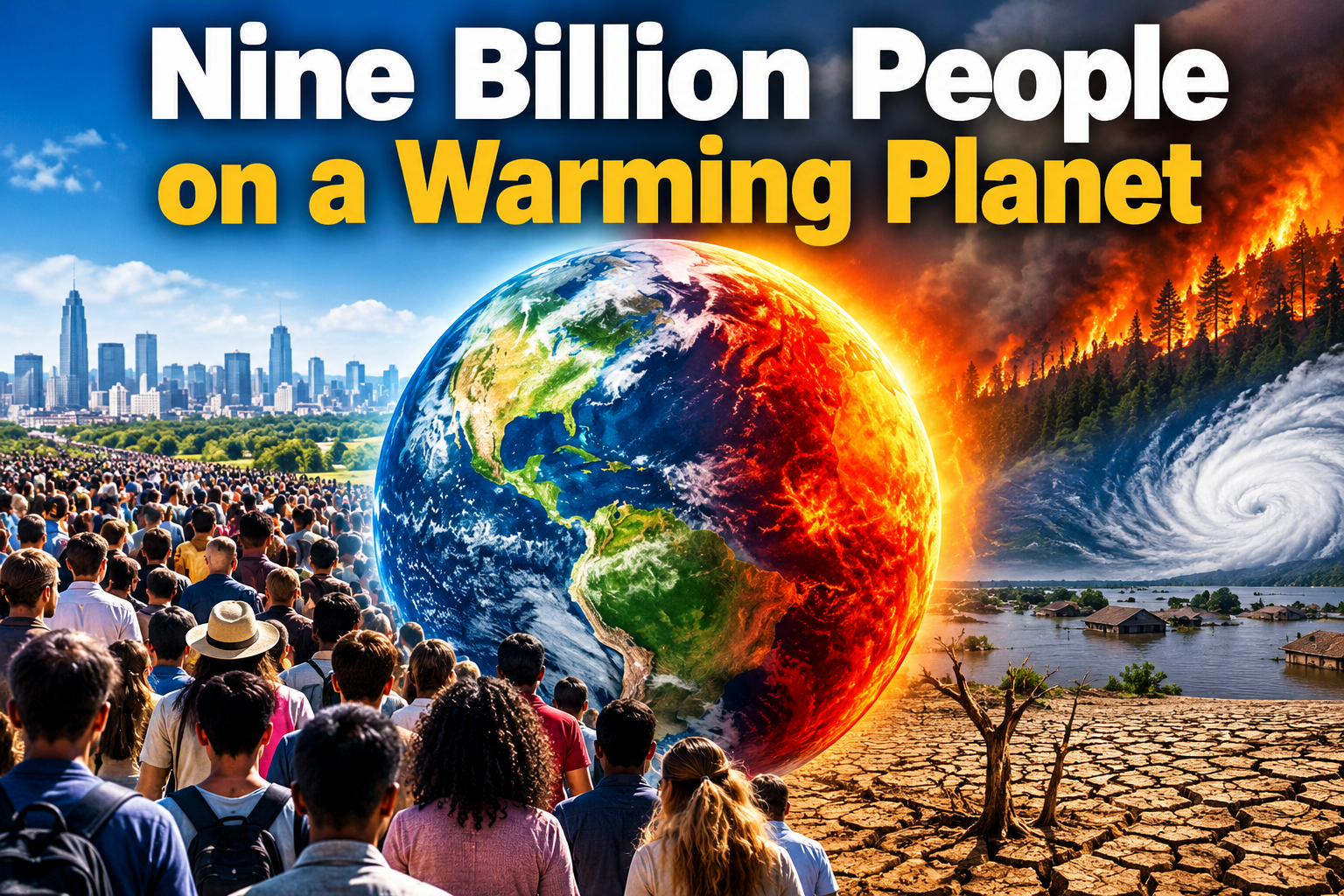
The world is moving toward another demographic milestone. But unlike the population explosions of the past century, the approach to 9 billion people is unfolding on a planet already being transformed by climate change due to global warming from the burning of fossil fuels.
According to the United Nations’ latest World Population Prospects, the global population was about 8.2 billion in 2024 and is projected to continue growing for roughly another half-century. The U.N. now expects humanity to reach a peak of approximately 10.3 billion people in the mid-2080s, and then begin declining, not factoring in the potential for massive and cataclysmic events in the meantime that kill millions.
That means the 9-billion threshold should arrive in the 2030s, roughly around the middle of that decade, although the exact year depends on future fertility, mortality, migration trends and other factors.
The more important question may not be when the world reaches 9 billion, but what kind of planet those 9 billion people will inherit.
A population milestone colliding with a climate crisis.
Population growth itself is not the primary cause of today’s climate crisis. The overwhelming scientific evidence shows that modern global warming is principally the result of human emissions of greenhouse gases, particularly from burning coal, oil and natural gas for electricity, transportation, industry and other uses.
And the planet is already registering the consequences.
The World Meteorological Organization reports that 2015 through 2025 were the 11 hottest years ever recorded, with 2025 approximately 1.43°C above the 1850–1900 average. The same report says Earth’s energy imbalance reached a new high in 2025.
The ocean is absorbing most of that excess heat. WMO says more than 91% of the additional heat in Earth’s climate system is being stored in the ocean, while ocean heat content reached a record level in 2025.
Related Coverage
Report: The World Will Soon Overshoot Global Warming Goal and Must Change Course
This matters because a hotter atmosphere and hotter ocean don’t simply produce warmer days. They change the behavior of the entire climate system.
The predicted disasters are already here.
Climate change does not create every hurricane, flood, wildfire, drought or heat wave. Natural variability continues to play an important role.
But warming caused by greenhouse-gas emissions is loading the dice toward more extreme conditions.
A warmer atmosphere can hold more moisture, contributing to heavier precipitation when storms develop. Higher temperatures intensify evaporation and can worsen droughts. Hotter conditions dry vegetation and soils, increasing wildfire risk in many regions. Warmer oceans can provide additional energy for tropical cyclones, while rising sea levels make coastal flooding more destructive.
The consequences increasingly arrive in combinations.
A drought can destroy crops, followed by a heat wave that kills livestock and threatens human health. A wildfire can destroy homes and watersheds, followed by intense rainfall that produces mudslides and flooding. A hurricane can combine storm surge, extreme rainfall and high winds. A coastal community can face repeated flooding long before its residents are permanently displaced.
The WMO’s 2025 assessment documented heat waves, wildfires, droughts, tropical cyclones, storms and flooding causing deaths, displacement, disruption of food systems and billions of dollars in economic losses.
The human cost extends far beyond deaths.
The conventional definition of a disaster often focuses on immediate casualties. But climate disasters produce a much larger secondary toll.
People lose homes. Farmers lose crops. Businesses lose buildings and equipment. Communities lose roads, bridges and electrical systems. Water supplies become contaminated or unreliable. Insurance becomes more expensive – or disappears altogether. Governments divert money from schools, health care and infrastructure toward rebuilding.
More than 100 million people are affected by disasters in a typical year, according to data summarized by Our World in Data. Droughts and floods account for enormous numbers of affected people because their consequences can extend well beyond the initial event into food production, water supplies and livelihoods.
And the economic consequences can be enormous.
Recent disaster damages have amounted to roughly 0.2% of global GDP in typical years, with substantially higher losses in particularly severe years, according to the same analysis.
Those numbers, however, don’t fully capture the human cost.
A destroyed home represents decades of savings for one family. A failed harvest can represent an entire year’s income for a farmer. A flooded community can lose businesses that never reopen.
Nine billion people means more people exposed.
Population growth becomes particularly important because much of the world’s future population growth will occur in regions already highly vulnerable to climate change.
The U.N. projects that sub-Saharan Africa will account for more than half of global population growth through 2050.
Many countries experiencing rapid population growth are simultaneously dealing with poverty, inadequate infrastructure, limited access to health care and exposure to extreme heat, drought, flooding and food insecurity, including India.
That creates a difficult equation:
More people + more climate hazards + limited resources = greater vulnerability.
But population should not be treated as a simple measure of environmental responsibility. A child born in a poor country does not have the same carbon footprint as someone born into a wealthy, fossil-fuel-intensive economy.
The world’s richest populations have historically consumed vastly more energy and produced far more greenhouse-gas emissions per person than many of the populations experiencing the fastest growth.
That distinction is crucial.
Transportation is part of the problem.
For more than a century, modern civilization has been built around fossil-fuel energy.
Coal fueled industrialization. Oil transformed transportation. Natural gas became a major source of electricity and industrial energy.
Cars, trucks, airplanes and ships connected the world in ways previous generations could scarcely imagine. The result has been extraordinary economic development.
But the same system has also pumped enormous quantities of carbon dioxide and other greenhouse gases into the atmosphere.
Transportation presents one of the most visible examples. Every gasoline- or diesel-powered vehicle converts fossil carbon into carbon dioxide. Multiply that by hundreds of millions of vehicles traveling billions of miles every day and the scale becomes enormous.
The challenge facing a planet approaching 9 billion people is therefore not simply to accommodate more people. It is to provide energy, transportation, housing, food and economic opportunity for billions of people without continuing to destabilize the climate.
Food becomes an increasingly important question.
Climate change is also a threat to the food system supporting those billions. Agriculture depends on relatively predictable temperatures, rainfall, water availability and growing seasons.
Extreme heat can reduce crop yields. Drought can devastate agricultural regions. Floods can destroy crops and topsoil. Warmer conditions can alter the geographic ranges of pests and diseases.
At the same time, agriculture itself requires enormous quantities of water and energy. This creates a potentially dangerous feedback loop: a growing population needs more food, while climate change makes reliable food production more difficult in many places.
The consequences are not confined to rural communities. A major crop failure in one region can ripple through global commodity markets, increasing food prices thousands of miles away.
Water may become the defining resource.
Perhaps nowhere is the intersection between population and climate change more obvious than water. A growing population requires drinking water, sanitation, agriculture and industrial production.
Yet warming is altering precipitation patterns, increasing evaporation and accelerating the loss of glaciers and snowpack that supply rivers in many parts of the world.
WMO reports that glaciers continued to melt in 2025, while sea levels continued their long-term rise.
For communities dependent on mountain snow and ice, the problem can be especially complicated.
Initially, accelerated melting can increase runoff. Eventually, however, shrinking glaciers mean there is less ice available to sustain rivers during dry seasons.
The ocean is becoming a second front.
The world’s oceans have absorbed enormous amounts of excess heat generated by global warming. They have also absorbed substantial quantities of carbon dioxide, contributing to ocean acidification.
Meanwhile, sea levels continue to rise. That creates an increasingly serious problem for the hundreds of millions of people living in coastal areas. Rising seas don’t have to permanently submerge a city to cause enormous damage. A relatively small increase in sea level can make storm surges more destructive, increase high-tide flooding and push saltwater into freshwater systems.
WMO says the consequences of ocean warming and sea-level rise will persist for hundreds of years, even though individual climate conditions can fluctuate from year to year.
Heat may ultimately become the biggest killer.
Floods and hurricanes produce dramatic television images. Extreme heat is different. There may be no spectacular photograph of a heat wave. No single moment captures the danger.
But heat can kill quietly—particularly among older people, people with existing vulnerabilities, outdoor workers and those without access to cooling.
As global temperatures rise, extreme heat becomes more frequent and more severe in many regions.
And unlike a hurricane, heat can affect an entire city or region simultaneously, placing enormous demands on electrical grids, hospitals and emergency services.
The good news is that humanity isn’t powerless The population story is not necessarily a story of inevitable catastrophe.
The U.N. itself has dramatically revised its population projections downward compared with forecasts made a decade ago. Fertility rates have fallen rapidly in many countries, and the U.N. now estimates an 80% probability that global population will peak during this century.
The climate story also contains reasons for hope. Human societies have become much better at surviving natural hazards. Early-warning systems, better forecasting, stronger buildings, improved emergency response and better public-health systems have dramatically reduced disaster mortality over the long term.
And the energy system is capable of transformation. Solar power, wind energy, batteries, electric vehicles, nuclear power, improved electrical grids, energy efficiency and other technologies provide alternatives to continuing to burn fossil fuels at today’s scale.
The question is increasingly one of speed, investment and political will.
This is the choice facing 9 billion people.
When humanity reaches 9 billion, the world will not necessarily be a disaster zone. Nor is population growth itself a sentence to environmental collapse.
The future depends heavily on what those 9 billion people consume, how their cities are designed, how they travel, how their electricity is generated, how food is produced and how rapidly societies deal with change and reduce greenhouse-gas emissions.
The U.N. expects the global population to eventually reach about 10.3 billion and then begin declining, although disasters could impact this number. Humanity is already approaching the later stages of the population explosion that defined the 20th century.
But the climate system has a much longer memory. Carbon dioxide released today will continue influencing the climate long after today’s political arguments have perhaps been forgotten.
The people reaching adulthood in the 2030s will live through the era of 9 billion people. Their children could live through the population peak.
They will also inherit the consequences of decisions being made now about coal, oil, natural gas, transportation, forests, agriculture, cities and energy.
The central challenge of the 21st century, therefore, may be summed up in one question:
Can humanity provide a decent life for roughly 9 to 10 billion people without destroying the environmental systems that make civilization possible?
The answer is not predetermined. But the climate clock is already ticking.
Personal Decisions
So if you are over 65 rely on Medicare and Medicaid and have health issues, do you, do I, really want to be around 10 or 15 more years to deal with all these disasters and crises?
Many fields are already being impacted negatively by changes in technology, including changes pioneered by Google, Meta and other technology companies, including A.I.
Artists, photographers, editors, musicians, actors, producers and yes news writers, are already under pressure. A.I. will only compound working in these and other fields. There are far more out of work journalists than there are out of work coal miners.
We all have decisions to make about our careers, lives and health care.
__
Part I – Facts Matter: The State of Health Care in America
Part II – When Medicine Starts to Look Like a Factory
Part III – The Affordable Care Act and the Corporate Transformation of American Medicine
Part IV – Trump’s Changes to American Health Care
___
If you support truth in reporting with no paywall, and fearless writing with no popup ads or sponsored content, consider making a contribution today with GoFundMe or Patreon or PayPal.









Again, I go back to my soapbox about allowing religion to intermix with politics. If you read the PHILADELPHIA TRUMPET (a well put together magazine), you will be exposed to the so-called Christian belief that “God” created global warming for a reason and if we humans interfere, collectively we are doomed to hell fire and damnation as we are going “against the Will of God.” This type of insanity goes way back-I personally heard Reagan’s Secretary of the Interior, James Watt, state (words to the effect) “We must use up all our national resources now before Jesus comes again” and therefore those not Raptured, and left behind, will not benefit.