



NAJ graphic
The Big Picture –
By Glynn Wilson –
Editor’s Note: Healthcare is one of the top domestic and economic concerns for Americans. Public opinion research consistently shows this to be the case. Recent surveys from Gallup reveal that a striking 61 percent of adults in the U.S. worry “a great deal” about healthcare, ranking it above inflation, federal spending and general economic concerns.
This research highlights several key dimensions of public anxiety about the U.S. medical system.
1. The Cost and Affordability Crisis – By far, the biggest issue for the public is how much healthcare costs. It’s a massive financial burden for families.
General Anxiety: Research by the Kaiser Family Foundation indicates that 64% of adults are actively worried about affording their family’s healthcare.
Rising Costs: A majority of Americans (57%) expect their personal medical expenses to become even less affordable over the coming years.
Political Consensus: High costs bridge political divides. According to Pew Research Center, 85% of Democrats and 60% of Republicans view healthcare affordability as a “very big problem” for the country.
2. Systemic Burdens and “Prior Authorizations” – Even when people have health insurance, they find the medical system incredibly difficult to navigate.
Insurance Roadblocks: A major KFF Health Tracking Poll found that prior authorizations – the tedious process of getting approval from an insurance company before receiving a doctor-ordered test or drug — is the single biggest daily hassle.
The Numbers: Nearly 70% of insured adults find prior authorizations to be a burden. This ranks as a worse headache than understanding medical bills or trying to book a doctor’s appointment.
3. Corporate Greed and Distrust – The public increasingly views the healthcare system as a business rather than a service meant to help people.
Corporate Blame: Most citizens blame a combination of insurance companies, drug manufacturers and hospital chain networks for driving up prices unnecessarily.
System Failure: This distrust has caused a historic shift in public opinion. Gallup reported a record-high 23% of Americans believe the healthcare system is “in a state of crisis,” while another 47% say it has “major problems.” That adds up to 70 percent of the public extremely worried about the state of the health care system overall.
4. What Voters Want – Because anxiety is so high, healthcare has become a critical focal point for elections.
Voter Priority: More than 75% of voters say a political candidate’s stance on healthcare costs directly impacts how they will vote.
Government Responsibility: A growing majority of the public believes the federal government has a fundamental responsibility to ensure all Americans have health coverage, though they remain split on whether this should be done through a government-run single-payer plan or by fixing the private market.
Key Topics: Beyond costs, voters highly prioritize hearing politicians discuss the future of Medicare, combating fraud in government health programs and the future of Medicaid.
Background Details
Before we get into all the nitty gritty details of this health care series, let me be totally transparent and reveal some of the personal details from my own experience and why I am reporting this information for the American public to understand the facts. Facts matter. Writers write.
I am not a podcasters or so-called social media “influencer,” although I have a long record of making a difference when it comes to media influence on public opinion and making a difference for democracy and the planet as a news writer. If you would rather see some crazy person aiming the camera at themselves, walking and talking fast reading an A.I. script, there are plenty of places on the web to turn to for that stupid “infotainment” shit. I am here putting all this information together for YOU in part because I’m in the middle of a bit of a health care crisis of my own.
Sure, I suppose could just reveal this in a meme on Facebook, but what could that possibly accomplish? A few likes, comments and shares? So what? I’m not impressed with social media. The web press is far better if you want timely, factual information from a real journalist.
So one of the reasons I am here at all is because I left my home state of Alabama for the most part 12 years ago and established a residency in Maryland, just north of the Washington, D.C. line. There I was able to sign up for a health care system that actually worked for the most part. If I had remained in Alabama, I would be dead already – and not around to pass on this information.
Ten years ago, I was back in my home state for a few months, and traveled to Montgomery to fight to save the STATE Medicare and Medicaid system.
HUGE Medicaid Crisis Looms in Alabama
Republicans in the Alabama Legislature had turned down $1 billion a year for health care for five years from the federal government after President Barack Obama signed the Affordable Care Act. Contrary to what was reported on Fox News, this was NOT a “socialized” national takeover of the U.S. health care system. It was NOT communism. It was simply the first law ever passed REGULATING the health care INDUSTRY. And when I use the term industry, I do it on purpose.
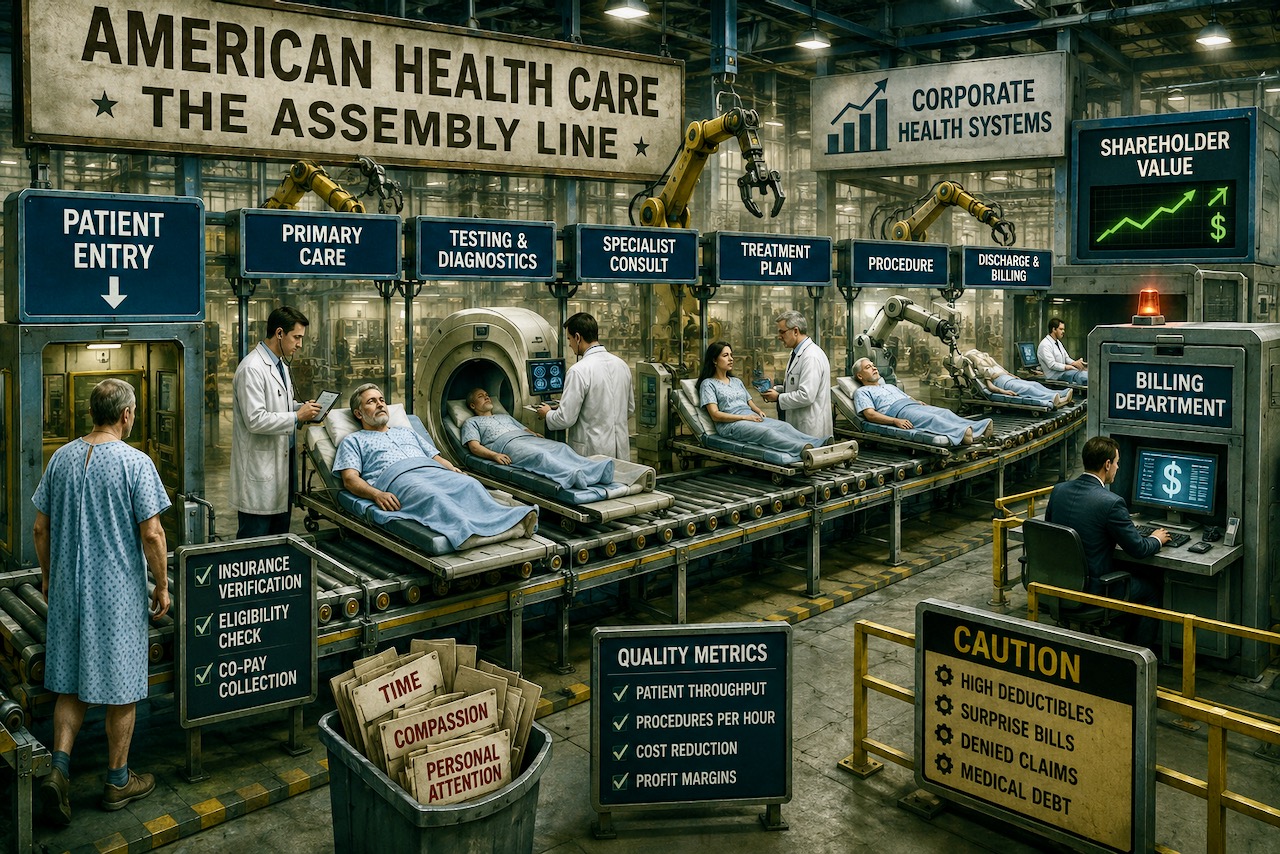
In my recent dealings with the health care system now in California, it still looks and feels like the health care field has been turned into an assembly line factory. Some of this may be the result of the massive health care crisis we faced a few years ago during the debilitating Covid-19 pandemic. But it is also a result of mergers and acquisitions that have allowed the conglomeration of large corporate chains to take over hospitals, just as they have taken over banking and other industries.
This is not to say that such a system is all bad. Economies of scale can have positive outcomes. And in fact, most of my dealings with health care professionals in Maryland and California has been amazing, compared to what is still happening today to people in Alabama and other so-called Red States, where federal money was denied to millions of citizens that could have saved hundreds of hospitals, thousands of jobs and tens of thousands of lives.
Health Details
While at the age of 67 last summer I was in a very good state of health, feeling good and having fun while covering politics and science in the nation’s capital, I did have a couple of health care issues. I had been diagnosed with gout in my knees and left big toe, so I had stopped riding a mountain bike around as my alternative form of transportation in addition to a Roadtrek camper van. My doctor prescribed pills to get rid of the gout, and scolded me to drink more water.
Then when I found it was hard to see to drive at night, I was diagnosed with cataracts on my eyes. So I began the process of getting lined up for cataract surgery to fix the problem, a relatively minor medical procedure these days. But my primary care doctor insisted that I have a physical exam before being approved for the surgery. He did not like the result of one electrocardiogram, so he insisted I see a cardiologist to get advance approval for the cataract surgery.
A bit perturbed by this, since I was in a hurray to get my eyes fixed before making a long-planned cross country excursion to California, I went along with it. I had no choice.
I passed the first test, a stress test, barely making it through a 10 minute ordeal on a treadmill running uphill while hooked up to a bunch of medical equipment. My heart rate tested pretty standard, although apparently there was one sort of blip on the electrocardiogram during the ordeal. So the cardiologist, a very nice young doctor from Brooklyn, New York, ordered another test, an echocardiogram.
When the results of that test came in, it was determined that I had a “sticky valve” in my heart that was not opening as wide or closing as fast as it should. At that time you could not even hear or detect this while listening to my heart in a stethoscope as a heart “murmur.” So the cardiologist signed off on the cataract procedure since it should have no effect on my eyes.
At the time I was having no symptoms from the problem. But because of having access to the health care system, it was detected fairly early. They did another procedure, inserting a catheter in my right arm artery, dropped some die in my heart and took pictures. When I woke up, the cool doctor from Haiti said.
“Mr. Wilson. We have good news. You have no blockages.”
So the cardiologist cleared me and told me when I got to California to get it checked out.
A few months ago, after being exposed to a large dose of Bull Pine rosin while helping a friend clear a downed tree from a driveway, I had an allergic reaction that resulted in a bout of pneumonia. No, I did not have the flu or Covid. But the cough was so persistent I ended up in the emergency room in Sonora, where they treated me successfully. But when the doctor on duty listened to my heart, he heard the murmur and referred me to a cardiologist.
Due to the remote, sparsely populated area where I’m staying, and a bit of a transportation handicap since the Ford camper van I traveled in across the country broke down in December, it took awhile to make the appointment to see the cardiologist. She referred me to a heart valve specialist in Lodi, north of Stockton, which is a two hour drive from Coulterville near Yosemite.
My main doctor and that specialist said my “sticky valve” would be easy to fix with a simple 30 minute not so invasive procedure to insert a balloon attached to a pig valve in an artery to replace the sticky valve. But he ordered another test at St. Joseph’s Hospital in Stockton, a CAT scan. This called for a followup appointment back in Stockton this past Thursday, another four hours of driving there and back.
I’ve got to be honest with you. St. Joseph’s is an old Catholic hospital that is now owned by a health care conglomerate. The woman who signed me in said it was a nice hospital back in the day when the nuns were running it. But something about it sort of gave me the creeps, including the fact that the crosses with Jesus were still all over the place.
“It’s all about the money now,” the woman said.
It did appear to be run a bit like a factory. The staff who do CAT scans do CAT scans all day long every day. This has to get monotonous and boring after awhile, sort of like working on the assembly line in a factory, although I suppose the pay and benefits must be pretty good compared to a lot of other jobs. The average pay for a radiology or imaging nurse working with CT scans in California ranges from approximately $112,191 to $139,129 per year ($53 to $67 per hour).
Working on an assembly line in a factory is something I know a little about. A long time ago I had a summer job working on an assembly line in a fire extinguisher factory in Trussville, Alabama. I sanded the red paint off the used, recycled ones. Then stacked them neatly in a box, and transported them to the beginning of the paint line using a fork lift.
Boring. I didn’t like it much and didn’t last long. I was fired after being late to clock in three times in 30 days, by five minutes each time. I fell asleep in my car in the parking lot after playing rock and roll all night from 2-5 a.m. in a late night club on the west side of Birmingham.
Followup Appointment
Anyway, on this followup appointment, I was escorted by a nurse down a long hallway to a remote part of the hospital where there were no other people, just rooms labeled “Physician Sleep Room.” I guess the surgeons sometimes take naps in between operations.
After waiting awhile, another heart specialist showed up and gave me the sobering results. I’m sure my facial expression dropped. He said the “team” in Stockton and Lodi had concluded they wanted to perform open heart surgery to replace the valve with a larger one than could be inserted in the less invasive procedure. In 10 years, he said, they could then insert the smaller valve with the newer TAVR method.
Now I have a decision to make. I’m considering asking for a second opinion from heart specialists in Modesto, where there is a hospital and doctors with a longer history and more established reputation. But of course that will delay everything. I was all set to agree to the TAVR procedure. But to tall you the truth, I’m not particularly interested in open heart surgery, especially since I’m experiencing no symptoms.
The doctors keep asking me if I’ve experienced any shortness of breath, dizziness, chest pains or trouble walking. I keep telling them no.
Back in May, I had no trouble hiking two miles in Yosemite National Park to the lower falls and the parking area by El Capitan.
A Promise of Community Collaboration Emerges From Visit to Yosemite
And then, why would I want to live another 15 years anyway? Why would anyone want to live in a country run by a fascist dictator-king and a world about to be run by A.I. bots, devastated by one climate related crisis after another with no political will or leadership to address the problems?
I could just let nature take its course. After all, why would anyone recommend open heart surgery for a patient who is experiencing no symptoms? Is it just all about the money as the woman indicated?
Stay tuned as we investigate this.
__
Next, we will report on how the Health Care Industry works like a factory. Then we will explain how the Affordable Care Act changed American health care. Next we will show how the Trump administration is changing it again. And finally, we write about what the world will be like in 10 years, when there will be nine billion people on a planet devastated by climate change.
Part II – When Medicine Starts to Look Like a Factory
Part III – The Affordable Care Act and the Corporate Transformation of American Medicine
Part IV – Trump’s Changes to American Health Care
Part V – Nine Billion People on a Warming Planet: Humanity’s Next Great Test
___
If you support truth in reporting with no paywall, and fearless writing with no popup ads or sponsored content, consider making a contribution today with GoFundMe or Patreon or PayPal.









Why is it Europe and the “advanced” industrial countries have socialized medicine and only America continues with an ill equipped, outdated system? Part of it centers around paid lobbyist protecting their already obscenely rich clients and the other deals with our collectively inability to think as “conservatives” and so-called religious influences have incorrectly linked social welfare to “socialism” and “communism.” Read the Teachings of Jesus, He really promoted social welfare and the interests of the downtrodden. Regarding those aspects, I believe, Sanders liberals are correct in stating healthcare is also a human right. What did surprise me is that the GOP got into lock step touting health care is a commodity that can only be explained by the belief that those without money are a drain on society failing to understand that this country’s biggest freeloaders are corporations that pay no taxes and maintain offshore bank accounts.