The Big Picture –
By Glynn Wilson –
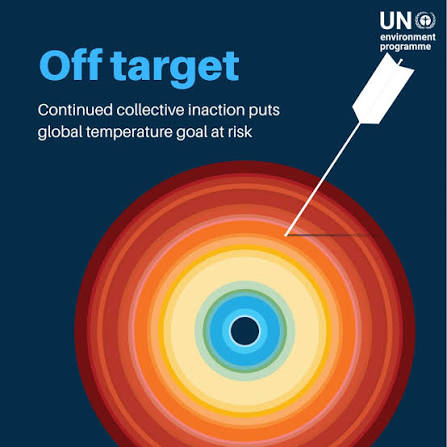
The world has failed in its goal of limiting the average global temperature to 2.7 degrees Fahrenheit and must take fast action to limit the “overshoot” or face even more cataclysmic consequences from climate change due to global warming from the burning of fossil fuels for energy and transportation.
This is the conclusion from a 141-page U.N. report released by the United Nations on Wednesday.
In first writing about the report,
Most of the world’s countries agreed in Paris a decade ago to try to limit global temperature rise to “well below” two degrees Celsius while aiming for the more ambitious target of 1.5 degrees Celsius, or 2.7 degrees Fahrenheit.
The new report warns that the world is certain to breach that mark and should focus on finding ways to limit “overshoot” and eventually bring global temperatures back down.
“Despite all the warnings, the world has continued to emit greenhouse gasses at record levels, so this conclusion wasn’t unexpected,” said Martin Krause, Director of the UN environmental program climate change division. “But it should be a wakeup call to everyone. Climate change is real, it’s happening and unless we do something about it soon, the consequences will be severe.”
Despite advancements in alternative energy sources such as wind, solar and battery power, most countries have continued to burn oil, gas and coal, releasing carbon dioxide into the atmosphere where it traps the sun’s heat. This has raised average global temperatures by about 1.4 degrees Celsius.
The damage from global warming is now felt across the planet, with intensifying heat, massive wildfires, debilitating droughts and catastrophic floods, along with other threats to people, animals and plants.
The idea laid out in the U.N. report would be extremely difficult because it would require pulling carbon dioxide out of the atmosphere on a colossal scale. Achieving that would potentially mean blanketing enormous parts of the world with forests or relying on novel technologies for sucking carbon out of the air that haven’t yet worked on any significant scale.
Under such a scenario, the planet would still continue to heat up for the foreseeable future, and wouldn’t return to temperatures like today’s for decades or even centuries. And some changes, like glacial melting or rising seas, would be essentially irreversible.
“This is by no means an acceptable or preferred pathway,” the U.N. said in its report. “It is simply the best remaining option.”
But even this fallback plan would require the kind of climate ambition and major cuts in greenhouse gas emissions that have long been out of reach. To add to the challenges, the Trump administration has withdrawn the United States – the largest historical emitter of greenhouse gases – not only from the agreement but from the global fight against climate change altogether, all while purposely weakening and domestic environmental policies.
Based on current climate policies among nations and trends, the planet is expected to warm 2.6 degrees Celsius, or 4.7 degrees Fahrenheit, by the end of the century.
“So long as we fail to find political will, we will be marching past every target we put out there. That is the danger,” said Michael Mann, a professor of earth and environmental science at the University of Pennsylvania who was not involved with the report.
Dr. Mann noted that even at current levels of warming, “dangerous and catastrophic climate change is here,” referencing last week’s deadly glacial collapse and flood in Nepal.
António Guterres, the U.N.’s secretary general, had previously acknowledged that the 1.5 Celsius mark — the most ambitious aspect of the Paris Agreement among nations to limit global warming — would inevitably be breached. The new report makes clear just how little margin there is for the overshoot plan to be feasible.
Specifically, in order for temperatures to be brought back to the 1.5-degree mark this century, global warming at its peak would have to be limited to 1.8 Celsius (3.2 Fahrenheit), compared with preindustrial times. Most scientists describe that as unlikely.
Then, countries would have to ramp up an enormous program for removing carbon dioxide from the atmosphere. Even under the most optimistic scenarios, a single decade of warming could take about 50 years to reverse.
Glen Peters, a senior researcher at the CICERO Center for International Climate Research in Norway, said the idea of bringing down temperatures might sound as easy as “planting a billion trees” to absorb carbon dioxide. But tracts of land larger than entire American states would need to be reforested. Conflicts with agriculture could arise. Higher temperatures could hinder forest growth. And of course, wildfires could stymie progress.
“Anything at scale, you’re going to run into some sort of problem,” said Dr. Peters, who was not involved in the report.
The report says that while tech-based solutions would be needed, it noted that the current industrial capacity to pull carbon dioxide from the atmosphere is extremely limited. The technology has long been controversial in part because the fossil fuel industry has pitched it as a way for their products to continue to be used. Over the course of the industrial age, the burning of fossil fuels has released immense amounts of planet-warming carbon dioxide into the atmosphere.
Climate Analytics, a Berlin-based climate science and policy institute, said in a statement that the U.N. report risked “being a call to apathy,” and criticized the report for not more explicitly mentioning the need to phase out fossil fuels. Countries committed to pivot away from oil, gas and coal at an international climate summit in 2023 but carbon emissions continue to climb.
The U.N. report predicted the rise in average global temperatures would eclipse 1.5 degrees Celsius in “the next few years.” At that level of warming, “there are no good outcomes,” said Inger Andersen, the executive director of the U.N. Environment Program.
Already common extreme weather events, like heat waves and floods, will intensify, as will the melting of glaciers, the rising of sea levels and the bleaching of coral reefs, the report said. There is also a risk of changes in crucial global systems, like the weakening or collapse of ocean currents that carry heat northward from the tropics, the report said, with the potential to “reshape the world forever.”
“Every fraction of a degree of warming we avoid means climate change will be less severe,” the U.N. says. “If we buckle down, we can still potentially save lives, spare economies and prevent the world from reaching devastating climatic tipping points.”
“We have the technology and the know-how to end the climate crisis,” Krause said. “What we need now is the political will.”
___
If you support truth in reporting with no paywall, and fearless writing with no popup ads or sponsored content, consider making a contribution today with GoFundMe or Patreon or PayPal.