More Than You Ever Wanted to Know About It –
The Big Picture –
By Glynn Wilson –
COULTERVILLE, Calif. – In a world battered by one instantaneous crisis after another, where attention spans are cut short from years of propaganda spread on phones and every other medium of communication by so-called social media, what is the place for a documentary based on 250 year old paintings that takes 12 hours over six days to make a subtle point? The American experiment in self government, a democratic republic, faces another dire threat that could be the end of it, again?
On the promotional trail leading up to the release of the film, eight years in the making and costing $30 million to make, the bright-eyed and seemingly innocent and still boyish Ken Burns has been careful to avoid any partisan edge to his comments. But during a trip to Saratoga, the author Rick Atkinson, a prominent voice in the film, spoke more pointedly.
“What did the founders fear most? What did they most fear?” He repeated. “It wasn’t the British. They most feared the rise to power of an autocrat who did not share the values that the founders tried to embrace.”
Burns’ response?
“I just really hope the film has an ability to speak to the people who are concerned about the direction of the country, whoever that might be,” he said impishly.
In three separate stories about the film, the book that comes with it, and the promotional tour, the vaunted New York Times is also subtle in making what should be a simple, straightforward point: On the eve of our 250th anniversary, we are being led down a destructive path by America’s first real fascist dictator. His name is Donald F. Trump.
So how hard was that? That’s all you have to say. Then run all the stories that prove it, as I have been doing for a decade now.
1138 search results for “Donald Trump”
But for those who need more convincing, and have the time to do a bunch of reading online, let me slow walk you through the maze of coverage.
According to Times coverage of Burns’s latest documentary, “the war for independence was also a civil war. Amid a bitter fight over history, its timing feels urgent.”
What ‘The American Revolution’ Says About Our Cultural Battles
In 1990, Ken Burns established his reputation with an enormous PBS documentary about the Civil War.
We may not be used to thinking of the fight for independence from Britain as a civil war.
“But this sweeping and sneakily provocative six-part series, which begins on PBS on Nov. 16, says that we should.”
“The greatest misconception about the American Revolution is that it was something that unified Americans,” the historian Alan Taylor says in the second episode. “It leaves out the reality that it was a civil war among Americans.”
Part of that division involved the bitter and often savage recriminations between pro-independence Americans and those loyal to Britain. But those were not the only Americans at battle. As the film emphasizes, the war was also often a struggle between American colonizers and Native Americans, between enslavers and the enslaved. Some Americans won their sovereignty and freedom. Others — particularly non-European Americans — lost it.
The film is not Burns’s most innovative, one Times writer says. “Its techniques and rhythms are familiar from ‘The Civil War’ and its successors. It is not his most moving; that title likely goes to his 18-hour heartbreaker, ‘The Vietnam War.’ But it is perhaps his best-timed, and not only because the country’s 250th anniversary is coming next year but also because Americans are again passionately and even violently divided, over matters including history itself.”
It arrives as public broadcasting, along with its mission to speak to every part of America, has been perhaps mortally wounded. It comes in an era of political violence and cultural war over American history, with deeply divided camps claiming the mantle of 1776.
And it is dedicated to a belief that seems increasingly old-fashioned: that we share a common story and that people are willing to hear it, both the good and the bad. There was a time when Burns’s expansive tales of the past could draw a broad audience of Americans, whatever their differences in the present. Perhaps that too is now history.
ON THE SURFACE, “The American Revolution” — directed by Burns with Sarah Botstein and David Schmidt and written by his longtime collaborator Geoffrey C. Ward — is exactly what Burns’s past documentaries and your memories of grade-school history class would lead you to expect.
Peter Coyote’s familiar, soothing narration tells of a rebellion that was not guaranteed to succeed. It lays out the Enlightenment ideals that inspired America’s fledgling democracy. It builds tension through the patriots’ early military disasters, illustrating battles with red and blue arrows snaking across parchment-hued maps, from land to sea, city to frontier, Lexington to Yorktown.
As in “The Civil War,” Burns and company create the kinetic illusion of war footage, cutting between artworks and re-enactment images to the sound effects of cannon. There are long, ugly descriptions of bayonet warfare. The war it depicts is not the jolly enterprise of fifes and drums and men in powdered wigs but savage, sweaty butchery, often among neighbors.
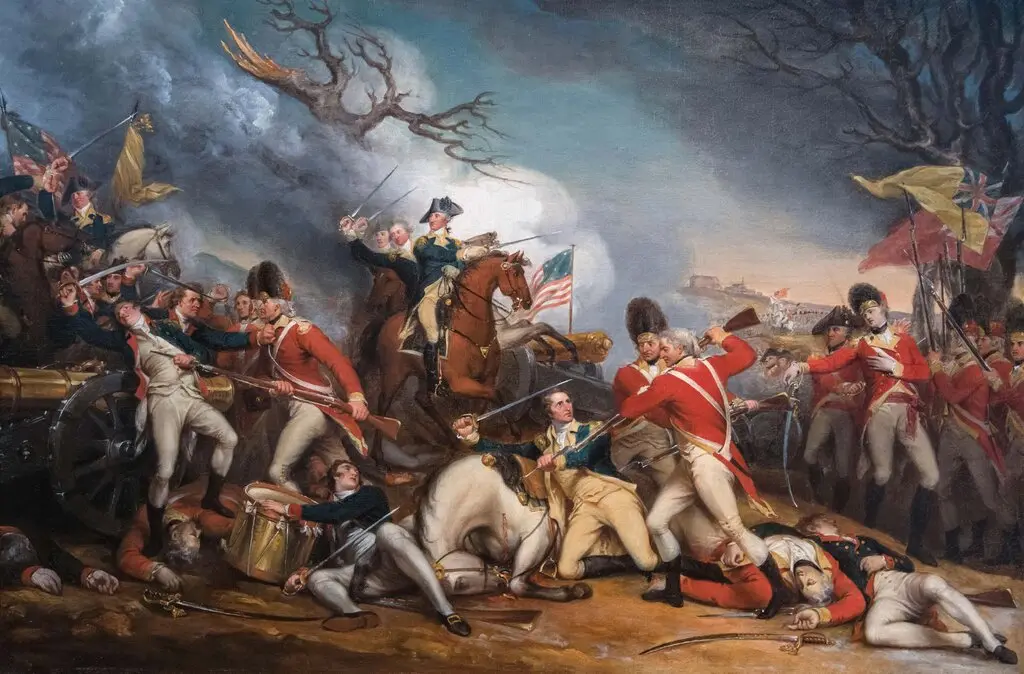
Also as in “The Civil War,” Burns enlists a troupe of celebrities to voice historical figures and common people. George Washington (Josh Brolin) emerges as a complicated hero, a field general who made numerous tactical mistakes but who also had the singular personal magnetism and character to hold together exhausted troops and squabbling politicians.
So far, so History 101. But the film also makes clear quickly that there is more to this story. The introduction shifts from Thomas Paine (Matthew Rhys) urging resistance against tyranny to a description of the Haudenosaunee Confederacy, a Native American democracy that long preceded the United States. It weaves in the voices of enslaved Black Americans, who fought on both sides of the war. (Washington, the historian Christopher Leslie Brown says, worried that having them fight alongside white soldiers would undermine the institution of slavery.)
Over its 12 hours, “The American Revolution” takes two parallel tracks: the stories of white leaders who would eventually appear on dollar bills and in portrait galleries, and those of Americans of color, who were often used as pawns or had to choose which side of the war offered them the best chance at autonomy.
These multiple tracks, in the film’s telling, are part of the same larger story. The Revolution was part of a worldwide war involving British colonies stretching to the Caribbean and Asia. And a big motive of the colonists, the film argues, was westward expansion into Native American lands beyond the Appalachians, which the British had forbidden (and in which Washington, among others, had financial interests).
The result is neither a glorification of the revolution nor a condemnation of the founding fathers. It’s just an attempt to bring in as many affected voices as possible, to situate “the most consequential revolution in history” in a global context, to make America’s founding story even bigger than you were originally taught.
THIS SHOULDN’T BE CONTROVERSIAL. It is simply history for grown-ups, which assumes that people can accept both that the revolution was a triumph for the idea of liberty and that the revolutionaries who fought it didn’t live up entirely to their beautiful words.
It is also the kind of story Burns has been telling for decades. “The Civil War” established an aesthetic style — the pans across old photos, the plangent fiddle music — as well as a people’s history approach that put the stories of foot soldiers and civilians on the same level as those of presidents and generals. The series drew some criticism, including that it was too sympathetic to Southern rationalizations for the war, but around 40 million Americans tuned in for a long-form history lesson whose most whiz-bang special effects were tintype photographs.
Burns’s approach hasn’t really changed much. There are some new tools, like 3D graphics, and some nods to the times. (“The Civil War” referred to “slaves”; “The American Revolution” talks about “enslaved people,” the preferred term among those who argue that it is dehumanizing to define people by their status as property.) You could imagine a timeline when “The American Revolution” would seem nothing more than an earnest, slightly dull prequel to “The Civil War.” But in our actual timeline, America, with a landmark birthday approaching, is in the midst of a pitched war over its own past. In this timeline, “The American Revolution” feels urgent, necessary and maybe even risky.
The second Trump administration has been purging cultural institutions of the barest whispers suggesting that the country’s history was anything but glorious triumph. The president has criticized the Smithsonian Institution for focusing on “how horrible our Country is, how bad Slavery was” and had its museums scrutinized for their “alignment with American ideals.”
His administration has ordered the renaming or review of military ships named for civil rights leaders and the restoration of military base names that honored Confederate generals. It has thrown out symbols of diversity and social progress in favor of celebrations of tradition and dominance. And the military parade that President Trump threw on his birthday, under the banner of the America250 semiquincentennial celebration, suggests he may cast next year’s anniversary in his own aggressive image.
When you control how people discuss the past, you control how they see the present and imagine the future. No wonder the country’s political movements have also fought to claim the legacy of ’76, from the Obama-era Tea Party to the current “No Kings” protests, whose anti-royalist branding is straight out of “Schoolhouse Rock.” The president has joined the war of symbolism too. On the day of massive demonstrations in October, the president shared a fake video of himself flying a military jet, wearing a golden crown and dumping excrement on the marchers.
“THE AMERICAN REVOLUTION” COULD be a teaching moment right now, a chance to find common ground, a reminder and warning about a volatile time when neighbors sought retribution against neighbors.
Though the film was in production for over eight years (around as long as the war for independence took to fight), it feels pointedly current. Sometimes the parallels are subtle. The film notes that Washington at first resisted and then mandated smallpox inoculations for soldiers, and it’s hard to imagine that anyone in the editing room was unaware of the Covid vaccine battles. The resentments of frontier settlers over limits on expansion recall the grievances of modern rural politics.
Other similarities hit, as history often does, square on the nose. As the current administration sends the National Guard into cities over the objections of local officials, the film describes the British alienating Bostonians by sending an army — citing security concerns — to occupy the city. “Good God,” says the Rev. Andrew Eliot (voiced by Tom Hanks), “what can be worse to a people who have tasted the sweets of liberty?”
And as the film describes the draft constitution’s balance of powers, the choice of emphasis is hard to ignore. “They feared that a demagogue might incite citizens into betraying the American experiment,” Coyote says. “Alexander Hamilton was concerned that an ‘unprincipled’ man would ‘mount the hobby horse of popularity’ and ‘throw things into confusion.’” The script names no current names, but critics of President Trump have cited this quote for years.
Meanwhile, the return of Burns, one of PBS’s biggest non-Muppet stars, is a meta-testament to another current story — the war on public broadcasting. The funding credits of “The American Revolution” note that it was “made possible, in part, with support from the Corporation for Public Broadcasting.” That organization announced plans to shut down next year, after Congress clawed back $1.1 billion in funding.
Burns has called the cuts “short sighted” but said he will personally be able to continue his work. He’s in the position to do that because of the support public TV provided him from early on. But Burns is 72. Who will support his successors? In a media environment that rewards flash, conflict and catering to ideological bubbles, what other network will tell Americans, all Americans, that they share a common set of facts, a common history and common challenges?
Of course “The American Revolution” does not address the public-broadcasting controversy or the continuing fights over public history in museums and universities, but it is an implicit part of those arguments. The series makes its case the way Burns’s whole body of work has: by trying to tell a full story and trusting, maybe with quaint optimism, that all kinds of Americans will want to hear it.
The series might well draw controversy pointing out the founders’ contradictions. But “The American Revolution” is also deeply patriotic. It gushes with love for America’s natural beauty, for its democracy and for its professed, if not always realized, ideals.
In its telling, the American story is one of always striving to get closer to those ideals — not of being perfect but of becoming more perfect. Its closing words are “The revolution is not over.” You can take that as a tribute to how the spirit of democracy endures. But watching the series in these times, I also hear an echo of the end of “The Civil War,” in which the historian Barbara Fields says: “The Civil War is still going on. It’s still to be fought. And regrettably, it can still be lost.”
As the historian Vincent Brown says in “The American Revolution,” you can admire how Thomas Jefferson articulated the cause of human freedom and recognize that he denied freedom to the humans he owned. “I think it’s incumbent on all of us to take those words from Jefferson and make them real in our own lives,” he says, “even if they weren’t real in his.”
Patriotism, “The American Revolution” argues by example, is not about hiding the stains of the past behind pretty oil paintings. It means loving your country enough to tell its whole story. Once upon a time, that mission might have seemed middlebrow and dull. Today, for better or worse, it is positively revolutionary.
The Book Review
THE AMERICAN REVOLUTION: An Intimate History, by Geoffrey C. Ward and Ken Burns
In “The American Revolution,” an illustrated companion to a new documentary series, the conflict is global, gruesome and tearing us apart.
Ken Burns Brings the War of Independence to the Unruly Present
An important historical anniversary is coming in 2026, and that can mean only one thing. Ken Burns will be ready with a PBS documentary …
Burns is also ready with a book, and it is a doorstop. “The American Revolution: An Intimate History” clocks in at 581 pages, with more than 500 illustrations. …
Brought forth with his frequent collaborator Geoffrey C. Ward, the book covers a vast terrain, chronologically and geographically. It is a sprawling canvas in every sense, including its generous use of paintings and maps.
There are six chapters written by Ward, corresponding to the six two-hour episodes that will be aired in the documentary. The first begins in May 1754 — 21 years before the Battles of Lexington and Concord — and the last chapter goes from “May 1780-Onward.” In other words, to now.
The authors are not wrong to suggest that all of American history goes back to these seminal events, including the French and Indian War that preceded and led to the Revolution. The founders, too, were conscious that something profoundly important had happened, even before the first shots were fired in Lexington. John Adams used the word “revolution” to describe a determination, forged “in the minds of the people,” to try a new form of government, rooted in the people themselves.
It required courage and eloquence and valor to win the battles that followed, and that, naturally, is the stuff of compelling television. But it can be daunting, in these toxic times, to approach any historical topic — let alone one as ripe for misinterpretation as the American Revolution — without setting off a trip wire. Was the Revolution the birth of the greatest nation ever known? Or a deeply racist enterprise, fought by slave owners to protect their property?
Ward and Burns are right to believe that the moment is favorable for a reappraisal. Scholars have been doing remarkable research on the Revolution in recent decades, correcting older histories that presented the founders as cerebral men of towering brilliance who simply willed the country into existence, like an Enlightenment parlor game.
We now know more about the Revolution’s violence, and the equally lethal effects of disease, especially smallpox. As Ward writes, the virus that had “scarred, blinded or killed hundreds of thousands of Native Americans” now ravaged both the British and the American armies.
Americans were fiercely divided as they fought the British (who were also divided). A substantial number of Americans — perhaps a fifth — did not want the Revolution to succeed at all. They included African Americans who sought their freedom under the British flag; but many African Americans also fought for the American flag. Native Americans fought on both sides as well, as did many of those who numbered among the constant stream of immigrants. One of them, Thomas Paine, called America “a blank sheet to write upon.”
These internal fissures are a good foundation for a new look at the Revolution, especially today. The Americans of 1776 bickered and saw evil conspiracies everywhere. They argued over health policy, with some leaders, including George Washington, who first resisted ordering inoculation against smallpox, then mandated it, while others were understandably terrified to risk exposure to the disease. In other words, they were much like us.
Ward and Burns have incorporated some of this recent research, to good effect. Their narrative is interrupted six times, by interventions from well-known historians. Vincent Brown reasserts how the Revolution’s promises of freedom were emphatically denied to most African Americans; Philip J. Deloria explores how militias that fought the British also massacred Native Americans, splitting the skulls of women and children with mallets and axes; Maya Jasanoff reminds us of the stubborn presence of Loyalists, wishing that “the most unnatural, unprovoked rebellion” had never happened. They nearly got their wish. Washington marveled at his own victory, and wrote that it was “little short of a standing miracle.”
These essays bring sharpness. They also create a mild tension, at odds with the more lyrical tone that Ward and Burns bring to their narrative. For them, the Revolution was ultimately a difficult struggle, to be sure, but also “our epic song, our epic verse.”
At the same time, the story benefits from the ways in which it is not too academic. Ward and Burns offer a visual feast, conveying the full continental grandeur of North America. We see the familiar battlegrounds — Bunker Hill, Saratoga, Yorktown — but the story also ranges into the deep interior, and toward Canada and the Caribbean.
The wide angle helps to promote another recent strain of research, by showing the complexity of a broader “Atlantic World” in which ideas of political liberty, maritime commerce and the right to enslave others jostled against one another, uneasily.
The conflict was truly global. Ward and Burns highlight the role of the Hessian soldiers who fought for the British and describe the French warships that came to the aid of the rebels; Brown paints the predicament of African Americans into the wider context of slave revolts in the West Indies; and the scholar Stephen Conway notes in his essay that the Revolution was only one front in a constantly changing imperial calculus that included chess moves in Spanish Florida and even in South Asia, where the British were expanding their influence at the same moment. Cornwallis, the British general who lost at Yorktown, later became governor-general of India.
Despite the book’s girth, some topics are treated hastily. We learn why New Englanders were irritated by British taxes, but spend less time considering why they clung tenaciously to their liberties. The reasons related to their long memories of self-government in matters both political and ecclesiastical; Bostonians particularly hated the way that British authorities abused search warrants, a topic of growing relevance in today’s ICE age.
Still, such lapses are rare and do not detract from the fact that the book and, no doubt, its companion film will effectively ground the coming national conversation about our origins. We can’t avoid the American Revolution, so we might as well face it squarely. This hefty volume does just that, and reminds us how, against all odds, a fractious people came together in the first place. Let’s hold that thought, and see if we can get through 2026 in one piece.
The Promotional Trail

Ken Burns
Burns’s 12-hour documentary about our national origin story is landing in the middle of a culture war. Yes, it’s complicated. No, he does not want to talk about President Trump.
Can Ken Burns Win the American Revolution?
Jennifer Schuessler observed Ken Burns’s promotional tour at stops including Colonial Williamsburg, Monticello, Saratoga Springs, N.Y., and New York City.
It was a brilliant early fall morning in upstate New York, and Ken Burns was back on the battlefield.
He had just driven two hours from his home in New Hampshire to a rolling meadow outside Saratoga Springs, where the view has changed little since the Continental Army scored its first major victory over the British in 1777. After climbing onto the porch of an 18th-century farmhouse, he started delivering his now-familiar spiel to a small group of journalists and local officials.
“The American Revolution is encrusted with the barnacles of sentimentality and nostalgia,” he said. But his six-part, 12-hour documentary about the subject, which debuts on PBS on Nov. 16, will aim to strip that away — and hopefully bring some healing to our own fractured moment.
“We say, ‘Oh we’re so divided,’ as if we’re Chicken Little and this is the worst it’s ever been,” he said. “But the Revolution was a pretty divided time. The Civil War was a pretty divided time. Almost all of American history is division.”
Maybe storytelling, he said, can “help short-circuit the binaries we have today.”
The remarks were pure Burns — the kind of sunny all-American optimism that thrills his admirers, and draws eye-rolls among skeptics. But “The American Revolution,” which Burns directed with Sarah Botstein and David Schmidt, is arriving at a moment when even attempting to bring a unifying story to a broad American middle feels like a radical act.
Since returning to office, President Trump has renewed his call for a return to celebratory “patriotic” history, blasting away at those he accuses of slandering the past. He’s moved to purge the Smithsonian of what he deems “divisive race-based ideology,” and ordered material that “disparages Americans” to be removed from National Park sites. In July, his Republican allies in Congress eliminated federal funding altogether for PBS, Burns’s longtime broadcast home.
“The American Revolution,” with its frank discussions of slavery and Native American dispossession, certainly cuts against the Trumpist view of history. But in a six-month, 32-city promotional tour across red, blue and purple America, Burns has been sticking relentlessly to a hopeful, nonpartisan, nonconfrontational script.
Whether at sold-out events organized by PBS affiliates or on bro-friendly podcasts like Joe Rogan and Theo Von, he has talked again and again (and again) about “putting the us back in U.S.,” and hailed the Revolution as “the most significant event in human history since the birth of Christ.”
At every stop, he has talked about the preciousness of democracy and defended PBS, where he is as synonymous as Big Bird. But he has rarely uttered the words “Donald Trump.”
In an interview last month in New York City, Burns acknowledged the charged moment. But when it comes to the film, he insisted, his responsibility is the same as it has always been: to tell the story of the past straight, to as many Americans as possible.
“I just really hope the film has an ability to speak to the people who are concerned about the direction of the country, whoever that might be,” he said. “This spectacularly inspiring story of our founding, as dark and complex as it is, has — I think, I hope — the ability to add something to the conversation right now that is unifying.”
Liberty For All?
Burns started working on the film in December 2015, while finishing up his documentary on the Vietnam War. Barack Obama had 13 months left in the White House, and enthusiasm for the upbeat, inclusive vision of the founding in the musical “Hamilton” was at its peak.
The filmmakers’ main concern wasn’t politics or historiography, but something more basic: How do you make a compelling documentary with no photographs, no newsreels, no living witnesses and a visual record that reads to many Americans as starchy and boring?
“The American Revolution,” which cost more than $30 million, began with the building of an archive. As the historian Geoffrey C. Ward (who has written 20 of Burns’s documentaries) dove into scholarship on the Revolution, researchers assembled more than 18,000 maps, engravings, paintings and documents, culled from nearly 350 galleries, museums and libraries.
The film makes ample use of the famous “Ken Burns effect,” with the camera panning across static images. It also uses newer tools, like the CGI maps used in some battle sequences. But the biggest departure was the use of re-enactors.
The cinematography team, led by Burns’s longtime collaborator Buddy Squires, filmed hundreds of re-enactors and costumed interpreters across the 13 colonies, in all kinds of weather. Shooting overhead with drones and up close on the ground, they captured soldiers and sailors, but also washerwomen, blacksmiths and farmers.
“We wanted to find a way to make people feel real and alive, including those who didn’t leave a lot behind that lets you figure out how to recreate them,” Botstein said.
The spine of the documentary is the military story, which is highlighted in 36 often suspenseful (and speaker-rattling) battle sequences, from the famous (Bunker Hill, Yorktown) to the more obscure. But its emotional heart is the first-person testimony of nearly 150 historical characters from all segments of society, read by 61 different voice actors.
We hear plenty from the Founding Fathers. But we also get the words of women, Native Americans, free and enslaved Africans, poor Irish immigrants, German mercenaries — all of whom wrestle with what it means to seek freedom, and often find very different answers.
That approach is very much in keeping with the latest scholarship, which depicts the Revolution as a hyper-violent civil war that divided families and communities and left many Native Americans and African Americans worse off, and less free. And the film doesn’t demonize loyalists, who were sometimes subjected to horrific retribution.
“They weren’t bad people,” Burns said. “They were just what we would call conservatives.”
The film notes that while roughly 5,000 Black people, free and enslaved, fought on the patriot side, an estimated 15,000 fought for the British, who promised them freedom (a promise that was largely betrayed).
But for many viewers, the most eye-opening part of the documentary may be the centrality of Native Americans. They are presented not as victims or bystanders, but as members of powerful nations faced with complex choices about how to defend their own liberty.
In the prologue, the film’s narrator, Peter Coyote, says the Revolution was sparked by disputes over “Indian land, taxation and representation.” It’s an acknowledgment that the colonists’ desire for unfettered access to Native lands was a primary cause of the break with Britain, which had forbidden any settlement west of the Appalachians.
That theme is echoed throughout the documentary. One of the most chilling sequences describes the Sullivan campaign of 1779, in upstate New York, where Washington ordered the destruction of all villages, crops and orchards of the Seneca and Cayuga, who had allied with the British. “You will not by any means listen to any overture for peace, before the total ruin of their settlements is effected,” Washington declared.
But the film is not an exercise in tearing down heroes. In one sequence, two historians — not a profession known for embracing the great-man view of the past — each describe Washington as the essential man of the Revolution, who kept the 13 colonies united through eight years of war.
“He was the glue that held people together,” the historian Annette Gordon-Reed says, adding, “We would not have had a country without him.”
‘Inspiration With Content’
Burns has had a complicated relationship with academic scholars, who have sometimes dismissed his films as sugary and sentimental, too quick to paper over unresolved divisions with appeals to unity. “The Civil War,” in particular, has drawn persistent criticism for what some see as a romanticized depiction of the conflict as a family feud that stemmed mainly from a failure to compromise.
For “The American Revolution,” the filmmakers drew on two dozen historical consultants, who offered extensive comments on multiple drafts and rough cuts. They include best-selling authors like Joseph Ellis and Stacy Schiff, along with leading academic scholars of three generations and multiple perspectives, from Bernard Bailyn to Ned Blackhawk.
Their differing views appear onscreen not as an argument, but as a kind of chorus — a reminder that the Revolution meant, and still means, different things to different people.
It remains to be seen what Burns’s version will mean to viewers, including ideologues who may be ready to pounce. Last January, Burns and Botstein appeared with three historians at the annual meeting of the American Historical Association. When someone brought up the possibility of political attacks, there was a pause, then nervous laughter.
“We’d love your help in getting it out and making sure in the local areas it isn’t excised in a way that just favors one shocking thing,” Burns said.
That fear remains. But some scholars who worked on the film said they sense a hunger across the political spectrum for a conversation that stands outside today’s partisan polemics.
Kathleen DuVal, a historian at the University of North Carolina, calls it “inspiration with content.”
“People want to be reminded why having a republic is important and what people did to get it,” she said.
Jane Kamensky, a former Harvard professor who is now the president and chief executive at Thomas Jefferson’s Monticello, said the film offers a “head and heart synthesis” that leaves room for viewers to reach their own conclusions.
“The Revolution was the Big Bang of the question of what it means to be one people,” Kamensky said. “That was there in 1776, and it’s there now. But at no point in working with the team did I feel like they were forcing resonances.”
A Republic, If We Can Keep It
Still, 2025 has relentlessly forced those resonances.
In March, during an appearance at West Point, Burns received an enthusiastic response from cadets in the grand Gothic dining hall. But a few weeks later, word came that a similar event at the Naval Academy would be postponed, out of concern that Burns’s criticisms of President Trump during the 2024 campaign might draw an outcry from conservatives.
On July 4, after a swing through Georgia, the Carolinas and Texas, Burns was at Monticello, in Virginia, where he was the speaker at the annual naturalization ceremony. Before the event, in a makeshift green room in Jefferson’s front hall, someone brought up President Trump’s plans, announced the night before, for a UFC mixed-martial arts fight on the White House lawn next summer as part of the celebration of the 250th anniversary of the Declaration of Independence.
Burns dropped an un-Jeffersonian expletive. But out on Jefferson’s lawn, where the crowd was dressed mostly in red, white and blue, with a smattering of “I ❤️ PBS” T-shirts, he kept the tone high.
Whatever its messy origins, he said, quoting the film’s prologue, the Revolution came to be about “the noblest aspirations of humankind.”
“That is what this special day, then and now, and every moment in between, and where we will be next July — and onward — is all about,” he said.
Still, the less uplifting historical resonances have continued to pile up. In August, after the president deployed the National Guard in Washington, the first episode of the documentary premiered at the Telluride Film Festival. When the film quoted a colonist protesting the British deployment of troops to an increasingly rebellious Boston, the audience, Burns said, “erupted.”
On the promotional trail, Burns has been careful to avoid any partisan edge. But during the Saratoga trip, while waiting between events, the author Rick Atkinson, a prominent voice in the film, spoke more pointedly.
“What did the founders fear most? What did they most fear?” He paused. “It wasn’t the British. They most feared the rise to power of an autocrat who did not share the values that the founders tried to embrace.”
“I just really hope the film has an ability to speak to the people who are concerned about the direction of the country, whoever that might be,” Burns said.
So far, Burns’s insistence on both inspiration and complexity has played well with audiences, including those well outside the PBS orbit.
Earlier this month, on Theo Von’s podcast, he and Von bantered about the nation’s astrological sign (Cancer), and whether it shares the sign’s virtues (emotional, imaginative, loyal) and flaws (moodiness, insecurity, pessimism).
When Von suggested the Declaration was “kind of a love letter to the future,” Burns bounced on his seat, eyes widening.
“Oh my God, that’s the best expression I’ve ever heard!” he said, before pivoting to a favorite anecdote about Thomas Paine.
It was much the same in June when Burns flew to Austin, Texas, to record “The Joe Rogan Experience.” Over nearly three hours, he and Rogan talked about the need for heroes, and for honest accounting of their flaws. For much of the conversation, as Burns ran through his chestnuts, Rogan barely got a word in edgewise beyond “Wow.”
It’s a reaction Burns loves — proof that the audience for open-minded, fact-based history is still out there.
“That’s a very powerful thing,” he said, “when people let go of their own dialectical or polemical objectives and just say ‘Wow, I had no idea.’”
No idea? Where have they been?
My biggest criticisms?
There were a lot of minor side stories that could have been left on the cutting room floor. And then:
None of these songs were included? Why not?
___
If you support truth in reporting with no paywall, and fearless writing with no popup ads or sponsored content, consider making a contribution today with GoFundMe or Patreon or PayPal.