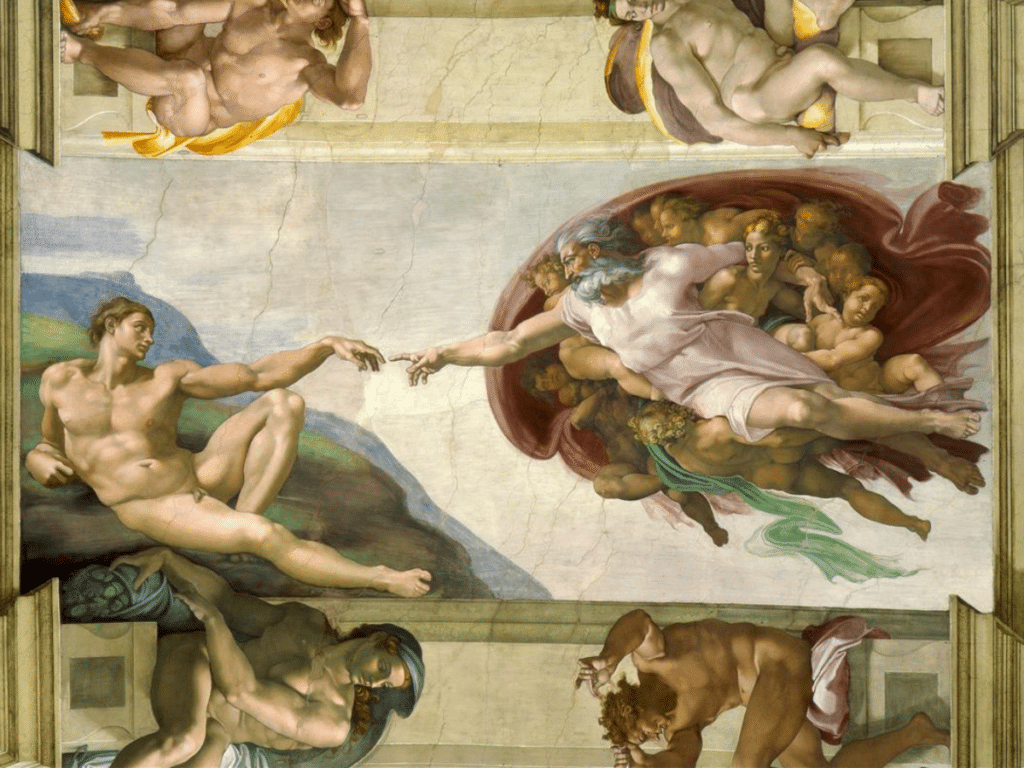
The Creation of Adam, 1508-12, Michelangelo Buonarroti
The Big Picture –
By Glynn Wilson –
Biologists sometimes talk about the cycles of life. Communications scholars occasionally debate aspects of the “news cycle.” Life appears to move in circles, like the rotating planet Earth itself.
Such it is with each individual life.
In recent times, with all the crazy chaos upending this fast changing world, I keep thinking back to 1969, about the time I turned 13. It was such a seminal year.
After our opening party Friday night with champaign toasts at the new Yosemite Arts and Crafts Center, I kept hearing this song in my head all weekend.
A Toast to a New Day in Coulterville California
It was Joni Mitchell singing the song she wrote about Woodstock, even though she was pulled from the bill at the last minute to appear instead on the Dick Cavett show in New York. When Crosby, Stills, Nash and Young recorded the song in 1970, they transformed Mitchell’s American folk meditation into an electric rock declaration. Neil Young’s searing guitar gave the song urgency, while the soaring harmonies made it sound as though an entire generation had found its collective voice.
I wonder where this voice has gone? And whether we will ever see another like it?
Vietnam
Then the war in Vietnam had become the nation’s open wound. Every night, the new television news cycle delivered another grim accounting of young Americans killed in jungles half a world away. Helicopters lifted the wounded. Body bags returned home with flags draped on caskets, while mothers cried. Politicians spoke of progress, while families buried sons whose names would one day be carved into black granite in Washington.
For millions of young Americans, faith in government was collapsing almost as quickly as faith in institutions built for progress over generations.
Nowhere was that transformation more visible than California. From the coffeehouses of Berkeley to the streets of San Francisco, from the beaches of Los Angeles to the hills above Laurel Canyon, an extraordinary cultural experiment was unfolding. Musicians, poets, artists, filmmakers and restless dreamers gathered with the conviction that another America was possible.
The counterculture was not simply about long hair, tie-dye T-shirts, or psychedelic music, as it is too often reduced in popular memory. At its heart was a rejection of violence, conformity, racial injustice and the relentless machinery of war. It was an imperfect movement filled with contradictions, but it carried a remarkable optimism — that ordinary people could build a more compassionate society.
Then Came Woodstock
Ironically, the defining festival of the era took place not in California but on a dairy farm in upstate New York during the summer of 1969. Yet spiritually, Woodstock belonged every bit as much to California as to New York. The ideals born in Haight-Ashbury, nurtured in Big Sur, amplified in Laurel Canyon and spread through the state’s music scene found their fullest expression there.
The remarkable thing is that one of the festival’s most enduring anthems was written by someone who never actually made it. Joni Mitchell, inspired by stories from her then-boyfriend Graham Nash, imagined the gathering as something almost biblical — a modern pilgrimage back to innocence.
It was not just a song but a prayer.
A prayer that hope existed alongside unbearable grief. While hundreds of thousands gathered in peace at Woodstock, young soldiers continued dying in Southeast Asia. While guitars echoed across open fields, bombers crossed foreign skies.
Well, I came upon a child of God
He was walking along the road
And I asked him, “Tell me, where are you going?”
And this he told me
Said, “I’m going down to Yasgur’s Farm
Gonna join in a rock ‘n’ roll band
Got to get back to the land
Set my soul free”
We are stardust, we are golden
We are billion-year-old carbon
And we’ve got to get ourselves
Back to the garden
Well, then can I walk beside you?
I have come to lose the smog
And I feel myself a cog
In somethin’ turning
And maybe it’s the time of year
Yes, and maybe it’s the time of man
And I don’t know who I am
But life is for learning
We are stardust, we are golden
We are billion-year-old carbon
And we got to get ourselves
Back to the garden
By the time we got to Woodstock
We were half a million strong
And everywhere was a song
And a celebration
And I dreamed I saw the bomber jet planes
Riding shotgun in the sky
Turning into butterflies
Above our nation
We are stardust, we are golden
We are caught in the devil’s bargain
And we’ve got to get ourselves
Back to the garden
While it’s tempting to romanticize the era, it would be equally mistaken to dismiss the period as naïve idealism. Many of the freedoms Americans now take for granted were strengthened during those turbulent years. Environmental protection gained momentum. Civil rights and Women’s rights came to the fore. The anti-war movement helped force difficult questions about executive power and military intervention. Music became a form of journalism, carrying truths that nightly news broadcasts often struggled to express.
California stood at the center of that cultural earthquake, and could once again play a role in changing the conversation with a song.
It was here the soundtrack was written for an anxious generation. Universities became laboratories for protest and political debate. The mountains and beaches offered the physical landscape for people searching for new ways to live.
Of course not every dream survived. Many were shattered.
Commercialism eventually swallowed much of the counterculture it once mocked. Politics hardened and division only grew worse. Cynicism replaced optimism. The Vietnam War ended, but new wars followed. The garden Joni Mitchell imagined proved more difficult to cultivate than anyone expected.
Still, the music endures.
More than half a century later, when you hear Crosby, Stills, Nash & Young sing “We are stardust,” listeners hear more than nostalgia. They hear a reminder that even during one of America’s darkest chapters, millions believed that peace was worth pursuing, that justice was worth demanding – and that art could still change hearts.
Perhaps that is the real legacy of 1969. Not that it solved America’s problems. But that, for one extraordinary moment, amid war and upheaval, a generation dared to imagine that another future was possible.
With the selfish gene now pumped up on steroids by politicians in Washington and social media, can we even stop and slow down for a moment to contemplate this time and see if we still have enough imagination to dream of another Renaissance?
The High Renaissance: A Golden Age of Artistic Innovation
Or have our attention spans and the ability to think clearly, creatively and abstractly just been blown to bits forever?
If so, while we won many battles in our lives since 1969, it appears we have lost the war. I do not want to admit that to you or to myself. But it appears to be true. What say you?
___
If you support truth in reporting with no paywall, and fearless writing with no popup ads or sponsored content, consider making a contribution today with GoFundMe or Patreon or PayPal.