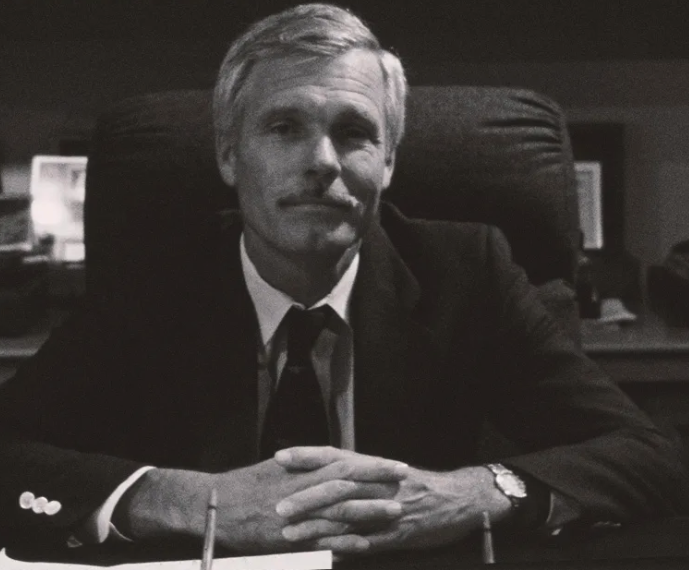
Ted Turner at CNN: NAJ screen shot
Tales From the MoJo Road –
By Glynn Wilson –
COULTERVILLE, Calif. – When I saw the news that CNN’s creator Ted Turner died the other day, I knew I would soon find time to write about him. He was one of the most iconic figures of our generation, and based in the Capital of the New South, Atlanta.
Nobody writes about the New South anymore. It was a late 20th century thing. But Ted Turner did more to move the South out of the 19th century than anyone, even though in his youth, he tended to side with the remnants of the Confederacy and against the Union cause.
As The New York Times wrote in its as always amazing feature obituary on Turner, he became much more than the creator of CNN and the 24-hour news cycle. I know people hate paywalls, which helped kill online newspapers, but this is THE one paywall you should pay for.
Ted Turner, Creator of CNN and the 24-Hour News Cycle, Dies at 87
“As one of the most important figures in media history, he oversaw a vast cable empire of news, sports and entertainment channels,” the Times writes in the subhead.
“Ted Turner, the media mogul who cut a brash and vivid figure on the American scene of the late 20th century by dominating the cable television industry, creating the 24-hour news cycle with CNN, and extending his restless reach into professional sports, environmentalism and philanthropy, died on Wednesday at his home near Tallahassee, Fla. He was 87.
“Phillip Evans, a spokesman for the family, confirmed the death. Mr. Turner announced in 2018 that he had Lewy body dementia, a progressive brain disorder.”
Yes, Turner will always be remembered for his signature creation, the Cable News Network, which did indeed revolutionize television news beginning in 1980 and coming into its own in the early 1990s during the first Gulf War. By using his father’s billboard advertising company in Atlanta as a launch pad, Turner started broadcasting often quirky news all day and night, eventually driving other media operations to do the same.
Many of us in the newspaper and magazine business at the time hated it, because it made us all have to work harder. It eventually created a news addicted culture, which led to the term “news junkie.”
The Times does not include that tidbit in its obit.
My first in person encounter with CNN came at the Atlanta headquarters building in 1986, when my good friend Brooks Boliek and I traveled there to take the test to try to go to work for the Associated Press, the dominate wire service then. Its Southern headquarters resided in Turner’s building.
They had us write news stories on old fashioned manual typewriters then, the kind you had to jam the keys down so hard you could not use the typing style taught in high schools and community colleges, where I learned to type. The only way to make them work was the old “hunt and peck” style of typing, one finger and one letter at a time. I had become fast at typing news stories on deadline on the first computers. So I did not exactly Ace the test on the time trials.
By the time CNN came into its own ahead of the ground operations in the Persian Gulf War in 1990 and ’91, when the cable news outlet found itself with a major advantage by having the only news crew left in Iraq because they were staying at a cheaper hotel across town in Bagdad while the major networks were kicked out of the country from the more expensive places, correspondent Peter Arnett became a media star even CBS, NBC and ABC had to follow and quote.
CNN’s coverage from Iraq brought it a prestigious Peabody Award, which noted that it had “matured from a cable curiosity to become an international service of inestimable importance.” Turner appeared on Time magazine’s cover as “Man of the Year” for 1991.
About that time Turner married the actress and activist Jane Fonda, and in part to please her, he hired Peter Dykstra away from Greenpeace and started a crack environmental reporting team that flew all over the country in a helicopter to cover breaking environmental news, especially disasters with great visuals for television.
At that time I had been hired by a chain of newspapers on the Gulf Coast to cover environmental news as a specialty beat, so many of my stories found their way onto CNN by way of the wire service UPI, where I was a free-lance stringer for about nine years.
In early 1993, I met Turner at the bar in the CNN building after interviewing with Dystra for an associate producer’s gig. He was drunk and holding court like the Captain Courageous of his reputation. He was a fascinating character with a boat load of personal charisma. I did not get that job, instead opting to go back to grad school in Tuscaloosa to earn a Master’s in Communications degree and teach journalism, including environmental journalism.
I met Turner one other time in that capacity. By the late 1990s, I was working on a Ph.D. in Knoxville, Tennessee and writing cover stories on environmental issues for the alternative weekly there, MetroPulse. One of those years the Society of Environmental Journalists held its annual conference in Chattanooga, Tennessee. I was a charter member that formed the organization in 1990 on the 20th anniversary of Earth Day in New Orleans.
Turner was the keynote speaker in Chattanooga, and Dykstra was there too. We had become friends.
Turner was his usual irreverent and quotable self, holding court after his luncheon speech at the bar in the Chattanooga hotel. I interviewed him there myself over drinks. But by then Turner’s influence had begun to wane at CNN. In 1996, he began the merger of his media conglomerate, Turner Broadcasting System, with Time Warner, to create one of the world’s largest media companies. It became necessary because Turner had amassed massive debt to build his empire.
“I’m trying to set the all-time record for achievement by one person in one lifetime,” he told the journalist Dale Van Atta in a Reader’s Digest article in 1998. “And that puts you in pretty big company: Alexander the Great, Napoleon, Gandhi, Christ, Mohammed, Buddha, Washington, Roosevelt, Churchill.”
It was a quotable expression of his mega ego, which often got him into trouble.
As the Times notes, not even his staunchest admirers placed Turner on that high a pedestal. But even a bitter rival like the media magnate Rupert Murdoch — who once had his New York Post run the headline “Is Turner Insane?” — had to concede that he was one of the most influential figures in the history of mass media.
About the time Turner captained the winning yacht in the America’s Cup race in 1977 and to take an active role as owner of the Atlanta Braves, he put baseball on live television. It was a brilliant move since it filled hours and hours of cable television time cheap.
I grew up as an Atlanta Braves baseball fan, the only professional baseball team in the South at the time. Turner made it possible for us to watch entire games on television, and finally built the team into a powerhouse by the 1990s. The team finally won a World Series in 1995 and dominated the sport in the 1990s, making it to the World Series five times.
Turner became a major philanthropist in his time, creating foundations devoted to protecting the environment, supporting the United Nations and reducing the threat of nuclear, chemical and biological warfare. A $1 billion donation to the U.N. in 1997, dispensed over 10 years, was aimed at aiding refugees and children, clearing land mines and fighting disease.
With typical brashness, Turner said the billion-dollar donation represented just the increase in his net worth in the previous nine months, and he called on other wealthy business people to follow his philanthropic example.
“There’s a lot of people who are awash in money they don’t know what to do with,” Turner said in a CNN interview with Larry King after the announcement. “It doesn’t do you any good if you don’t know what to do with it. I have learned the more good that I did, the more money comes in. You have to learn to give. You’re not born as a giver. You’re born selfish.”
There may be some truth to that, or not. I suspect we are all born with a selfish gene and altruistic tendencies, part of our evolution of survival.
Like Martin Luther King, also of Atlanta, once preached, “Everyone must decide whether they will walk in the light of creative altruism or the darkness of destructive selfishness.”
In the end Turner will be remembered as an egotistical and selfish son of a bitch who found the light and gave back much to his country and the world, unlike some of our egomaniacs in this country, like the one now occupying the White House. For that Turner should be remembered fondly.
___
If you support truth in reporting with no paywall, and fearless writing with no popup ads or sponsored content, consider making a contribution today with GoFundMe or Patreon or PayPal.