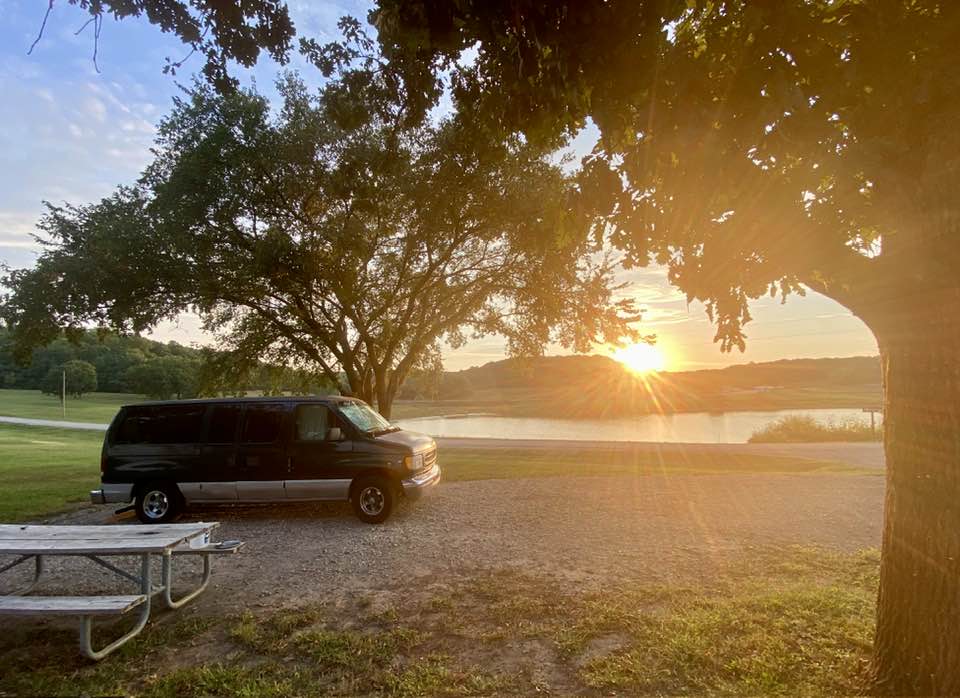
Gwyneth Ford in a Corps of Engineers campground on a Kansas lake near a dam on the Kansas River: Glynn Wilson
Tales From the MoJo Road –
By Glynn Wilson –
TOPEKA, Ks. – Oh, to have the patience of the great white egret I can see fishing outside the media camper van window as I sip the morning coffee, read the New York Times and post on Facebook.
It stealthily moves along the bank of the Kansas lake, inching forward and craning its neck in and out, watching the water for small fish to swim close enough for the jab. Then quick as a grasshopper, it snatches the fish and gulps it down, looking around as if to see if anyone is watching.
Then it lifts its wings out and up, and circles overhead to find a new fishing spot. Then repeats the routine until its morning hunger is sated. Next it flies higher and around in a larger circle, hooking up with its mate for a victory lap. Then it’s time for some play and maybe sex.
What a life, the life of a bird. Here there are also white pelicans and white storks, and all manner of birds, including blue birds, in a Corp of Engineers park and campground near a dam on the Kansas River. Reminded me of a song from a classic movie.
There is nothing partisan or divisive about fishing. If my camera equipment was not obsolete, I might try for photos, although that is not my top priority these days.
The tribe of Canadian geese feeding in the grass nearby do seem to find something to squawk about, even jostling one another from time to time. I suspect this is a mating ritual, and/or a socialization ritual, and like other animal species, there is some selfish competition to be the leader of the tribe. Although most of the behavior seems more altruistic, like the mother goose helping her goslings keep up with the gaggle as they stroll along looking for more food in the grass, mainly munching on sedges, berries and grains.
I think we could learn a lot from observing nature, if more people would turn off the cable TeeVee and get outside to see it for themselves. But we seem to be an impatient species these days, driven by all the sensational and frivolous content being thrust in front of us everywhere we look. The clamor for the almighty dollar is relentless.
These are my morning thoughts, anyway, as I sit here literally smack dab in the middle of the country, looking at the Google map full screen to plan my next move on this nearly 3,000 mile trek from Washington, D.C. to Coulterville, California.
It’s about nine hours from here to the Four Star Hotel in Denver where I’ve been invited to attend a Veterans Mental Health Conference for a couple of days, with a free room and meals, courtesy of the VA and my friend from Birmingham, Alabama who now lives in the small California town bypassed by the interstate highway a long time ago. He’s a Vietnam vet, one of the good ones who went back to the country many years ago and started a non-profit organization to help the kids affected by Agent Orange.
From there we plan a visit to the Woody Creek Tavern near Aspen, Colorado, and to camp for a couple of days maybe in the northern part of Rocky Mountain National Park, before continuing through Utah and Nevada to the Golden State.
On the drive I will not be listening to talk radio, not even on NPR. I will be listening to classical music when I can find it, and thinking about this new plan to build a media and social media platform to poison fascism while feeding and nurturing democracy. It’s an intriguing proposition.
What if they other media and social media platforms that exist already had started out with this philosophy, instead of selfish capitalism to get the most people to sign up, subscribe and click so the owner could make billions of dollars?
What if we start out by building an altruistic community or think tank, and plan something much smarter even than the hackers now spending billions of dollars to try creating Artificial Intelligence platforms, which only seem destined to put us all out of work without finding a way to help any of us survive in this new world?
This is crazy, y’all, the selfish gene at its worst, and it needs to be slowed down and regulated, although there is no coherent movement to even begin to do that, just like there was no real plan for the internet from the start. The owners who got the funding to power the breakthroughs only had one thing in mind: How to break things and get uber rich doing it. They have accomplished that, nearly breaking this country and the world in the process.
Surely as educated, thinking humans, we can do better than this.
An Initial A.I. Response to the Question: How to Build a Better System to Protect Democracy?
The latest thought experiment.
THE QUESTION – What would a human population need to start a new tribe?
ChatGPT said:
“Great question! Starting a new tribe—or any sustainable small human group—depends on a few key factors. Here’s a rough breakdown.”
1. Population Size
Minimum viable population: To avoid inbreeding and maintain genetic diversity, anthropologists suggest a minimum of around 150-200 individuals for a sustainable long-term group.
For short-term survival or initial founding, a smaller group can start (maybe 40-50 people), but it risks genetic problems and social instability over generations.
2. Genetic Diversity
Diverse gene pool is crucial. This means having unrelated individuals to avoid inbreeding depression, which causes health problems and reduces fertility.
Ideally, founders come from different family lines or populations.
3. Social Structure
Roles: Hunters/gatherers, caregivers, leaders, artisans, and mediators.
Cooperation and social bonds are essential for sharing resources, child-rearing, and defense.
Clear social norms and conflict resolution methods help stability.
4. Resources
Access to water, food sources (plants, animals, fish), and shelter materials.
Sustainable environment to support ongoing subsistence without rapid depletion.
5. Culture and Knowledge
Shared language or communication system.
Traditions, knowledge of local environment, survival skills.
Teaching and learning systems for passing knowledge to the next generation.
6. Mobility
Some tribes are nomadic, moving seasonally to follow resources.
Others are settled, relying on stable agriculture or fishing.
Summary:
A small founding group of 40-50 people might be able to start a new tribe initially, but for long-term viability and growth, 150-200 people or more with genetic diversity, resource access, social cohesion, and cultural knowledge are necessary.
“Are you thinking about a historical tribe, a fictional story, or a modern experiment? I can tailor the details to your goal!”
You said:
“Modern experiment.”
ChatGPT said:
“Nice, a modern experiment—super interesting! Starting a new tribe today would definitely face unique challenges compared to historical times, but also some advantages.”
Here’s how the factors adapt for a modern experimental tribe:
Population Size
Ideal starting group: 50-100 people
Large enough to maintain genetic diversity if people come from varied backgrounds (not related), but still manageable socially.
Smaller groups risk social stress and genetic bottlenecks unless you plan on bringing in new members regularly.
Genetic Diversity
Since this is modern, you could select participants to maximize genetic diversity upfront.
Could even consider modern genetic testing to avoid close relatives.
Social Structure & Governance
Clearly defined roles and responsibilities, possibly blending traditional and modern leadership styles.
Conflict resolution strategies and communal decision-making processes.
You might want some experts in sociology, psychology, and conflict management to help keep things stable.
Resources & Sustainability
Access to land that supports your needs (water, agriculture, energy).
Plan for modern sustainable tech—solar panels, permaculture, rainwater collection.
Food systems could blend traditional foraging/growing with modern cultivation techniques.
Culture & Knowledge Sharing
Create your own culture or adapt existing ones.
Use modern communication tools but also emphasize face-to-face bonding.
Education systems for children and adults.
Emphasize shared values and vision to keep the group unified.
Health & Safety
Medical support or access to healthcare is important—especially to avoid infectious diseases.
Mental health support is crucial in tight-knit communities.
Legal & Ethical Considerations
Navigating modern laws about land ownership, community governance, and individual rights.
Transparency and consent from members.
A Quick Practical Outline:
Recruit a diverse founding group (50-100 people) with different skills and backgrounds.
Secure land and resources that can sustain the group.
Develop social contracts—rules, leadership, conflict resolution.
Build infrastructure: housing, water, food production, energy.
Focus on culture-building: rituals, shared values, language or communication style.
Plan for health: medical support, hygiene, mental health care.
Set protocols for bringing in new members or interacting with outsiders.
If you want, I can help brainstorm specific roles, rituals, or even a mission statement for your modern tribe! What’s your vision for this experiment?
(To come).
You said:
How Much Venture Capital Would it take to start a new online system to stop fascism and save democracy?
ChatGPT said:
“That’s a huge, inspiring mission!”
The amount of venture capital needed to start an online system aimed at stopping fascism and saving democracy depends on a lot of factors, like:
Scope and scale: Is this a global platform or targeted to specific countries?
Technology: Are you building a social network, a fact-checking engine, AI moderation tools, education platforms, or all of the above?
Team: How big is your founding team and how many specialists do you need (engineers, designers, content experts, legal, marketing)?
Operations: Infrastructure costs, partnerships with NGOs, outreach, user acquisition, legal compliance.
Timeline: How quickly do you want to launch and scale?
Ballpark estimates for different stages:
Seed stage: $500K – $2M
To build an MVP (minimum viable product), assemble a small core team, and validate the idea.
Series A: $5M – $15M
To scale the platform, hire more staff, launch marketing campaigns, expand features, and grow users.
Growth stage: $20M+
To aggressively expand globally, build AI systems, and engage in wide-reaching campaigns and partnerships.
Some thoughts:
“Fighting fascism and saving democracy isn’t just a tech problem; it involves education, policy, community organizing, and more. You might want to combine venture capital with grants, philanthropic funding, and partnerships. Success depends not just on money but on strategy, trust, and collaboration.”
If you want, I can help you sketch a plan or a budget based on what you envision for the platform! What do you imagine this system doing exactly?
(To come).
Starting a new think tank is a great way to influence policy, generate research, and drive change in a specific area of interest. Here’s a step-by-step guide to help you get started:
1. Define Your Mission and Focus
Identify your niche: What specific topics or issues will your think tank focus on? (e.g., climate policy, technology, economics)
Clarify your mission: What impact do you want to have? Who is your audience (policymakers, academia, public)?
2. Develop a Strategic Plan
Outline your goals, objectives, and the methods you’ll use to achieve them (research, advocacy, publications).
Plan short-term and long-term activities.
Identify key performance indicators (KPIs).
3. Build a Team
Recruit experts, researchers, and staff passionate about your focus area.
Consider advisory board members with credibility and connections.
Define roles clearly (research, communications, fundraising).
4. Legal and Organizational Setup
Choose a legal structure (nonprofit, NGO, foundation, etc.).
Register your organization according to your country’s laws.
Draft bylaws and governance policies.
5. Secure Funding
Identify potential funding sources: grants, donations, sponsorships, partnerships.
Create a fundraising plan.
Consider seed funding to get started with initial projects.
6. Establish Partnerships and Networks
Connect with universities, government agencies, other think tanks, NGOs.
Attend and host conferences, workshops, and seminars.
Build media relationships for outreach.
7. Produce Quality Research and Content
Develop a rigorous research methodology.
Publish reports, policy briefs, articles, and opinion pieces.
Use clear, accessible language to reach your target audience.
8. Communication and Outreach
Build a website and use social media.
Host events/webinars to disseminate ideas.
Engage with policymakers and the public through media appearances and briefings.
9. Monitor and Evaluate
Regularly assess the impact of your work.
Adjust strategies based on feedback and outcomes.
“If you want, I can help you draft a more detailed plan tailored to your specific area of interest or region. What kind of think tank are you thinking of starting?”
(Tocome).
My next question: Name an organization to save democracy using a garden analogy in the name.
ChatGPT said:
“Sure! Here’s a name idea using a garden analogy to represent nurturing, growth, and resilience — all fitting metaphors for saving and sustaining democracy.”
“Democracy Garden”
A place where democratic values are planted, nurtured, and grown.
If you’d like something more symbolic or poetic, here are a few creative variations:
The Civic Grove – Suggests a cultivated, thriving space where citizens (trees) grow strong together.
Seeds of Liberty – Emphasizes planting and cultivating the core ideals of freedom and democracy.
The Democracy Greenhouse – A protected space for nurturing fragile democratic principles until they’re strong enough to thrive.
Roots of the Republic – Focuses on grounding and deep foundations of democratic society.
The People’s Pollinator Garden – Evokes the image of citizens (like pollinators) actively sustaining democracy.
The Democratic Orchard – Symbolizes long-term investment and collective harvests of justice, rights, and governance.
“Would you like the tone to be more activist, poetic, educational, or institutional?”
You said:
“Activist.”
ChatGPT said:
“Great! If you’re aiming for an activist tone—something that feels urgent, empowering, and action-oriented, but still rooted in the garden analogy—here are some bold, evocative name ideas.”
🔥 Activist-Oriented Garden-Themed Names to Save Democracy:
Grow the Vote
→ A clear call to action, tying voter empowerment to growth and grassroots action.
Democracy Roots
→ Emphasizes getting back to the foundational values and mobilizing from the ground up.
Reclaim the Garden
→ Suggests taking back democracy from corruption or decay—powerful activist messaging.
The People’s Plot
→ A double meaning: a garden plot and a citizen-led movement. Radical and communal.
Liberty Blooms
→ Idealistic but with a strong undercurrent of persistence and hope through activism.
Civic Seeds Collective
→ Highlights planting change through collective action—great for grassroots organizing.
Tend the Republic
→ A call to care for democracy like a living organism—hands-on and urgent.
The Uprising Garden
→ Directly activist—”uprising” signals resistance, “garden” softens with hope and growth.
Roots & Resistance
→ Sharp, bold, and perfect for a movement. Combines grounding with defiance.
Harvest Democracy
→ Speaks to reaping the rewards of active, ongoing civic engagement.
Would you like a logo idea or tagline to go with any of these?
You said:
sure
ChatGPT said:
Awesome! Let’s pick a few of the strongest activist-style names from the list and give each one a tagline and a logo concept that reflects the garden + activism + democracy theme.
🌱 1. Grow the Vote
🔹 Tagline: “From grassroots to government — every vote is a seed of change.”
🔹 Logo Concept:
A raised fist holding a trowel, with a vine wrapping around it and a ballot sprouting like a flower. The roots form the word “VOTE” underground.
🌿 2. Roots & Resistance
🔹 Tagline: “Dig deep. Rise strong.”
🔹 Logo Concept:
A tree with deep, tangled roots shaped like protest slogans (e.g., “Justice,” “Equity,” “Voice”). The canopy above is made of interlinked human figures standing together in solidarity.
🌻 3. Reclaim the Garden
🔹 Tagline: “Weeding out corruption. Planting power with the people.”
🔹 Logo Concept:
An overgrown, chaotic garden being tended by people with protest signs shaped like gardening tools. In the background, healthy sunflowers rise toward the sky with “Democracy” carved into their stalks.
🌾 4. The People’s Plot
🔹 Tagline: “This land, this vote, this future—ours to grow.”
🔹 Logo Concept:
A shared community garden with each section labeled with democratic values (e.g., “Free Press,” “Fair Elections,” “Equal Rights”), being cultivated by diverse citizens.
🌼 5. Civic Seeds Collective
🔹 Tagline: “We plant change. We grow power.”
🔹 Logo Concept:
A circular emblem with seeds turning into people holding hands in a circle. In the center: a ballot box with roots extending downward and flowers blooming upward.
“Let me know which name resonates most, and I can help you flesh it out into a full brand concept (colors, fonts, mission statement, etc.)!”
“Let me get back to you on that, ChatGPT.”
___
If you support truth in reporting with no paywall, and fearless writing with no popup ads or sponsored content, consider making a contribution today with GoFundMe or Patreon or PayPal.