



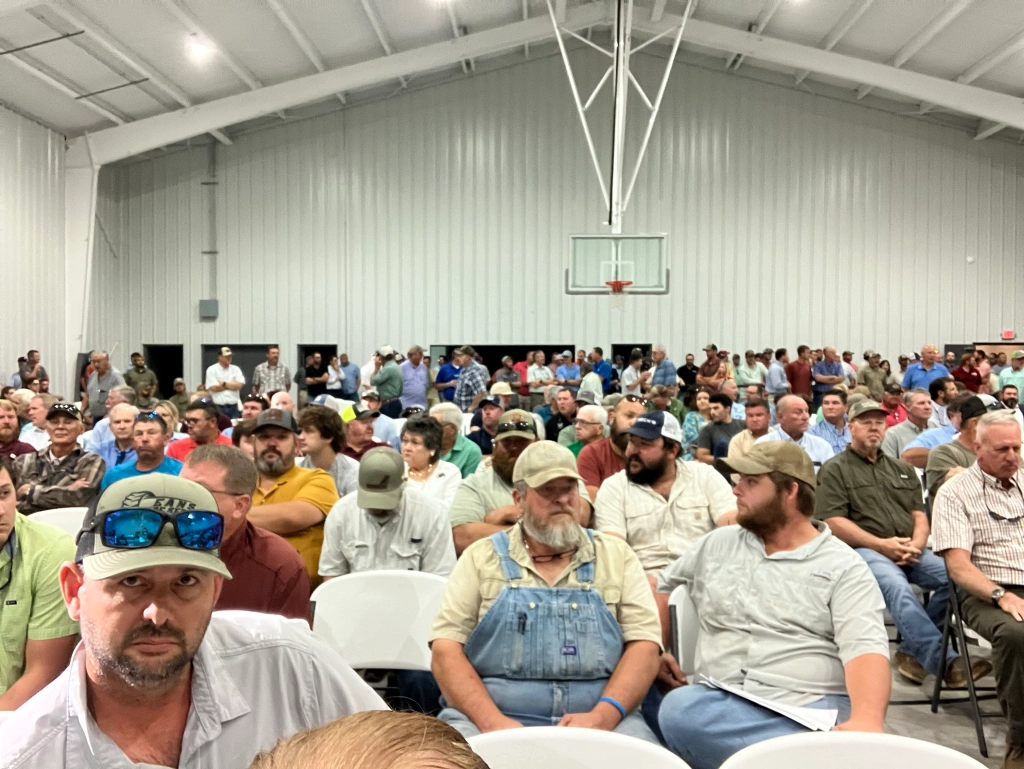
Farmers pack town hall meeting concerned about surviving Washington policies: Ron Sitton
By Ronald Sitton –
Trumann Observer –
BROOKLAND, Ark. — When Alan Brown got into farming his wife’s family’s land in Trumann four years ago after leaving the Air Force, he couldn’t have foreseen the day when the money he’d earn wouldn’t cover the cost of putting the crops in the ground, let alone the bank notes on the equipment and the land.
“If I’m having to fight markets and the banks, that’s not good odds,” Brown said. “I’m a fighting man, but I can only fight so long.”
Brown and scores of farmers from around the region — including Walnut Ridge, Corning, Wynne, Newport, Woodruff County, Cross County, and Pope County — packed into the Woods Chapel Baptist Church of Brookland’s Family Center Tuesday, Sept. 2 to hear from Congressional leaders and voice their concerns about surviving in light of recent changes to farm and trade policies in Washington.
Social media posts noted the location change from the First Community Bank to host the expected crowd … and there still weren’t enough chairs to seat everyone. By 8:15 a.m., a line backed up to enter the building and most of the paved parking was full, causing farm trucks to pull into the grass all the way to the street and across the road.
Farmers would normally be out in the fields on an early September morning.
“It must be real important,” said one farmer waiting in line to get in the packed meeting hall, noting how many members of the crowd should be starting their harvest, but instead chose to attend the meeting with field representatives from the offices of Congressman Rick Crawford and Senators Tom Cotton and John Boozman.
Brookland Mayor Kenneth Jones opened the meeting and noted the crowd should be an “eye-opener” for the American public and politicians in Washington. The meeting started at 8:30 a.m., but had to be stopped and restarted to let more people make it inside. Even with the hall filled, a line still wrapped around the church and out into the road.
An executive summary prepared by Paul McAnally of Trumann was passed out as people entered the meeting. Market president of Southern Bancorp Bank, McAnally read from the summary a letter sent to state and local leaders, noting agriculture is Arkansas’ largest industry, contributing $16 billion to the state’s economy.
Since 2023, row crop farmers have suffered net losses due other high input costs and low commodity prices. Farmers responded by restructuring operations, depleting equity and relying heavily on banks just to remain in business. But 2025 marked the first year in McAnally’s 25 years of crop financing where no workable budget exists for row crops under current price and cost conditions. McAnally has started to appeal directly to Governor Sarah Sanders, noting she has President Donald Trump’s ear and cellphone number.
“She’s our ace in the hole,” he said, noting if something isn’t done, the state will face its biggest farm loss in generations. “It’s going to ripple through northeast Arkansas.”
Based on the University of Arkansas Extension budgets and current commodity prices, McAnally projected that farmers face $1.075 billion in potential net losses in 2025 alone (excluding subsidies delayed until 2026). He said farmers need federal bridge-gap funding by Feb. 1, 2026 beyond the Emergency Commodity Assistance Program and the One Big Beautiful Bill Act, payments from which won’t arrive until November 2026. Without immediate aid, McAnally said Chapter 12 bankruptcies will skyrocket. He suggested anywhere from 25% to 33% of farmers will get out if something isn’t done soon.
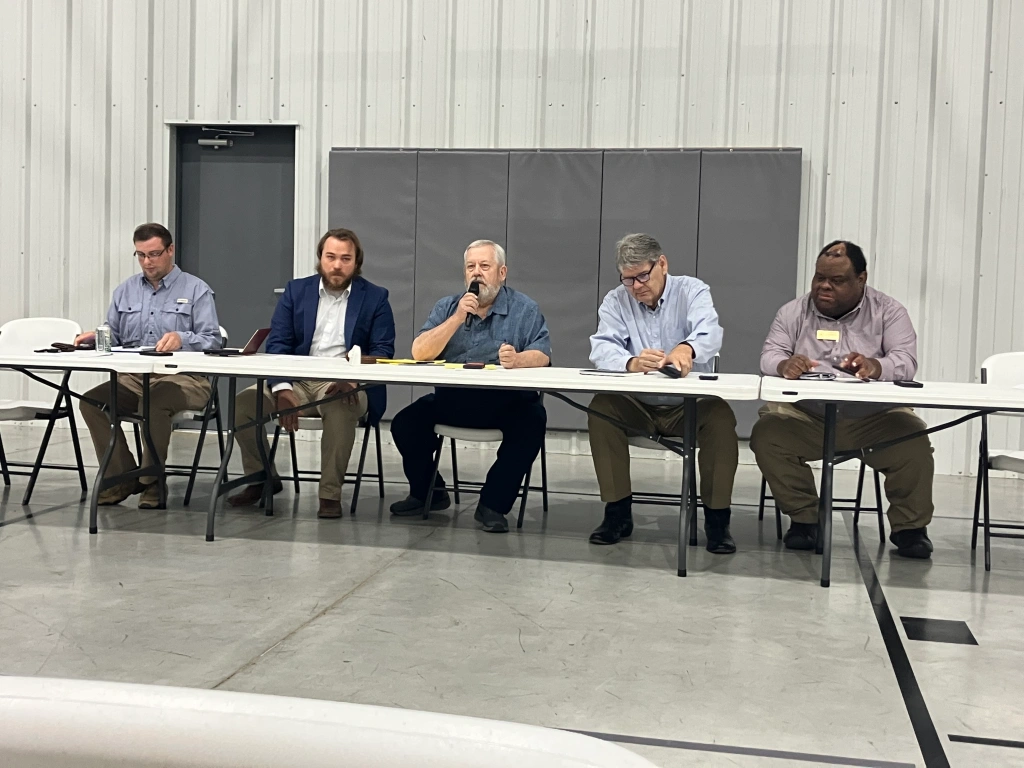
Brookland Mayor Kenneth Jones opens the meeting flanked by field representatives from Congressional offices. Jones kept the meeting going for just under 30 minutes: Ron Sitton
Jones read some of the questions written by people as they arrived at the meeting. When asked about payments on physical production instead of base acres based on 20-year-old figures, Boozman field representative Joshua Mullinax said he’d be sending that information and more gathered from the meeting to Boozman’s D.C. office. Although the senator got updates in prices through the One Big Beautiful Bill — made this year instead of a farming bill — those payments won’t be made until 2026.
Arkansas farmers said they cannot wait that long.
Terry Gaines of Brookland noted farmers cannot control the prices they receive for their product, while also noting they’re at the mercy of the grain elevators. He noted government subsidies won’t pay for the crop insurance due in October.
“Right now, I don’t see where a farmer in America is going to make it,” he said. “It is beyond belief, the stress level. It’s beyond hope.”
Gaines said communities where farmers live have seen a 75% downturn in business as farmers have quit spending in hopes of making the bills. Affected businesses include crop-dusting services, farm equipment and hardware stores … a small sampling of what could be a much bigger problem.
One farmer said farmers aren’t making the money to cover input costs plus additional costs, let alone the cost of living. Another asked why it takes a meeting to recognize the crisis of family farms. A few discussed how their grandchildren won’t have a farm if things continue as they are. Some noted the equity they’ve built in their farms is now gone. Halfway through the discussion, one man stood up and prayed for farmers and the country.
Stan Jones of Walnut Ridge farms 11,000 acres that have been in his family for 54 years; he’s only farming a fraction of that this year. He said Congressional leaders “don’t have a clue,” forcing him and others to stop what they’re doing to come let the field representatives know. He noted Iran, China and Russia won’t do business with American famers due to federal government policies, namely Trump’s ill-conceived and perhaps illegal trade war and high tariffs on imports and exports.
“The government enforces rules against them and it hurts us,” Stan Jones said.
A farmer who had traveled overseas said he couldn’t find any American rice in Iraq and Turkey during his travels.
Chris King, who farms in Woodruff and Cross counties, said the real remedy is to open the markets so that farmers can sell their crops.
“Mr. Trump, you looked at me and said ‘I love you’,” King said. “Mr. Trump, I need to see the fruit of that love.”
The problems mean more than just losing the farm. Jill Beck said five of her customers have committed suicide in the last 14 months.
“It is serious,” she said. “These men and women live out in isolated areas working on a piece of equipment they owe a lot of money on, on land they owe a lot of money on. They might be losing the family farm because of this situation. That’s how serious it is.”
Jerry Morgan of Wynne noted there hasn’t been a disaster declaration for the flooding that brought a year’s worth of rainfall in less than six months. The Trump administration gutted funding for FEMA and passed the buck to the states. As a result, he’s only planted 330 acres out of 2,200. Other farmers also noted they only planted fractions of their fields this year.
“February 1st is great, but it’s going to be too late,” Morgan said. “Crop insurance is only going to get the inputs back. There’s no income that’s going to be coming in. ‘See that wall? We’re probably going to hit that wall.’ … It’s not going to be a payment like last spring. Those payments are just band-aids. There’s no safety net, it’s a band-aid. Something’s got to change fast. We’ve got to have some help.”
Hallie Shoffner, a sixth-generation farmer from Newport who has launched a bid to unseat Cotton in the midterm elections, said her family made the decision to get out of farming this year.
“I pray for bridge funding,” she said. “We have to have a vision for the future. We have to plan for moving forward. It’s not enough for the government to throw money at the problem and act like it’s been solved.”
Charles Landrum, field representative for Congressman Crawford, told the community that Crawford understands what Arkansas farmers are going through, noting a Harrison banker handed Crawford a folder showing the problems during an August meeting. Although he said it in a comforting manner, his face showed his concern.
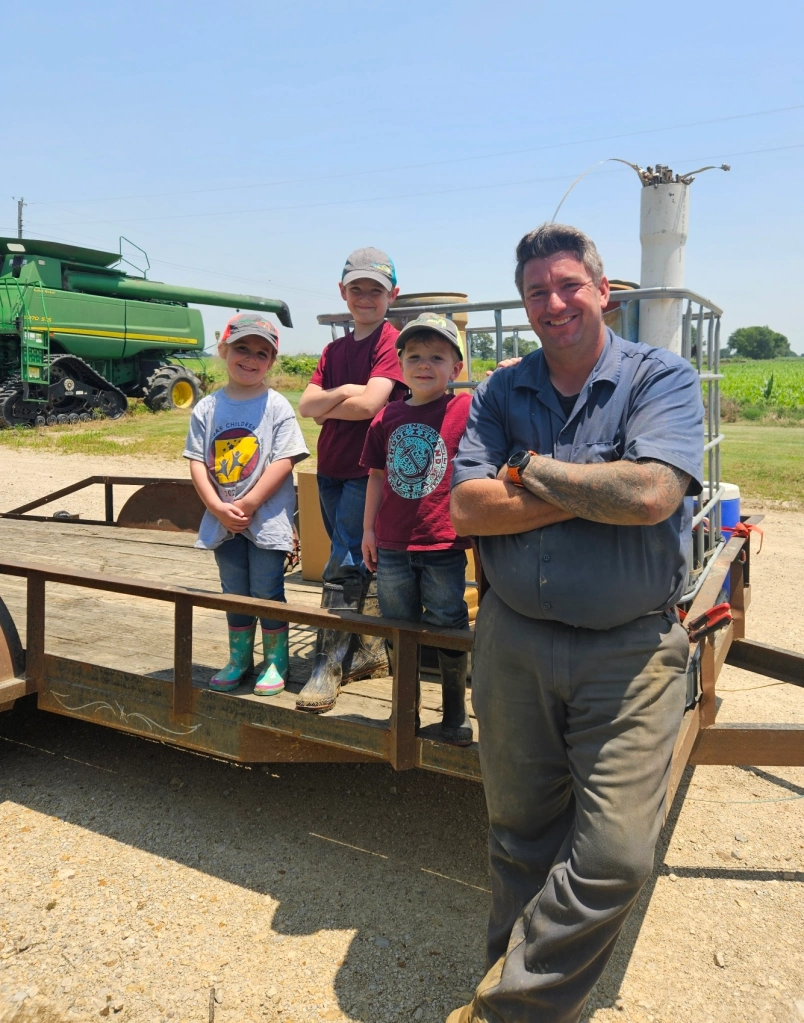
Alan Brown (right) with his boys Ryker (9), Lynx (5) and Kysen (4) after they finished laying and popping polypipe. Brown questions if he should have gotten into farming: Alan Brown
After listening to the 30-minute meeting, Brown’s concerns weren’t eased. He questioned if the Congressional leaders could see the houses filled with young kids about to lose the farms and their homes. He took a moment to judge what he’d learned from the event.
“There’s a lot of concerns about what’s going to happen about subsidies, but no one has an answer,” he said. “No one has a fix from the producer’s standpoint to the government’s standpoint.”
Brown said if things don’t improve, he probably won’t be farming the land that’s been in his wife’s family since the mid-1970s.
“I doubt the banks will lend on no equity; all the equity is gone,” Brown said. “I keep going deeper and deeper.”
Related: John Deere, a U.S. Icon, Is Undermined by Tariffs and Struggling Farmers
___
If you support truth in reporting with no paywall, and fearless writing with no popup ads or sponsored content, consider making a contribution today with GoFundMe or Patreon or PayPal.











Sad these situations exist-during the Great Depression and basically all our recessions, vulture capitalist interests have repeatedly worked against hard working people just trying to make ends meet, but for some reason keep voting against their own best interests. A large part of it is that the only alternative party available to choose from is equally controlled by vulture capitalist corporate interests. One day we collectively may realize the bill of goods sold us, and we purchased without question, is a slow acting poison no one needs.
Sorry but capitalist corporate interests did NOT put the massive tariffs on every country on the planet and cost all Americans, including farmers, more for EVERYTHING! And I must take acception with your “pox on both parties.” The Dems have never started a tariff war. The Dems did not destroy USAID, where farmers could sell their surplus commodities. And EVERYTHING was better a year ago, under Biden. Lower costs to consumers, children fed in schools, poor people had health insurance, manufacturing was returning (see Chips Act), we were a leader on the world stage not a phirah, we stood with our allies, very low unemployment, and lower inflation than today (2.5% under Biden compared to 4% under this Trump admin.) So sorry but your argument doesn’t hold water. We should all start dealing in facts not emotions.
This is what farmers voted for. They should suck it up, pull themselves up by their bootstraps and not ask for socialism in the form of hand-outs.
Maybe some of them will finally see the writing on the wall and realize Trump doesn’t give a shit about them?
History lesson: During Trump’s first term, he started a tariff war with China. So, China took it’s soybean purchasing power to Brazil. US farmers lost their soybean market and it has not returned yet. When farmers got caught in Trump’s stupidity, US taxpayers bailed them out to the tune of 27 Billion dollars! Today, farmers are caught between Trump tariffs that are causing input costs to skyrocket, while the price they get for their commodities has not changed, thereby choking out the farmer. Tack onto that Trump’s destruction of USAID, where farmers could sell their surplus commodities, and they are really hurting. And I feel for them. However, these same farmers voted for Trump by 78%. So, knowing what he did in his first admin., what did you think you would get this time around? THIS IS WHAT YOU VOTED FOR! And I for one am tired of bailing out farmers because they are too stupid to learn their lesson the first time! So shut up! And I don’t want to hear your whataboutism! “Oh, the dems…” Did Biden start a tariff war that cost every American more by leaps and bounds? NO! Did Biden destroy USAID? NO! So let’s deal in FACTS!