



But this 21st Century Hell is Not for Me –
Tales From the MoJo Road –
By Glynn Wilson –
COULTERVILLE, Calif. – The Old West is full of great stories, famous the world over. Some are based on a bit of truth; others seem made up out of whole cloth.
The Shootout at the O.K. Corral in Tombstone in the Arizona Territory on October 26, 1881 comes to mind.
I don’t know if the Old Johnny Haigh Saloon in the Gold Rush town of Coulterville, California ever saw such a scene, since I’ve not completed my research yet. But Friday nights there could be a bit lively, I’m told, back in the day when John Muir was hanging out planning to lure President Teddy Roosevelt to Yosemite.
Over the past few days, I’ve been revisting an old favorite Western show on Amazon Prime Video, “Bonanza,” set near Virginia City, Nevada bordering Lake Tahoe.
Bonanza is an American Western television series that ran on NBC from September 12, 1959, to January 16, 1973, according to the Wikipedia page. It lasted 14 seasons with 431 episodes, and was NBC’s longest-running Western, the second-longest-running Western series on American network television (behind CBS’s Gunsmoke), and one of the longest-running, live-action American series and one of the first to run in color.
The show continues to air in syndication. It is set in the 1860s and centers on the wealthy Cartwright family, initially starred Lorne Greene as Ben Cartwright, Pernell Roberts as his son Adam, Dan Blocker as Hoss and Michael Landon as Little Joe. The show was known for presenting pressing moral dilemmas, and like many TV shows in the ’60s, the main characters were “good guys” who treated Native Americans and Black folks well, while corrupt and racist redneck cowboys were depicted as “bad guys,” who usually died in gun fights or were banished from communities for being assholes.
The title “Bonanza” is a term used by miners for a large vein or deposit of silver ore, from Spanish bonanza (rich ore body) and commonly refers to the 1859 revelation of the Comstock Lode of rich silver ore mines under the town of Virginia City. The show’s theme song, also titled “Bonanza,” became a hit song.
In 2002, Bonanza was ranked No. 43 on TV Guide’s 50 Greatest TV Shows of All Time, and in 2013 TV Guide included it in its list of The 60 Greatest Dramas of All Time. The time period for the television series is roughly between 1861 (Season 1) and 1867 (Season 13) during and shortly after the American Civil War, coinciding with the period Nevada Territory became a U.S. state.
Growing up in the first generation to have television, the show plays an important role in my own life and story.
When I was a little kid growing up in the late 1950s and early 1960s, the show aired in prime time on Sunday nights. This came to the chagrin of a flamboyant hell fire and brimstone Baptist preacher in the suburbs east of Birmingham, Alabama named Ralph Fields. He led the congregation at the second largest Southern Baptist church in Alabama, the First Baptist Church of Center Point. The only Baptist church in the state with a larger congregation at the time, we were told, was the Dauphin Way Baptist church in Mobile.
Brother Fields was known for literally keeping Prohibition alive in Jefferson County, Alabama, for years. Stores were not allowed to sell alcohol in Center Point until Republican Governor Fob James got the legislature to privatize the liquor business in the late 1970s and early 1980s. Until then, you had to buy booze from a state “ABC Store,” make do with moonshine from a bootlegger or drive to Texarkana for Coors beer, like in the “Smokey and the Bandit” movies. The state controlled the liquor business for many years when Governor George C. Wallace was dictator in charge.
Fields was also known as a Candy Man, like the Sammy Davis Jr. hit song. The closet in his office was a free candy store, the better to lure kids to church and get them hooked.
At one time the church also had 13 used school buses to bus kids all over the suburbs to church. White kids of course. No Blacks were allowed, and it was a scandal when a Black family came to the church and sat in the balcony one Sunday morning. We were coached to ignore them and hope they went away without trouble. This was in Birmingham, after all, home to the Birmingham Bombing of the 16th Street Baptist Church downtown where four little girls died on September 15, 1963. Where Bull Conner set his dogs on protesters.
It was also one of the first big churches to adopt the use of guitar, bass and drums to accompany the large choir in addition to the piano and organ.
In the early days, my mom was a big fan of the “Roy Rogers Show” and Elvis Presley movies, often set in the West, like “Flaming Star.”
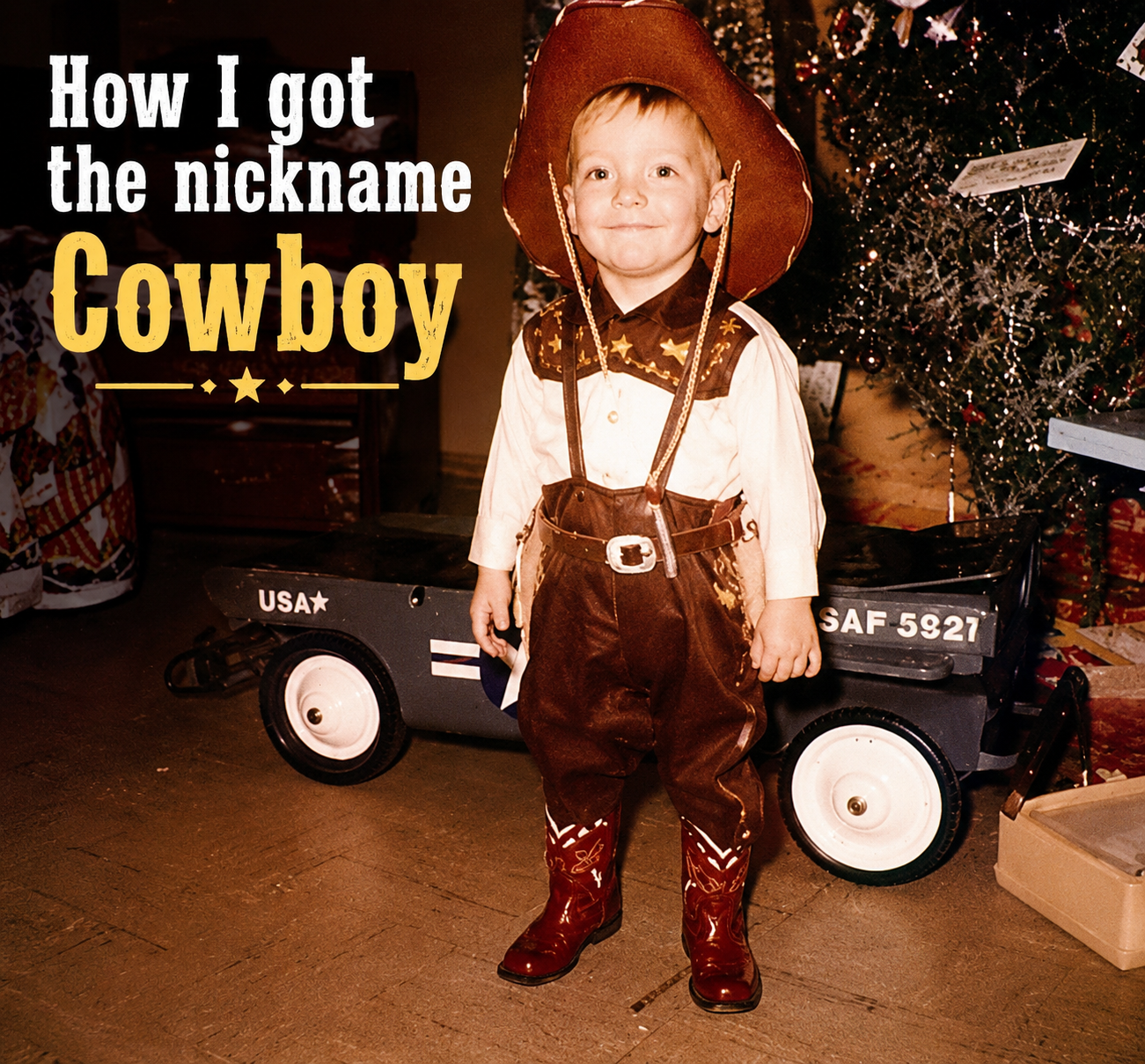
On my third Christmas in 1960, my parents gifted me a cowboy suit and dressed me up in it for the picture by the Christmas tree. As you can see, it had cowboy pants and chaps, cowboy boots and hat and a western shirt, complete with a gun belt with two plastic toy “Pearl Handled” six shooters that made a popping sound when you pulled the trigger, if loaded with caps, like small firecrackers.
Well Brother Fields was not a big fan of “Bonanza,” because it started cutting into his Sunday night “Training Union” services, which were intended to teach the congregation about church doctrine. He started letting church out early, saying, “I know everybody wants to get home in time to see Bonanza.”
Of course in those days, Baptists were still strong advocates for the separation of church and state. That all went away later along with Sunday night training union when televangelists like Jerry Falwell started teaching the “prosperity gospel” and formed the Moral Majority, becoming blatantly political and helping Ronald Reagan get elected president in 1980.
I once interviewed a historian named Wayne Flynt about this.
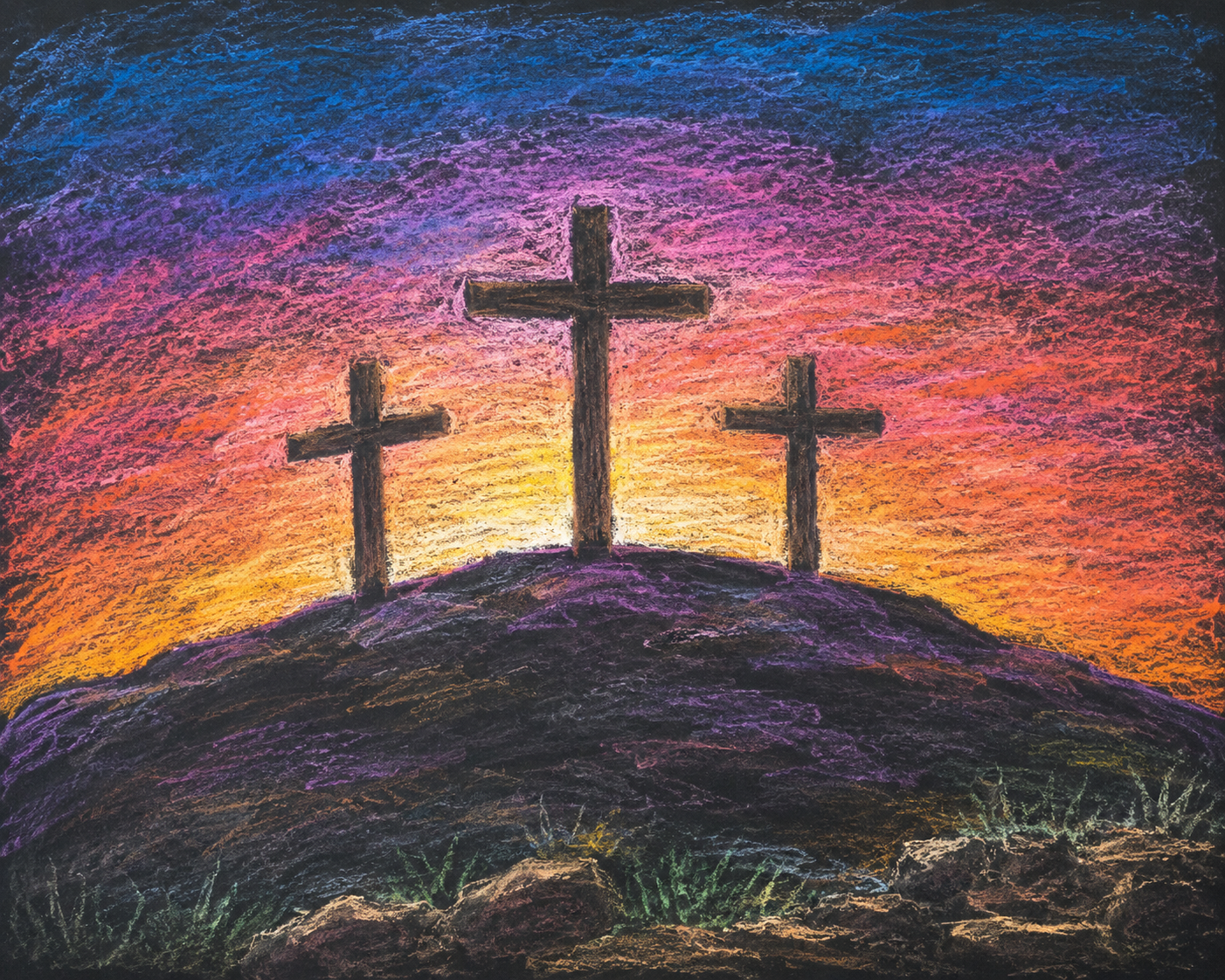
But preacher Fields saw an opportunity to capitalize on the Bonanza cowboy craze. It might have been my mother’s idea. In those days, there were evangelists called “chalk talk artists” who would visit a church and preach a sermon, while painting a picture with colored chalk.
One night to lure people to church, the preacher sponsored a cowboy look alike contest for all the kids. Parents were encouraged to dress their kids up like cowboys for the service. At the end, we were lined up in the front of the chapel and the congregation voted on the kid who looked the most like a real cowboy. The winner would take home the chalk painting that night.
It was a depiction of the famous scene of three crosses on Mt. Calvary. This is not it. It hung on my underground hippie bunker wall for years along with all the blacklight posters.
Well by now you can guess who won. Because of my mother’s enthusiasm and love for Roy Rogers and Elvis, as well as Little Joe on Bonanza, I was hands down voted the kid who looked the most like a real cowboy.
Well, the preacher then started calling me Cowboy, and it really took off when a Youth Director named “Shorty” started calling me that all the time. By the time I entered the First Grade in 1963, all the kids knew me as “Cowboy.” It was a nickname that stuck through childhood and into my teen years in the 1970s, when I started playing the drums in rock and roll bands. I donned a cowboy hat and boots and became the first drummer to dress like a cowboy, until others started doing it on TV, like Joe Saylor on “The Late Show with Stephen Colbert.”
Some of my friends would later say I was a cowboy before “Cowboy” was cool.
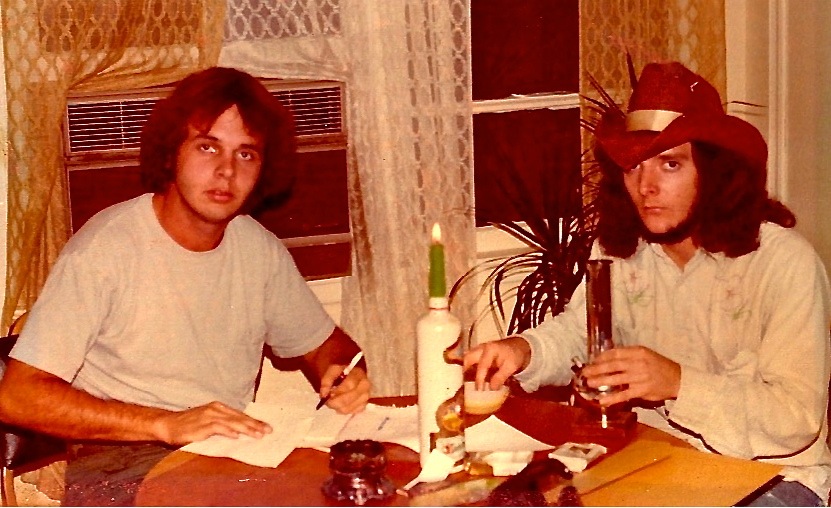
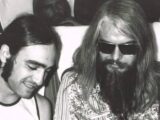
Guitar player Chris Sheppard and Cowboy in Jimmy Lanier’s house in Center Point, Alabama, 1977: Scanned by Glynn Wilson
Of course when I quit Rock and Roll and went back to college in the summer of 1979, I cut my long hair and stopped wearing a cowboy hat and got into writing for a living as a journalist. I never used Cowboy in my newspaper or magazine bylines.
But last year, after I returned from Washington, D.C. to Birmingham to embed with Wayne Perkins and his brother Dale to work on a website, YouTube channel and book proposal on his life and times, I added the nickname Cowboy back on my Facebook page. I figured that’s the name people in Birmingham knew me by. It made it easier for them to find me on Facebook.
So maybe it’s no wonder I’ve long had a fascination with the West, and wanted to make it all the way across the country and retire to California.
Some people don’t seem thrilled with my narrative story. People don’t read stories anymore anyway. They watch podcast videos and look at and share memes on social media. But I don’t care. I am a writer, and writers write.
I feel about the 21st century about how Mark Twain said he felt about the 20th century.
“The 20th Century is a stranger to me,” he wrote in his Notebook once. “I wish it well but my heart is all for my own century (the 19th). I took 65 years of it, just on a risk, but if I had known as much about it as I know now I would have taken the whole of it.”
I loved the 20th Century, or most of what I saw of the last half of it. I missed World War I, although my grandfather was exposed to mustard gas fighting in it. I also missed the “Roaring 20s,” the Great Depression and World War II. But I was there for the heyday of the great American newspaper and magazine, the era of CBS News at its finest, when Rock ‘n’ Roll came out of the blues and took over the music business.
In the great and free 1970s, after the hippie era ended in California when Meredith Hunter was stabbed to death by Hells Angels at the Altamont Free Concert, viewed as the end of the hippie era and the de facto conclusion of late-1960s American youth culture movement, that movement did not really end. It just migrated to the American South in the 1970s and shook up the culture in the Heart of Dixie, as I wrote in the story on Wayne Perkins.
Wayne Perkins: The Story of a Swamper And a Sideman
The truth is he quit trying to live and work about the turn of the century. I made a hell of a run at it publishing on the web for 20 years. But as America is about to celebrate the 250th anniversary, it feels like the entire experiment as a democratic republic is coming to an end. If this is an empire, it’s about over.
God save the rest of the world when we fall. It’s a selfish dog-eat-dog world now for sure. I’m not sure how many humans will be able to survive it. Maybe the tech billionaires in their safe underground bunkers, like Mark Zuckerberg’s in Hawaii.
Brother Fields used to preach that he wanted to be around to see the Battle of Armageddon and the End of the World, when Jesus would surely come back from Heaven to save mankind, at least those with their names recorded in the Book of Life. He also adopted the view of Billy Graham, who preached about looking forward to the day when he could drive his Cadillac on the streets of Heaven, paved with gold.
But what some Christians forget about their own teaching is this. The battle is supposedly to be followed by 1,000 years of Hell on Earth.
I was baptized in the old chapel baptismal when I was 7-years-old, mainly to please my mother and make her happy.
This 21st century Hell is not for me.
Like Willie Nelson and Waylon Jennings sang, “Mamas don’t let your babies grow up to be cowboys.”
___
If you support truth in reporting with no paywall, and fearless writing with no popup ads or sponsored content, consider making a contribution today with GoFundMe or Patreon or PayPal.









You asked for this one: Preacher “Can you name the First Man?” Answer: “Little Joe?” Preacher: “Wrong!” Answer: “Hoss?” Preacher: “Wrong, it was Adam!” Answer: “I knew it was one of the Cartwrights.” First man a cowboy???