




Don Quixote by Pablo Picasso, 1955
“When life itself seems lunatic, who knows where madness lies?”
– Don Quixote
Tales From the MoJo Road –
By Glynn Wilson –
COULTERVILLE, Calif. – Mark Twain was already on my mind Tuesday morning when the news came across the email wire that one of our great science writers died.
In the account of another great New York Times writer, Robert D. McFadden, it is reported that “John Noble Wilford, a Pulitzer Prize-winning science reporter for The New York Times who covered America’s first moon landing a half-century ago with the zeal of a fellow space traveler stepping onto the powdery lunar surface alongside Neil Armstrong, died on Monday at his home in Charlottesville, Va. He was 92. His niece, Susan Tremblay, said the cause was prostate cancer.
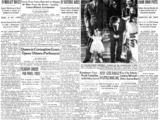
“Under the front-page banner headline ‘MEN WALK ON MOON,’ with a Houston dateline of July 21, 1969, Mr. Wilford gave readers an awe-inspiring and comprehensive account of Apollo 11’s gentle touchdown and exploratory mission on the moon’s arid Sea of Tranquillity after a 230,000-mile voyage from Earth.”
John Noble Wilford, Times Reporter Who Covered the Moon Landing, Dies at 92
My comment was immediately published. “Glad I got to know him a little, speaking to my journalism students at the University of Tennessee 25 years ago. He was one of the greats. Not many around anymore, and that’s sad.”
It’s been awhile since I thought of John, since he left Facebook quite a few years ago and I knew he had health issues.
Today seems like a good day to remember him, since like almost every day now, we seem to be hurtling toward a deep, dark abyss at the end of yet another era in human history.
“It was man’s first landing on another world,” he wrote at the time, “the realization of centuries of dreams, the fulfillment of a decade of striving, a triumph of modern technology and personal courage, the most dramatic demonstration of what man can do if he applies his mind and resources with single-minded determination.”
In today’s New York Times, this human search for some kind of greatness in new horizons takes a much darker tone.
“Human history can be told as a series of advances in warfare, from chariots to crossbows to nuclear-tipped missiles, and we are living through what may be the fastest advancement in weaponry ever,” the Times Editorial Board warns. “Ask any five veteran national security experts and you will hear about five different emerging technologies with the potential to change the world of combat. Swarms of robotic aircraft that work in unison to find and kill targets without any human oversight. Advanced cyberweapons that can immobilize armed forces and shut down electrical grids across the country. A.I.-designed bioweapons engineered to kill only those with certain genetic characteristics.
“Some of these weapons will remain confined to the pages of science fiction, but others are already in the works. Innovations in artificial intelligence, synthetic biology and quantum computing are set to change how we wage war just as they transform all aspects of our lives. The United States has the lead in some areas, especially in A.I., thanks to the massive investments of the private sector. But China, Russia and other authoritarian regimes are accelerating state investments at purpose-built universities and finding ways to incorporate innovations into their militaries now.”
Wilford earned his degree in journalism in 1955 at the University of Tennessee, two years before I was born and 40 years before I met him while teaching there myself. It was the late 1990s, in the early days of the internet, and we all still possessed a great optimism about what the new technology might hold for us.
There were a few written hints at a dark side. But we put those aside and forged ahead, and felt we too were living in an era when there might be another “triumph of modern technology and personal courage, (another) dramatic demonstration of what man can do if he applies his mind and resources with single-minded determination.”
But it all seems to have gone for naught now that the dark side has taken over. It’s as if Darth Vader won the war over Luke Skywalker and “the force.”
From afar I almost pity poor Amy Klobuchar, the U.S. senator from Minnesota, who is still tilting at windmills as about the only voice left in the wilderness still crying out for us to find some way to regulate this so-called Artificial Intelligence.
Amy Klobuchar: State A.I. Laws Keep Us Safe. Trump’s Next Move Could Upend That.
She tried to help us a few years ago, writing a bill that was almost passed to force social media companies to pay news outlets for content like laws in Europe, Australia and Canada. It died over the Christmas Holidays in 2023 thanks to Senate Majority Leader Chuck Schumer of New York, who never got it on the Senate calendar because his daughter worked for one of the tech companies the bill would have regulated. The story died an ignoble death, as TeeVee news outlets ran stories instead about Santa Claus and his sleigh and reindeer on Christmas Eve.
So you will have to forgive me on this sad day if I harken back even further in history to when Sam Clemens walked the Earth, writing about jumping frogs and such.
I’m on my way to San Francisco on Wednesday to see it for myself. An investigation is in order on what all the A.I. hubbub is about there, now that Meta, Google and Apple are laying off hacker/programmers in Palo Alto, a.k.a. Silicon Valley, and everyone is moving back to the city where the A.I. boom is on. All except Elon Musk, of course, who fired everybody at Twitter in San Francisco and moved his X empire to Austin Texas. I have no doubt Willie Nelson is not pleased.
“The 20th Century is a stranger to me,” Twain wrote in his Notebook once. “I wish it well but my heart is all for my own century. I took 65 years of it, just on a risk, but if I had known as much about it as I know now I would have taken the whole of it.”
I can definitely relate. Some days the 21st century feels like a stranger to me.
I’m not giving up on it just yet, however. By some miracle of fate and timing, I finally made it to California this year. Perhaps I should have moved here 25 years ago. But that was not to be.
I could go on to quote Don Quixote here, or in fact The Ingenious Gentleman Don Quixote of La Mancha,” a Spanish novel by Miguel de Cervantes, labelled by many well-known authors as the “best novel of all time” and the “best and most central work in world literature.” Don Quixote is also one of the most-translated books in the world and one of the best-selling novels of all time.
But instead let me quote “The Newsroom,” an American political drama television series created and principally written by Aaron Sorkin that premiered on HBO on June 24, 2012, and concluded on December 14, 2014, consisting of 25 episodes over three seasons. You can still see it on HBO-Max, at least now before Netflix or Paramount take it over.
Perhaps there was still some hope then. President Obama ran his successful campaigns on that hope. It is not clear there is any hope left now. But I will not give up without a fight.
If you recall the story, Don Quixote is a brave white knight who battles an evil empire in the form of the Knight of the White Moon (a young man from Quixote’s hometown who had earlier posed as the Knight of Mirrors) on the beach in Barcelona, Spain. When he was defeated in battle, Quixote submits to prearranged chivalric terms: the vanquished must obey the will of the conqueror. He is ordered to lay down his arms and cease his acts of chivalry for a period of one year, by which time his friends and relatives hope he will be cured (of his apparent hopeless idealism).
On the way back home, Quixote and his sidekick squire Sancho “resolve” the disenchantment of Dulcinea, his dream princess. Upon returning to his village, Quixote announces his plan to retire to the countryside as a shepherd…
If this final battle does not work, I will retire to the mountain woods near Yosemite, never to be heard from again.
___
It is now in the Public Domain. Here’s Don Quixote by Miguel de Cervantes Saavedra Part 1/4 on YouTube.
___
If you support truth in reporting with no paywall, and fearless writing with no popup ads or sponsored content, consider making a contribution today with GoFundMe or Patreon or PayPal.








Love the Public Domain!