



Everyone is failing every day at everything. Is that a bad thing? –
The Big Picture –
By Glynn Wilson –
WASHINGTON, D.C. – It seems to me there is a central conundrum facing American society these days, and it involves the two-tiered society we have allowed to develop basically to serve capitalism. Not just between the haves and the have nots economically, but between those who pursue knowledge and those who do not.
On one hand you have the above average IQ crowd with at least some college education, many of whom still read news sources like the New York Times online and maybe even listen to National Public Radio, at least sometimes, even though it can be annoying even to me at times, and not because it is “liberal” as Trump and the Fox News MAGA crowd like to scream.
I think what they are really angry about is that they do not understand what they hear if they accidentally happen to land down low on the radio dial in their cars on the way to and from work, often hard, crappy work for low wages with assholes for bosses. This starts because they were not raised in families or communities where science information was valued. It is exacerbated by so-called news commentators on cable news and social media and politicians on the far right who profit financially and politically from an ignorant populous. Thus the popularity of the anti-woke movement.
I’ve experimented with this myself, at times trying to get certain friends and family to listen to “Morning Edition” or “All Things Considered” in the afternoon a few times. I watched their faces as they tried to understand what they were hearing, including my own mother quite a few years ago before she died. Amazingly, even though she was aware of public television, she had never heard of public radio, until I found out about it as an undergrad in college and tried to get her to listen. To me it was a revelation. From her reaction, it was obvious that cognitive dissonance was at work. The stress of hearing contradictory information showed on her face, and I gave up and turned it off after only a few minutes.
For people in this camp, hearing the same old canards about life from talking heads on talk radio and cable news talk shows reinforces what they already believe, what they have been told by their parents and preachers, so it is not uncomfortable to listen to and watch.
It seems to me by attempting to develop programming to reach so many different slices of the market, public radio at least kind of loses the interest of a mass audience. In a mass circulation daily newspaper, the public was able to turn the pages of a newspaper and zero in on the stuff they were interested in, say coverage of football, and ignore what they were not interested in, like the politics of Democrats, for example. The two-sided objective model worked for most of the 20th century, but it started breaking down in the 21st and is now seemingly obsolete, even as some outlets keep trying to keep it alive. We need a new theory.
I long ago gave up on that, thinking if we just published solid, well written information enough people would find it valuable and eventually it would make a difference. But now there is too much noise in the communications system, and people are overwhelmed by it, at least those who try to keep up. It seems like half the people in the country have given up, and are just willing to trust a dictator who seems to stand up for their core values. Never mind that he’s a totally corrupt, mob boss conman and anti-christ figure, who has mastered the grift of manipulating the media and the public with propaganda.
We have long known that the majority of people do not have the time or inclination to “do their own research.” It was up to major news outlets and politicians to set the tone and lead, and on most fronts, the public would go along. But that is no longer the case. There are no leaders anymore, only those chasing an audience and the almighty dollar.
Take a show like “Freakonomics.” They call it a podcast, because that is the popular term these days, even though really it’s just a radio show you can also listen to over the internet.
They recently reran a series on How to Succeed at Failing, and as intelligent readers, you can see how this has a certain sensational appeal right away. How can failing ever be considered some kind of success? It’s a great teaser, and sucks you in.
I think I probably listened to part of it back when it was first aired in 2023, but on the weekends, NPR needs to fill air time when most of the staff is off so they reran it last Sunday. I happened to be driving around in a car on Sunday afternoon, so I listened to part of it again. This time I heard something that made me look up the show online. As you know I often think about things in evolutionary terms, so parts of this episode really piqued my interest.
In some ways I think the producer crammed too many sources into the show, which would make it really hard for people like my mom and Trump supporters to get through an hour long show. But taken separately, they were all interesting. One of those interviewed was Theresa MacPhail, an associate professor at the Stevens Institute of Science and Technology, who based on her own experience, has developed a course with the title: Failure 101. The basic idea is that we all fail at times in our professional lives on the way to becoming a success. Or, “Everyone is failing every day at everything.”
An excerpt from the online transcript:
MACPHAIL: So I start off the class with the ultimate failure, which is death. I really think I’m an intellectual granddaughter of Ernest Becker, who famously wrote The Denial of Death. He was an anthropologist as well. And his take was that society everywhere is a living myth of the significance of human life, that we defiantly create meaning where none exists because we do not want to deal with the terror, that the ultimate mistake is one that’s going to get us killed. I start off the class saying, listen, life is terrifying because death is terrifying. And I think EVOLUTIONARILY, mistakes meant catastrophe. And that’s probably why we don’t like them. Because if you make a wrong move in the savannah when you’re hunting, you’re dead.
Stephen Dubner is the creator of the show and interviewer.
DUBNER: When I read your course description, and you describe teaching about failures in all realms of science, and then you write that death is the ultimate failure, my response was, “Well, that’s not fair.” My reasoning would be that failure implies at least some small level of un-inevitability, whereas death has a perfect record, as far as I know.
(Haha)
MACPHAIL: Yes, but if you look at biology, death is your systems all failing. See what I’m saying? But that’s a perfect example to try to get them to accept that failure is necessary. Because the example of something that doesn’t die is cancer. And that’s not what we want. And so there’s that tension that, yes, death is, if you think about it from that perspective, it’s all your systems shutting down one by one, in a cascade.
And you can see that as the ultimate failure. But then I try to get them to embrace that because — and again, I’m just Becker’s granddaughter, because his argument was, if we distract ourselves and we try to push down our fears of failing, ultimately that’s about our fear of dying, that ironically, trying to push all of that down and not talking openly about it creates more problems. So that’s my take, is that, yeah, you have to embrace failure because you can’t have a successful life without it. I basically tell them at the start of my classes that I need you to get comfortable being uncomfortable. And I need you to be comfortable with uncertainty. And I really think embracing the idea that you’re going to fail is the antidote to that anxiety.
DUBNER: Okay, but, Professor McPhail, I’ve gotten nothing but A’s the last 13 years of my life, and I’m not going to stop now. So would you please not say things like that and get out of the way and start lecturing and give me an A?
MACPHAIL: No. I’m trying to take failure and put it on the table and look at it as a social object. From an economic perspective, what does it look like? From a business perspective? From a science perspective? Because failure is a changeable object. Like, one failure in one arena doesn’t necessarily have any of the components of the same label in another. I mean, I’m old-school, I’m talking about Hobbes. And we’re going over things like, what is the social contract, and what does the social good look like, and what does Hobbes think failure will be?
This is gong to be lost on many if not most listeners and readers, so for context, let me insert that Thomas Hobbes was an English philosopher best known for his 1651 book Leviathan, in which he expounds an influential formulation of social contract theory. He is considered to be one of the founders of modern political philosophy.
For Hobbes, the solution to having a successful society was a “social contract” in which society comes to a collective understanding that it is in everyone’s interest to enforce rules that ensure safety and security for everyone, even the weakest in society. That is a very democratic idea, and had a profound influence on the Founding Fathers of the United States.
Clearly the Republicans in charge of American politics today do not agree with him. I doubt they’ve ever even heard of him, and are not the least bit interested in reading him or listening to a radio show about him. They seem only interested in a contract that turns a massive profit for themselves, and leaves everyone else behind, including the American experiment in democracy.
My Personal Test
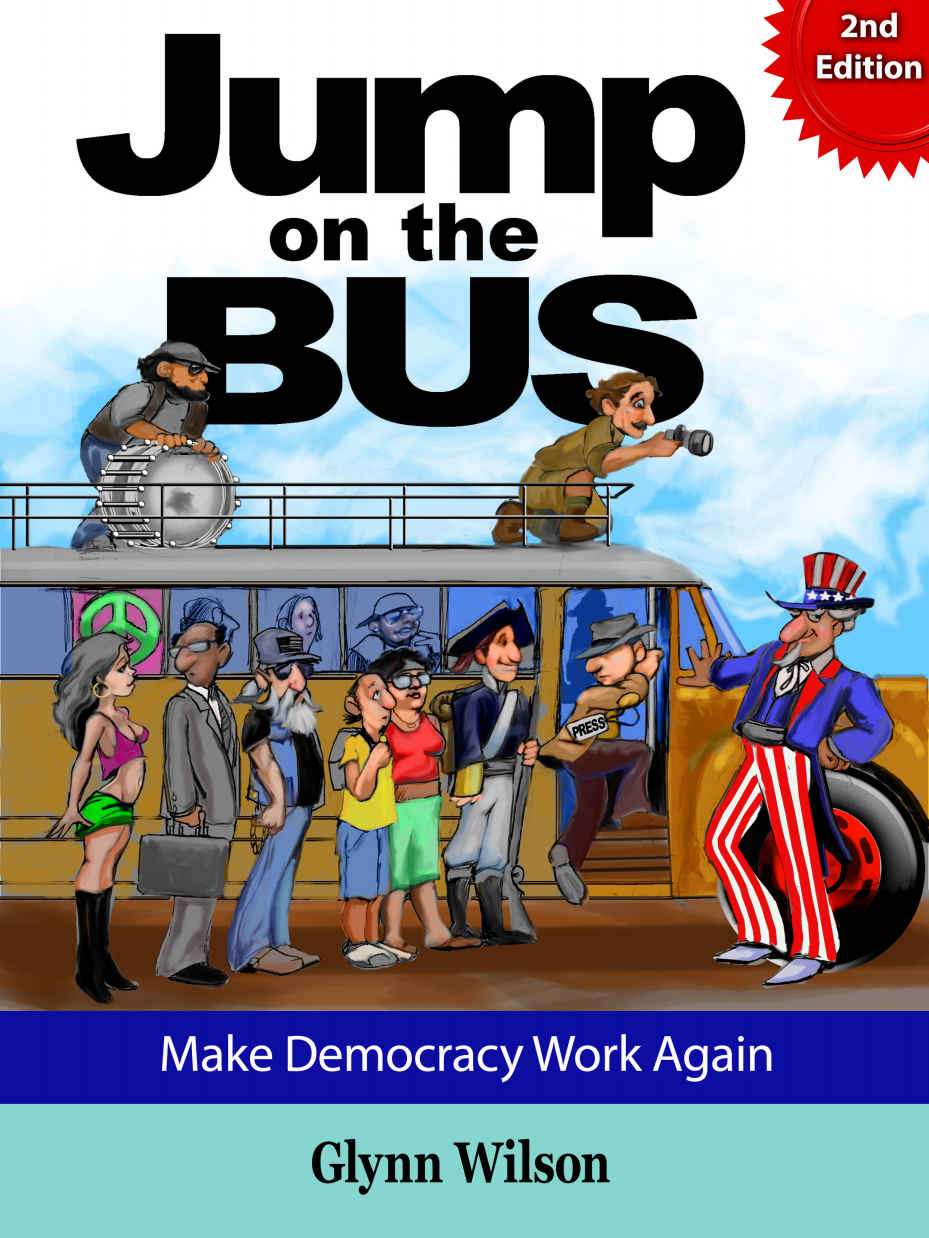
As an undergrad in philosophy classes 45 years ago, I did read about Hobbes, as well as other philosophers. Nobody then had a class on failure, but there was much talk about how to succeed. Some of the ideas I was exposed to were similar. As I wrote in my memoir, Jump On The Bus: Make Democracy Work Again, I tell the story of a professor at the University of Alabama named Jim Salem, who taught a class on Rock ‘N’ Roll. It was very popular to say the least. The title and inspiration for the book was based on a story he told about how to succeed in rock and roll or life. To summarize, you have to keep your suitcase packed and be ready to jump on the opportunity bus, and the courage to get on the bus when it pulls up to the station.
That is the story of my life. Yes, I have failed, over and over again. But so far at least, I’ve kept going and managed to succeed in many of the endeavors I chose to pursue, and to make a difference along the way. It may be over soon, but I am still jumping on that damn bus.
So as an excersice in self reflection, lets take a look at the failures that led to successes and see what we can learn.
So one of my first goals in life was to be an athlete. I played baseball, basketball and football. At some point it became obvious I was not going to succeed at becoming the best in the world at those sports to become a highly paid professional. But I had a lot of fun and got myself in pretty good physical shape. Later on I took up tennis, and did get to play on a college tennis team. So maybe I failed at the ultimate goal, but I succeeded anyway. Then I took up golf, and had a lot of fun doing it and kept in pretty good shape doing it and even managed to score in the 70s quite a few times. Is that a failure or a success?
The next goal was to become a musician. I took up learning to play the drums. I wanted to play in rock bands, and did it. So maybe it was a failure in that I did not become rich and famous doing it. But again, becoming rich and famous was never the goal. I did learn to play the drums, got pretty damn good at it, had a lot of fun doing it and made a living at it for a time. Is that a failure or a success?
Then I wanted to go to college, got accepted, became good at it, learned a lot, and ultimately obtained three degrees and all but the dissertation defense on a fourth. So I may have failed to obtain a doctorate and become a full time college professor for life, but again, that was not the goal. I was pretty successful at college, and again, learned a lot and had a lot of fun.
In my first college experience, I decided I wanted to become a writer and work as a newspaper reporter. It worked. I did it.
One of the things you learn along the way in life is that you cannot reach your goals without crossing paths with others involved in the same pursuit. Sometimes those people help you. Sometimes they work against you. So maybe you have to modify your goals.
Running into some corruption in the newspaper business, and getting fired from my second job at a daily newspaper, I decided I still wanted to be a writer, but to learn to freelance for magazines. I also fell in love, and decided to go into business for myself. I succeeded in opening the first San Fancisco style newsstand and coffee bar on the Southside of Birmingham. Reading all those magazines was an education in itself and I was successful at getting paid and published as a freelance writer.
Even though the relationship ended, and I ended up closing the business, it was still a success in many ways. I met many interesting people, and made good friends for life, including Spider Martin, who I would ended up writing about for public radio last year.
As the business was winding down, I got an offer to go back into the newspaper business and moved to the beach in Gulf Shores, Alabama, where I had a hell of a run as the first environmental reporter in the state. I also wrote my own column for a few years, another goal. Again, learned a lot and had a lot of fun.
When that run came to an end, I set another goal. To get accepted into grad school and get paid to teach journalism. Check. Did that for a decade, while still working as a freelance writer and still playing the drums with some great musicians, mainly at blues jams in places like Sassy Anne’s in Knoxville, Tennessee, the Maple Leaf bar on Oak Street in New Orleans, and at several clubs in and around Washington, D.C. for a few years, until Covid hit.
When the teaching thing seemed to reach its logical conclusion, I had another run in the newspaper business, this time reaching another goal. Getting published in The New York Times. Boom.
Knowing by now that all runs seem to come to an end, I had another goal. To move to Washington and cover politics in the nation’s capital. Check. The first time it was short-lived, so I had another goal. To publish independly on the web. Check. That run has lasted more than 20 years. Made a living at it, and for the past decade, I did make it to Washington and do many of the things I set out to do. Also made a difference along the way. Ask Doug Jones, although he may deny it, thinking he had a partial success of his own all by himself. To become a United States Senator. OK. He did it. For half a term. Could he have succeeded at it without my help? Doubtful.
I’ve long had another goal. To make it to California and basically end my career and life there, a personal version of manifest destiny. To do that, I needed to come back to Maryland to get cataract surgery. That’s where we are. The first eye will be fixed in the morning. See you down the road.
___
If you support truth in reporting with no paywall, and fearless writing with no popup ads or sponsored content, consider making a contribution today with GoFundMe or Patreon or PayPal.










Bravo-we have been conditioned to accept without question the very things that harm us most while rejecting the fact that the greatest example of compassionate socialism was the life of Jesus. Sadly many religions, especially Calvinists, equate success with money; many church leaders extort “sacrifices” from their congregations while they live a life of luxury. The Golden Rule now is “He who has the gold, makes the rules.”