



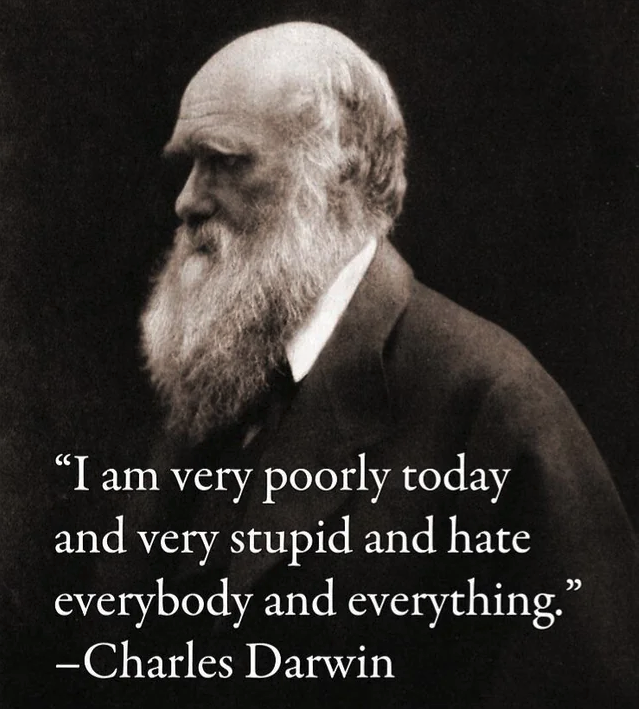
“I believe there exists… an instinct for truth … & that our having such an instinct is reason enough for scientific researches without any practical results ever ensuing from them.”
– Charles Darwin to J. S. Henslow, April 1, 1848
The Big Picture –
By Glynn Wilson –
COULTERVILLE, Calif. – Could there be any irony that the great scientist Charles Darwin wrote these words on April Fool’s Day? Or was there an April Fool’s Day in 1848?
Yes, it can perhaps be traced back to Geoffrey Chaucer’s The Canterbury Tales in 1392.
By the early 1870s there was a turning point in the global debate about human evolution, with deep implications for science, colonial expansion, industrial progress, religious belief, and ethical and philosophical debate. Darwin’s correspondence from this period is of fundamental importance for understanding both the development of his theory of human origins and its relationship to prevailing assumptions about human nature, according to the Darwin Project at Cambridge University.
It has now been 177 years since On the Origin of Species: By Means of Natural Selection was published. It is now in the public domain and anyone can read it for free here.
Yet facts and truth now seem to have even less to do with anything being talked about publicly than it did in Darwin’s day. In his time, religious dogma ruled the day, even in his own house. (See the 2009 film Creation).
Somehow I can’t shake the feeling I’ve had for some time now that on this subject at least Darwin was wrong. It seems that Mark Twain understood human nature more in some ways, if he actually said something like this. Historians disagree. “A lie can travel halfway around the world before the truth puts on its shoes.”
In any event humans seem to have an instinct to trust lies more than truth, and to be more than happy to spread them, especially if and when they are uttered on television by the man in the White House.
And even as there is much to celebrate for me in accomplishing a life long dream to make it all the way across the country to California, to sit in the warm sunshine as much of the nation shivers in the cold, all is not sweetness and light. There continues to exist a plague of thought that evolution has reached a turning point, and is turning back on itself. Rather than a straight line of progress, there appears to be a pollution in the system driving us backwards into failure.
After being alive and witnessing events for nearly three-quarters of a century, so many of the hopeful campaigns we fought in our lifetimes now seem lost.
We fought for Civil Rights, and won them, only to see them being stolen from us once again.
We fought wars and stopped them, but they just keep coming.
We fought to save the Earth from pollution, and we made a lot of progress. Dog knows I’ve fought, won and lost many battles on that front. Now all hope seems lost.
I took a stab at the current generation the other day on Facebook, and was attacked for it. But I believe I am right. I see no movement today to compare with what occurred in the 1960s and ’70s, when those victories for Civil Rights, against war and for the environment were won.
I can’t shake the feeling that we are so divided now that the end is near and we have lost it all.
I was recently contacted by a Political Science professor at the University of California-Berkeley. Steven Fish had read some of my writing and thought we might agree on some things, mainly in how Democrats have approached the political war we’ve been involved in for decades now. He has a new book out called, Comeback: Routing Trumpism, Reclaiming the Nation, and Restoring Democracy’s Edge.
“The fate of American democracy now hinges on the Democrats’ ability to defeat the Republicans for the foreseeable future. But for the Democrats to win consistently, they must reestablish their credentials as fearless leaders, tough fighters, and fierce patriots,” he writes.
“Many liberals think that escalating economic anxieties and cultural backlash drove voters to Trump. But a crush of data shows this thinking to be deeply flawed. It also strikes working-class voters as condescending and repellent. And while the Democrats stick to ‘kitchen table’ issues and showing how much they care, voters care more about strength and commitment to principle than prescription drug prices,” he writes.
“Politics is a dominance game and a contest to capture the flag. Politicians who seem to be the strongest leaders and most passionate patriots hold the advantage. The Republicans get it. The Democrats don’t.
“Republicans have a high-dominance political style. They take risks, savor conflict, and use provocative language. Democrats have a low-dominance style. They’re risk-averse, afraid to engage on cultural issues—and more than a little boring. Republicans hammer away at their patriotism, even as they betray the nation and shred American values. Democrats are loyal to American values but have grown squeamish about patriotism and have no national story.
“Ordinary people often don’t recognize themselves in the stories liberal politicians tell about them, while the authoritarians speak a language of dominance and national greatness that connects. The Democrats need a new approach to messaging. Comeback spells it out—and provides a roadmap for trouncing Trumpism.”
But if I am right, and Darwin was wrong, and the lie wins every time these days in the era of Trump and social media, all hope may be lost.
I hope the results of the midterms in November prove me wrong. It could be that all is darkest before the dawn and humans and Americans are about to turn the corner into a bright new day. Let us hold out just a sliver of hope amidst all the darkness in the news.
___
This was originally written as a syndicated column for The Progressive Populist newspaper.
___
If you support truth in reporting with no paywall, and fearless writing with no popup ads or sponsored content, consider making a contribution today with GoFundMe or Patreon or PayPal.











Enlightening as usual…